
Why Is There a Wet Spot on My Ceiling Below the Bathroom?
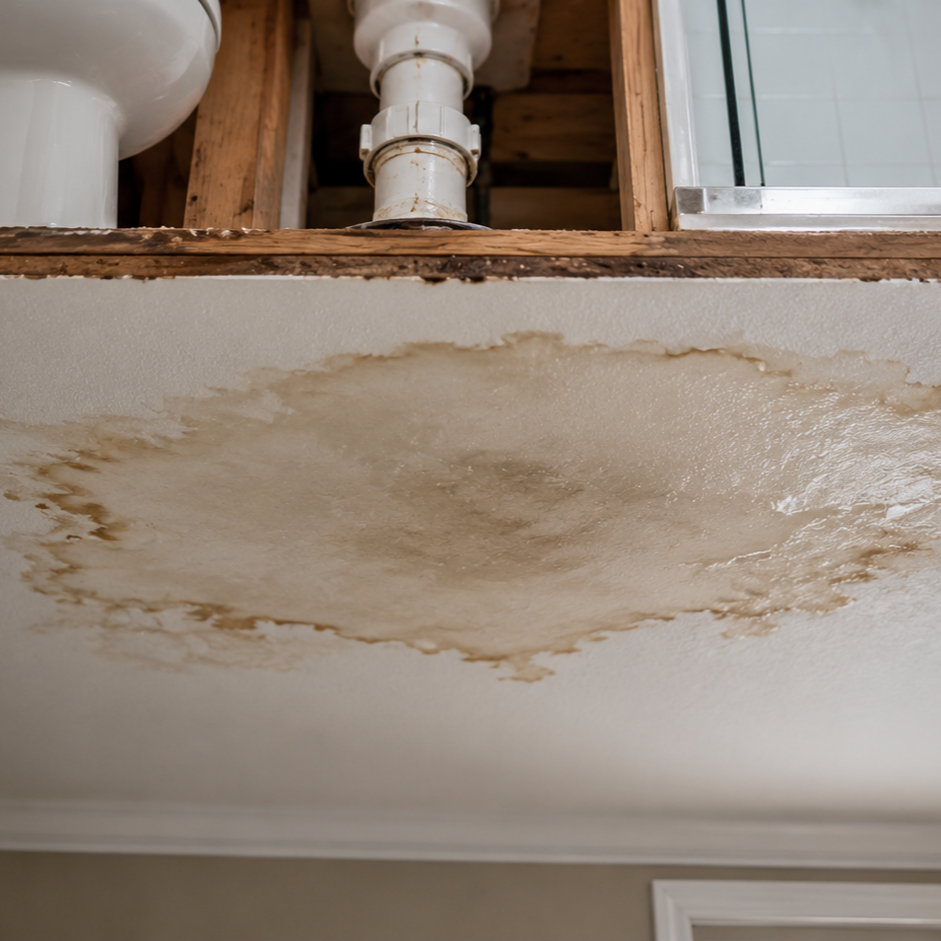
The stain showed up last week. Yellowish-brown at the rim, still damp in the center, sitting directly below the upstairs bathroom. And it's getting bigger.
That stain is telling a story. The question is which pipe, seal, or fixture is doing the talking.
A ceiling leak from a bathroom above is rarely random. There are five main sources, and each one behaves differently. With some systematic observation, a homeowner can often narrow down the cause before a plumber ever arrives.
The stain is rarely directly below the source
Water rarely falls straight down. That's the single most important thing to understand about ceiling leaks.
Once a drop escapes a pipe or a broken wax seal, it lands on a floor joist or subfloor beam and travels sideways. It follows wood grain, runs along obstacles, and pools where it finds a low point. By the time it soaks through the drywall and creates a visible stain, it may have traveled 3 to 5 feet from where it actually escaped.
Think of it like a crack spreading across a car windshield. The impact point and the visible edge are rarely at the same spot. Water exits one place and reappears somewhere else entirely.
The stain's location is a clue, not a diagnosis. The actual failure could be under the toilet, near the tub drain, or at a supply line connection — none of which may sit directly above the wet spot on the ceiling.
Timing reveals the source more than location does
The most useful diagnostic tool isn't a camera. It's a watch.
If the ceiling gets wet right after a toilet flush, the likely culprit is the wax ring — the pliable seal that sits between the toilet base and the drain flange embedded in the floor. That ring compresses during installation. Years later, especially if the toilet ever rocked slightly, the wax deforms and leaves gaps. Every flush pushes water through those gaps and into the subfloor.
If the ceiling gets wet during or after a shower or bath, the likely sources are the drain assembly or the caulk line at the tub perimeter. A shower drain connects to the drain pipe via a gasket and compression fitting. When that gasket breaks down — which happens after 10–15 years of wet-dry cycling — water runs along the outside of the pipe into the ceiling cavity instead of through it. A failed caulk line at the tub-floor junction does the same thing: water that pools at the perimeter finds the gap and takes it.
If the ceiling is damp but not actively dripping, and worse in summer, the cause may not be a plumbing leak at all. Uninsulated cold-water supply lines running through warm floor cavities sweat in humid conditions. In Phoenix, where outdoor humidity spikes sharply during the July–September monsoon season, condensation on an uninsulated line can stain a ceiling without any fitting ever failing.
If the ceiling stays wet regardless of bathroom use, a slow supply line drip is the likely cause. Supply lines — braided stainless or plastic connectors between shutoff valves and fixtures — can develop pinhole leaks or loose connections. These drip at a steady rate, not tied to any specific use pattern.
Five sources, ranked by frequency
Not all bathroom ceiling leaks start in the same place. Here's where they actually come from, in order of how often they show up on service calls.
Failed wax ring. The most common source by a wide margin. Toilets that rock even slightly wear through the ring's seal. A failed ring rarely floods — it usually produces a slow, intermittent drip that builds into a stain weeks or months after the seal first broke.
Shower or tub drain assembly failure. The gasket beneath a shower pan or tub floor degrades with age, cleaning chemicals, and temperature swings. A cracked or displaced gasket routes water along the outside of the drain pipe rather than through it.
Caulk failure at the tub or shower perimeter. Caulk shrinks and cracks. A gap as thin as a credit card at the tub-floor or tub-wall junction is enough to funnel water into the subfloor during a normal shower.
Supply line leak. Supply lines run at constant pressure — typically 40–80 PSI. A worn fitting, a loose compression nut, or a cracked braided line drips whether the fixture is in use or not.
Condensation on uninsulated pipes. Uncommon in Phoenix's dry climate, but not impossible during monsoon season or in homes where incoming water runs especially cold.
Before calling a plumber, run a controlled test. Flush the toilet once and watch the ceiling for 10 minutes. Then run the shower for 5 minutes and watch again. If the ceiling responds to only one of those tests, the source narrows significantly, reducing diagnostic time during the service call.
A failed wax ring causes more structural damage than it looks like
Most wax ring failures announce themselves quietly. The toilet flushes fine. Nothing in the bathroom gives any sign of trouble.
But every flush is pushing a small amount of water through the broken seal into the subfloor. Plywood and OSB absorb that moisture. They swell, soften, and begin to delaminate. By the time a stain appears on the ceiling below, the subfloor around the toilet flange may already feel spongy — weeks of cumulative saturation soaked in before anyone noticed.
Mold takes hold in 24–48 hours inside a wet cavity. In a sealed floor-ceiling sandwich with no airflow, nothing dries on its own.
This is why a ceiling stain below a bathroom shouldn't be watched to see what happens next. It won't improve. The only question is how much structural damage accumulates before someone opens the ceiling.
If the ceiling drywall feels soft or sags under light pressure, do not push on it. Saturated drywall can hold several gallons of water and collapse without warning. Puncturing a small relief hole carefully with a screwdriver lets water drain in a controlled way before the panel gives out on its own.
What a plumber sees that a homeowner can't
A plumber can run a borescope camera through a small access hole in the ceiling — no demolition required — to inspect the condition of the pipes and subfloor damage. Electronic moisture meters map the wet zone precisely, showing how far water traveled and where the dry perimeter begins.
That mapping determines repair scope. Moisture extending 2 feet beyond the visible stain indicates 2 feet of additional drywall and possibly subfloor replacement. Catching a leak at the first stain rather than three months later is typically the difference between a $400 drain repair and a $1,500–$2,000 subfloor job.
For leak detection and repair, a plumber will pull the toilet to check the flange and wax ring, inspect the drain assembly from below where ceiling access permits, and pressure-test supply lines for any slow drip. If the stain traces back to a shower or tub, repair may involve re-seating or replacing the shower or tub drain assembly, recaulking the perimeter, or swapping a damaged overflow plate. If the toilet is the source, the fix is usually a new wax ring and a close look at the flange for cracks or corrosion.
Frequently Asked Questions
Roof leaks typically occur near exterior walls or below roof penetrations—skylights, vents, and flashing joints. Plumbing leaks almost always surface directly below a bathroom, kitchen, or laundry room, which are the spaces with active water connections. If the stain is centered under a bathroom and the roof is otherwise intact, the source is almost certainly plumbing.
Yes, though it's less common than an actual pipe or seal failure. Condensation-only stains tend to be diffused rather than circular and concentrated. They are most likely on ceilings below bathrooms without exhaust fans, or near uninsulated cold-water lines running through a warm floor cavity. If the exhaust fan vents into the ceiling space rather than outside, trapped steam can stain drywall even if no fitting is leaking.
Not always — but it needs prompt attention. A slow wax ring or drain leak may produce only a stain at first while structural damage builds in the subfloor over weeks. A supply line drip under constant pressure can escalate fast. If the ceiling is actively dripping, soft to the touch, or visibly sagging, that's an emergency: shut off water to the affected bathroom at the fixture shutoffs or at the main and call a plumber.
The moisture will dry. The stain won't. Minerals and organic material left behind by the water wick into the drywall, causing a persistent discoloration. After the leak is confirmed resolved and the drywall is fully dry — typically 48–72 hours with good airflow — the area can be primed with an oil-based stain-blocking primer and repainted.
Cost depends on the source and how long it's been running. A wax ring replacement runs $150–$300 in most markets. A shower drain gasket repair is in the same range. If the subfloor around the toilet flange has softened from long-term moisture exposure, subfloor repair adds $500–$1,500, depending on the area affected. Ceiling drywall patch and finish typically runs $300–$600. Catching the leak early keeps costs on the lower end; delays that allow structural damage can reach $2,000–$4,000 once all trades are done.
Shut off the individual water supply valves in the bathroom above — the oval handles behind the toilet tank and beneath the sink. Place towels or a bucket under the stain if it's dripping. If the ceiling is sagging, puncture a small relief hole with a screwdriver to drain the water before the panel fails. Don't flush the toilet or run the shower until a plumber has identified the source.
A ceiling stain below a bathroom won't resolve on its own. The longer a slow leak runs, the more structural damage accumulates in the subfloor and ceiling cavity. Simba Plumbing serves Phoenix, Scottsdale, Mesa, Chandler, Gilbert, Glendale, Peoria, Tempe, Surprise, Goodyear, Avondale, and surrounding Valley communities. (602) 500-2153.
