What Should I Do When My Toilet Is Overflowing?
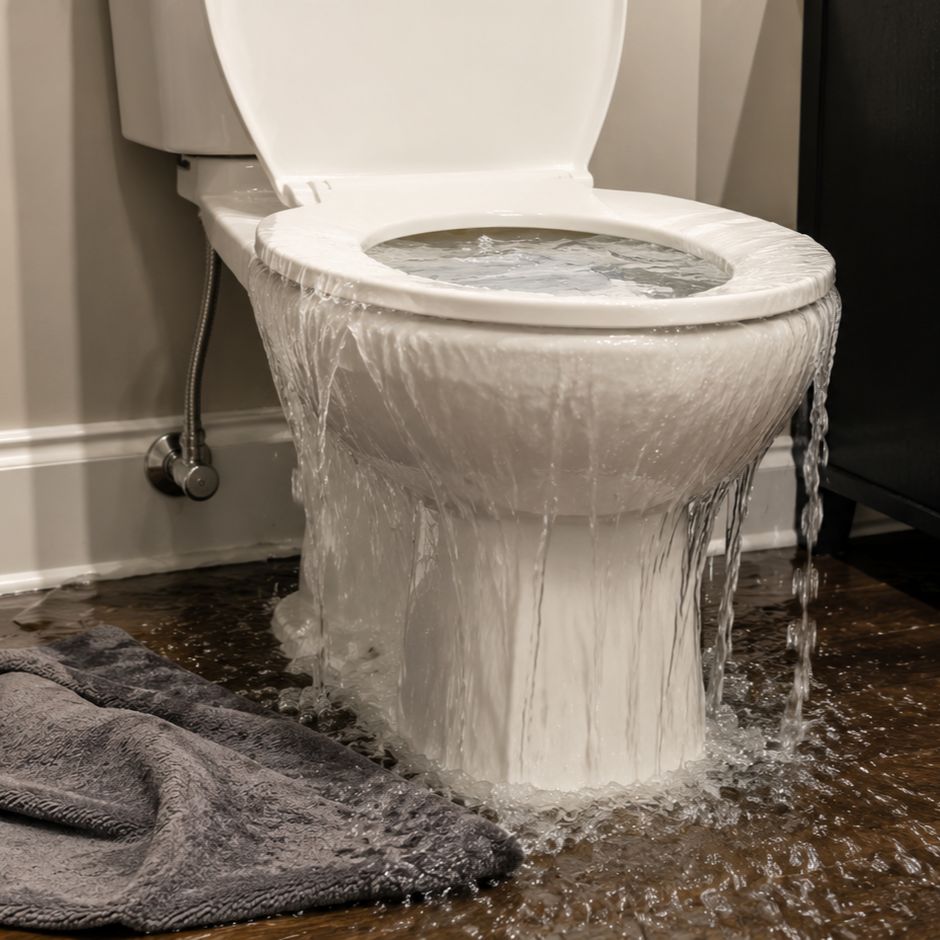
Water is still rising. Your bathroom floor is getting soaked, and there is maybe sixty seconds before it hits the baseboard, wicks under the flooring, and starts working on the subfloor below.
Stop reading. Go shut the water off. Come back.
Shut off the water supply valve behind the toilet immediately (turn clockwise). If it's stuck, open the tank and press the flapper down. Once the flow stops, use a plunger — but only if the problem is a toilet clog. If sewage is backing up from multiple drains, that's a main sewer line issue and needs a plumber.
Step 1: Kill the water supply first
The shutoff valve is the small oval or football-shaped knob on the water supply line behind the toilet, near the floor. Turn it clockwise until it stops. That cuts the water to the tank and ends the overflow.
If the valve hasn't been turned in years, it may be stuck or corroded from mineral buildup. Don't force it hard enough to break the valve stem — that makes everything worse. If it won't budge, skip to Step 2.
Phoenix tap water runs 200–400 ppm TDS. Calcium deposits build up around valve stems and threads, making them harder to turn with every year they sit untouched. Work the valve back and forth a few times every few months — during routine bathroom cleaning is fine — and it'll be there when you actually need it.
Step 2: Open the tank and press the flapper down
If the shutoff valve won't move, pull the tank lid off and set it on the floor. Look at the bottom of the tank. There's a rubber disc — the flapper — seated over a circular opening. If it's lifted or not seating flush against that hole, water flows from the tank into the bowl and keeps going.
Press it down with your hand. Water stops entering the bowl almost immediately. Hold it there or wedge something underneath it while you deal with the floor.
Step 3: Lift the float to cut the refill
Still running? Lift the float arm — the plastic arm connected to a hollow ball or cylinder that rises with the water level. Lifting it manually signals the fill valve to stop. Water quits flowing in.
This won't fix anything. But it stops the bleeding while the mess on the floor gets sorted.
Step 4: Contain the spread
Lay towels around the toilet base right now. Every minute matters. Water that hits the baseboard wicks under the flooring fast — a saturated subfloor can start growing mold within 24–48 hours of exposure. If any water's already at the baseboard, pull back the bath mat and check the corners. What looks like surface moisture often isn't just surface moisture.
Step 5: Try plunging — but only for a toilet clog
A toilet plunger with a rubber flange fits the drain opening better than a flat-cup style. Press it firmly into the drain, create a seal, and work it with slow, steady strokes. Fast slapping motions introduce air and splash contaminated water on everything nearby.
Five to ten firm pumping strokes usually dislodge a standard toilet clog. If the bowl doesn't clear after two full rounds, stop — either the clog's too dense for a plunger or it's not in the toilet at all.
Don't use a plunger if sewage is backing up from multiple drains at once. If the bathtub is filling with sewage, the floor drain is pushing back, or other toilets won't flush — that's a main sewer line problem, not a toilet clog. Plunging against a sewer line backup forces pressure into an already-maxed system and can push sewage into floor drains or fixtures across the house.
Why the toilet overflowed in the first place
An overflowing toilet comes down to one of three causes: the bowl can't drain, the tank can't stop filling, or the whole drain system is backed up.
Drain clog in the toilet. The most common one. The trapway — the S-shaped passage cast into the toilet's porcelain — is roughly 1.5 to 2 inches at its narrowest point. Too much toilet paper, a non-flushable item like wipes or hygiene products, or something dropped in can bridge that gap completely. The toilet flushes, the bowl fills faster than it drains, and water goes over the rim.
Sewer line blockage. When sewage backs up into the tub, floor drains push back, or multiple toilets fail at the same time, the toilet isn't the issue — the main sewer line is. Tree root intrusion, grease buildup, or a collapsed pipe section can block the 3- to 4-inch drain, leaving the house entirely. A sewer camera inspection pinpoints the blockage and tells a plumber whether the line needs clearing or has structural damage requiring sewer line repair.
Fill valve or flapper failure. This one shows up differently. The toilet runs constantly, and the tank overfills. The fill valve is a spring-loaded mechanism calibrated to shut off at a specific water level inside the tank. When its internal diaphragm goes, it won't seal — the tank keeps filling past the overflow tube, which drains straight into the bowl nonstop. Phoenix's hard water can scale up the fill valve internals in as little as 5–7 years. A worn flapper does the same thing: water trickles from tank to bowl continuously until someone notices the bill.
Think of the overflow tube as a last resort. It's a vertical plastic standpipe inside the tank — if the fill valve fails and water keeps rising, the tube routes excess water into the bowl instead of the floor. But when the fill valve fails hard enough, even that doesn't keep up.
When a plunger won't cut it
Plungers address soft clogs near the drain exit. That's it. They can't clear mineral-hardened buildup further down the line, pull out a foreign object lodged in the trapway, or reach anything past the first foot or two of pipe. A drain cleaning professional uses a toilet auger — a flexible cable with a coiled head built specifically for toilet trapways — to reach and clear what a plunger can't touch, without the porcelain scratching that a standard cable snake would cause.
And clogs that come back within days or weeks? That's not a toilet problem. Buildup is accumulating further down the drain line, and only clearing the full line actually fixes it.
Cleaning up after the overflow
Toilet overflow water falls into two categories, and they aren't handled the same way.
Tank water — water that never contacted waste — is Category 2. Gloves, a household disinfectant, a thorough mop, and let the floor dry completely. Bowl overflow is Category 3, also called black water. It contains bacteria and pathogens regardless of how clean the toilet looks. Proper gloves, thorough disinfection, and professional remediation are warranted if the water soaked into grout lines, drywall, or subfloor material.
Don't put bath mats or rugs back until the floor is fully dry. If water sat for more than 30 minutes, press the baseboards — soft spots and discoloration are signs that more damage has already started.
Frequently Asked Questions
A persistent partial blockage — usually at the trapway or within the first few feet of the drain pipe. The clog isn't clearing between uses. A toilet auger or professional drain cleaning finds and removes it.
No. Chemical drain cleaners aren't designed for toilet clogs and can damage rubber seals and internal components. They're also difficult to handle safely when the bowl is already full of standing water. A plunger or toilet auger is the right tool.
When it comes from the bowl, yes. Bowl water carries bacteria and pathogens even when the toilet looks clean. Wear rubber gloves, disinfect every surface the water touched, and wash your hands thoroughly. If overflow soaked into the flooring material or drywall, professional remediation keeps mold from taking hold.
Only toilet paper and human waste belong in a toilet. "Flushable" wipes don't break down the way toilet paper does — they pile up in drain lines. Baby wipes, cotton balls, paper towels, dental floss, hair, hygiene products, and food waste all create clogs.
If only one toilet is affected and every other drain in the house runs fine, the clog is likely in that toilet or its immediate drain line. If multiple fixtures back up at the same time — sewage in the tub, floor drains pushing back, other toilets refusing to flush — it's the main sewer line. That starts with a sewer camera inspection.
A fill valve that won't shut off or a worn flapper is letting water run past the overflow tube. Both are mechanical failures inside the tank, not drain problems. They're inexpensive to fix — a new fill valve assembly or flapper can be swapped in under an hour.
Simba Plumbing handles toilet clogs, sewer line backups, fill valve failures, and overflow damage assessment at any hour. Simba Plumbing serves Phoenix, Scottsdale, Mesa, Chandler, Gilbert, Glendale, Peoria, Tempe, Surprise, Goodyear, Avondale, and surrounding Valley communities. (602) 500-2153.
