
Is a Gas Smell in My Home a Plumbing Emergency?
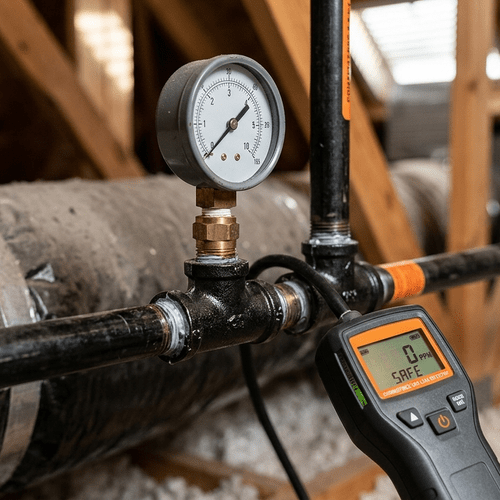
The faint sulfur smell hit the moment the back door opened — not strong, just there. Like struck matches, but nobody struck anything. That half-second of uncertainty is exactly when the wrong call turns a minor leak into something much worse.
A gas smell indoors is an emergency until a professional confirms otherwise.
Yes — any gas smell indoors should be treated as an emergency until a professional confirms otherwise. Leave the building immediately, avoid all electrical devices, and call 911 and your gas utility from outside. The utility shuts off the supply at the meter; a licensed plumber performs the actual repair and pressure-tests the line before service is restored.
Leave first. Investigate never.
Get out. That is the entire instruction.
Do not flip a light switch. Do not open the refrigerator. Do not use a phone until clear of the building. Every electrical device — including a light switch — produces a small spark. A gas-rich room does not need much. The lower explosive limit for natural gas is 5% concentration in air, and at that level, static discharge from pulling off a jacket is enough to ignite it.
Here is exactly what to do:
1. Do not operate any electrical switches, appliances, or devices
2. Leave any door open that is already open — do not stop to open windows
3. Get everyone out immediately, including pets
4. Leave the front door open as you exit to allow airflow
5. Move at least 100 feet from the structure before making any calls 6
. Call 911 and your gas utility from outside — Southwest Gas serves most of the Phoenix metro and operates a 24/7 emergency line
7. Do not re-enter until emergency responders clear the building
Never attempt to locate a gas leak by sniffing around the house or holding a flame near pipes or fittings. A gas-rich pocket can ignite without warning. The gas company has electronic combustible-gas detectors that pinpoint leaks safely — no open flames, no guesswork.
The gas company and a plumber have different jobs
This is where the confusion usually starts.
The gas utility — Southwest Gas in most Phoenix-area homes — responds to gas smell calls at no charge. Technicians carry combustible-gas detection equipment and can shut off the meter. But they do not repair gas lines or appliances. Once the utility has killed the supply, every repair falls to a licensed plumber.
A licensed gas line repair plumber performs the actual work: locating the source precisely, replacing corroded fittings or damaged line segments, pressure-testing the repaired section, and ensuring every appliance reconnects correctly. The utility restores service only after a plumber confirms the repair is complete.
The utility is the first responder. The plumber is the surgeon. Two different roles — neither one optional, neither one replaces the other.
Why gas has a smell at all
Natural gas is odorless. So is propane. The rotten-egg smell that signals a leak is not the gas itself — it is a chemical called mercaptan, injected at trace concentrations during distribution. A human nose detects mercaptan at 1 part per billion. The explosive threshold for natural gas sits at 50,000 parts per million.
The nose catches a leak long before the air becomes dangerous. But only if someone notices and acts on it.
Mercaptan is the only warning system built into residential gas distribution. No secondary alarm, no backup signal. A faint smell does not mean a small leak — it may mean the gas has partially dispersed, or the leak is intermittent.
Carbon monoxide detectors do not detect natural gas or propane. A plug-in combustible-gas detector — available at hardware stores for $25–$60 — adds a second layer of early warning in any home with gas appliances.
Natural gas vs. propane: one critical difference
Most Phoenix homes run on natural gas delivered through underground municipal lines. Some older homes, rural parcels, and detached casitas use propane from above-ground tanks.
And the difference matters when there is a leak. Natural gas is lighter than air — it rises, dispersing toward ceilings and out through attic vents. Propane is heavier than air and sinks, pooling in low spots like crawl spaces, under-floor voids, and garage pits. A propane leak that seems to clear at nose height may be quietly collecting below it. The explosion risk does not dissipate the same way.
For propane homes, the tank shutoff valve is accessible outdoors — it sits on the tank itself. For natural gas, meter shutoff requires a wrench, and utility companies ask homeowners to leave that step to their technicians unless specifically trained.
What causes gas leaks in Phoenix homes
Black iron pipe was the residential gas standard before the late 1990s, and it corrodes at threaded connections over time. In Phoenix, caliche soil and hard-water irrigation accelerate that process on any buried segment. A fitting that held for twenty years can open up without any warning sign before it does.
Loose appliance connections account for a large share of residential leaks. The flexible corrugated connectors behind gas ranges, dryers, and water heaters use compression fittings. Normal vibration works these loose over the years. A fitting that is hand-tight but not wrench-tight will develop a slow leak that no visual inspection would catch.
Phoenix summers hit 115°F. Homes with gas runs through unconditioned attic space cycle those metal fittings through enormous temperature swings — 120°F days against 55°F winter nights, repeated thousands of times. Connections sealed years ago can back off slightly under that stress. This is particularly common in older Valley homes with exposed attic piping, where the thermal movement is most severe.
Improper appliance installation creates problems that show up later rather than immediately. A gas range pushed hard against a wall, a dryer improperly reconnected after a move, an overtightened flex connector — all of these create stress points that fail gradually rather than all at once.
Any digging is a risk. Landscaping, irrigation trenching, concrete saw cuts, and post installation can nick a buried gas line. The damage does not always produce an immediate smell. A small nick weakens the pipe wall until it eventually opens.
After the repair: pressure testing and re-commissioning
A gas line repair is not finished when the fitting is replaced. The repaired segment must pass a pressure test before the utility restores service. A plumber isolates the section, pressurizes it to 1.5 times normal operating pressure, and watches for any drop over a set interval. Pressure holds — the repair passed. Pressure drops — there is still a leak somewhere.
Once the utility purges air from the lines after restoration, appliances with standing pilot lights require manual re-lighting. Spark-ignition appliances cycle through several ignition attempts automatically before the burner lights. If any appliance fails to ignite after multiple attempts, the plumber should check the gas supply to that specific unit before assuming the appliance itself has failed.
If a gas smell is associated with broader plumbing concerns — water line issues, pressure drops across multiple fixtures — an emergency plumber can assess multiple systems in a single visit.
Frequently Asked Questions
Rotten eggs or sulfur — sharp, unmistakable, nothing else quite like it. Some people describe it as a struck match. If the smell seems to come from a floor drain or p-trap rather than a gas appliance, it may be sewer gas rather than a combustible-gas leak. Both need attention, but the evacuate-and-call protocol applies whenever a combustible gas source is possible.
No. Small leaks get bigger as fittings corrode or loosen further. Gas also builds up in enclosed spaces — a faint smell in an open kitchen can reach dangerous concentrations inside a closed cabinet or beneath a floor. A licensed plumber should assess and repair any confirmed gas leak regardless of apparent size.
Utility technicians carry electronic combustible-gas detectors that read concentration in parts per million. The detector sounds an alert as the technician moves it along piping runs and near appliance connections. The source can be pinpointed to within inches without opening walls or using any flame.
Not always. Sudden large releases produce an obvious odor. Long-term small leaks in well-ventilated areas may produce an intermittent smell that comes and goes with airflow changes. Some occupants also become partially desensitized to a persistent faint smell over time, which is one reason intermittent odors should be investigated even when the smell is not currently present.
Most residential gas leak repairs are completed in a single visit once the utility has shut off the supply at the meter. Simple fitting replacements and connector swaps are typically same-day work. Larger repairs involving underground line segments take more time, but a licensed plumber can give a realistic timeline after the on-site assessment.
The gas utility owns and maintains lines from the street to the meter. Everything from the meter inward — in-home gas piping, shutoff valves, flexible connectors, and appliance connections — is the homeowner's responsibility. A licensed plumber handles all in-home gas line work.
A licensed plumber can locate and repair residential gas leaks, pressure-test the repaired line segment, and re-commission appliances once the utility restores service. Simba Plumbing serves Phoenix, Scottsdale, Mesa, Chandler, Gilbert, Glendale, Peoria, Tempe, Surprise, Goodyear, Avondale, and surrounding Valley communities. (602) 500-2153.
