
Why Is Sewage Backing Up Into My Bathtub?
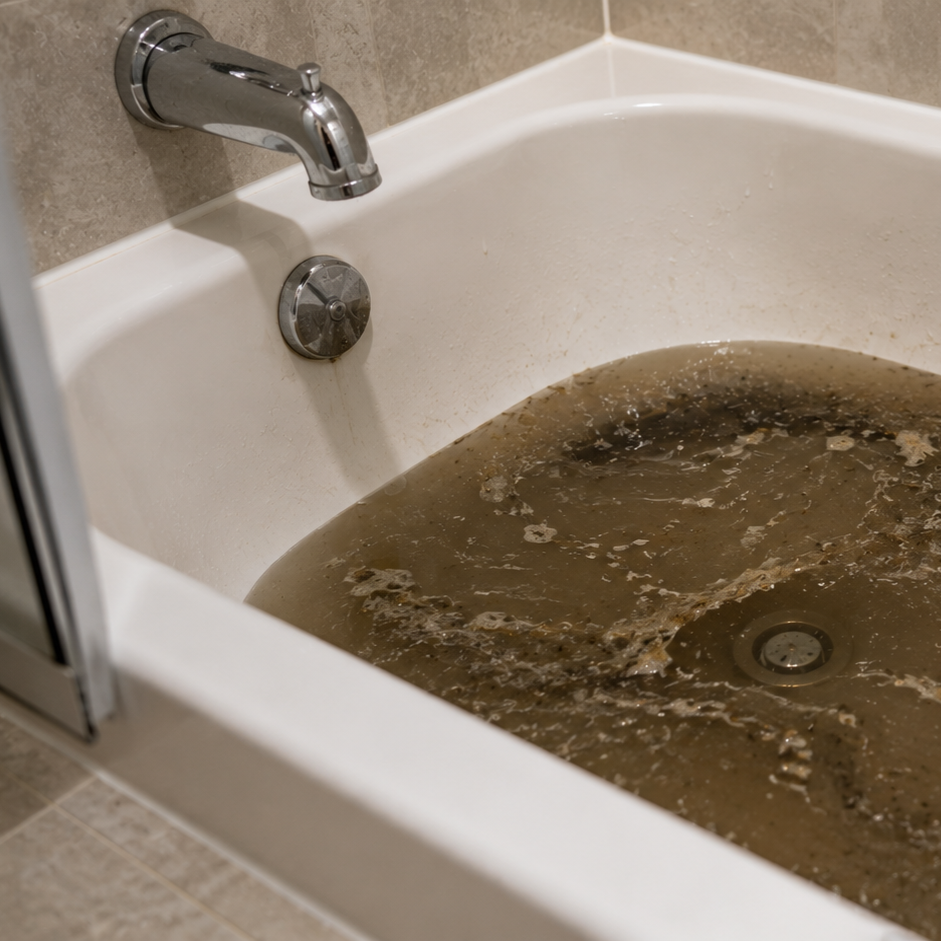
Brown water pooled around the drain. The smell hit first — sulfur and rot — and then the trickle spread across the basin. No one put it there. The toilet in the next room had just been flushed, and that single flush pushed raw sewage backward through the drain stack and out through the tub, which sits at the lowest point of the drain system.
That's a sewer backup. It needs attention now, not tomorrow.
Stop all water use before doing anything else
Every flush, every running faucet, every load of laundry pumps more volume into a line that's already blocked. Stopping the inflow is the only way to keep the backup from spreading further through the house.
Here is what to do right now:
1. Turn off the main water shutoff valve. This stops all flow into the house. The main shutoff is typically at the water meter near the street, or where the supply line enters the foundation slab.
2. Do not flush any toilet. Not one. A single flush sends another wave of waste back through the tub.
3. Do not run any drain — sinks, washing machine, dishwasher. All of them feed the same main line.
4. Open the sewer cleanout cap if the house has one. The cleanout is a 4-inch threaded plug set into a short pipe, usually near the foundation or in the yard. Removing it releases pressure from the main line and redirects backed-up sewage outdoors instead of through interior drains.
5. Clear the bathroom. Sewage water carries E. coli, Salmonella, and hepatitis A. Anyone who contacts it should wash immediately with soap and water. Children and pets stay out until the area has been disinfected.
Sewage water is a Class 3 biohazard. Avoid contact with the eyes and mouth. After the line is cleared, disinfect the tub and surrounding floor with a bleach solution — one cup of bleach per gallon of water. Let it sit for at least 10 minutes before rinsing.
After those steps, call a licensed plumber. A sewer backup doesn't hold. The longer the line stays blocked, the more wastewater finds its way up through whatever drain is available.
The bathtub fills because it sits at the bottom of the stack
Every drain in a house — sinks, tubs, showers, toilets, and washing machines — connects to the same 4-inch main sewer line running through or beneath the foundation. When that line is blocked, wastewater has nowhere to go. It backs up through the pipe network and exits through the first drain it reaches, going upward. In most homes, that's the tub or shower floor.
Not the toilet. Not the sink. The tub, because it's lower.
This is why sewage in the bathtub almost never means the bathtub has a problem. The tub is where the symptom appears. The cause is farther downstream in the main line. One slow drain usually means a localized clog in a single branch. Multiple fixtures backing up at the same time means the main line is the problem.
Four things that block the main sewer line
Grease, wipes, and debris accumulate until the line fails
The most common cause is material accumulation in the main sewer line over the years of use. Cooking grease and fat cool as they travel down the pipe, coating the interior walls and steadily narrowing the usable diameter. Wet wipes — including brands labeled "flushable" — don't break down in water the way toilet paper does. They bind with grease and hair, forming dense, semi-solid masses that sit in the line for months before one hard flush tips the balance. A 4-inch sewer main can limp along with a partial blockage for a long time before it finally chokes.
Tree root intrusion finds every weak joint
Desert landscaping doesn't mean root-free pipes. Ficus, ash, mesquite, and large ornamental trees common in Phoenix-area yards push feeder roots 20 to 30 feet looking for moisture. A hairline crack at an older pipe joint or a deteriorating rubber seal is all a root needs to push through. And roots don't stay thin. They branch, thicken, and form a lattice that catches every piece of solid waste passing by until the pipe is fully obstructed.
A blocked vent pipe creates back-pressure in the drains
Most homeowners don't know that the plumbing system has vent pipes at all. These 2- to 3-inch pipes exit through the roof and let air into the drain stack so water can flow freely. Picture a drinking straw with a finger pressed over the top: even full of liquid, nothing flows until air gets in from one end. A blocked vent pipe — stuffed with leaves, debris, or a bird nest — creates that exact vacuum. Drains slow, gurgling sounds develop, and eventually the pressure differential forces wastewater up through the lowest available drain.
Pipe damage restricts flow before any clog forms
Older Phoenix homes may still have original cast-iron drain lines. Cast iron corrodes from the inside over decades; rust scale builds up on the pipe walls and chokes down the effective diameter. Clay pipe, found in some pre-1960s construction, is vulnerable to cracking under Phoenix's expansive caliche soil, which can shift substantially when monsoon-season rains saturate the ground. A collapsed or heavily scaled pipe restricts flow enough to cause a full backup even without a classic obstruction.
Warning signs that appeared before the backup
A main-line backup rarely arrives without advance notice. In the days or weeks before sewage shows up in the tub, the system usually gives clear signals.
Multiple drains running steadily at the same time is the most telling sign. So is a gurgling noise from the toilet when a nearby sink drains, or the toilet bubbling when the washing machine runs. A sulfur smell rising from drains without any visible backup. The garage floor drain or laundry room drain backing up before the bathroom does. Any of those across multiple fixtures — not just one — points to the main line.
A camera inspection comes before any repair
A licensed plumber doesn't guess. The standard first step is a sewer camera inspection— a flexible camera run through the line from the cleanout access point. The camera shows exactly where the blockage is, what it's made of, and whether the pipe wall around it is intact. That information determines the repair path.
But what the camera finds matters a great deal for what comes next.
If the camera finds grease, debris, or root mass in an otherwise intact pipe, hydrojetting is the most effective fix. A drain snake only punches a hole through the obstruction and leaves the pipe walls coated in whatever caused the clog. Hydrojetting sends 3,000 to 4,000 PSI of water through the line, cutting through grease and flushing the interior clean. Most main-line blockages respond to a single pass.
If the camera reveals a cracked or collapsed pipe section, the options are spot excavation (digging up only the damaged segment), pipe relining (inserting a resin-coated liner that cures into a smooth new pipe surface inside the old one), or pipe bursting (pulling a new pipe through while fragmenting the old one around it). A plumber reads the camera footage and picks based on the pipe's condition, depth, and access.
Sewer camera inspections typically run $150–$400 in the Phoenix market and are usually credited toward the repair when the same plumber does the work. Hydrojetting a main sewer line runs $350–$600. Spot pipe repairs start around $1,500; full line replacement ranges from $5,000–$10,000 depending on depth, pipe material, and access.
Frequently Asked Questions
The bathtub drain sits lower in the drain stack than the toilet. When the main line is blocked, wastewater finds the first available exit going upward — and the tub or shower floor drain is below the toilet's water trap level. That geometry means the tub fills before the toilet bowl overflows.
Yes. Raw sewage carries E. coli, Salmonella, hepatitis A, and parasites. The tub and surrounding floor need to be cleaned with a bleach solution after the line is cleared. Any towels or bath mats that came into contact with the water should be laundered in hot water or discarded.
Snaking the branch drain — the short pipe running from the tub to the main — can temporarily restore flow if the blockage is in that section. But a consumer-grade snake won't reach a main-line blockage, and running it through a tub drain risks scratching the finish. Anything past 10 to 15 feet needs a plumber's power snake or a jetter.
Yes, if the house has one. Opening the cleanout releases pressure in the line and redirects backed-up sewage to the yard instead of through interior drains. It's a reasonable temporary measure while waiting for a plumber. The tradeoff is sewage pooling in the yard that needs to be rinsed down after the repair.
It can. During heavy monsoon rainfall — July through September — Phoenix's city sewer system handles significantly more volume than normal. When the municipal line reaches capacity, pressure can push back through residential connections. Backups that occur only after major storms often point to a combination of aging lateral piping and city-system overload. A camera inspection after the storm passes can confirm whether the lateral contributed to the problem.
If grease accumulation caused it, getting the main line hydro jetted every few years prevents re-accumulation. If root intrusion caused the backup and the cracked pipe wasn't repaired, roots grow back into the same entry point within 12 to 18 months. Relining or replacing the damaged section closes that entry point.
A hydrojetting job on an accessible main line typically takes two to four hours, including the camera inspection. Spot excavation and pipe repair depend on depth and access — most standard jobs finish in a day. Trenchless relining is often completed in a single day, with minimal disruption to the yard.
Schedule sewer inspection — Sewage in the bathtub means the main line needs attention today. Simba Plumbing serves Phoenix, Scottsdale, Mesa, Chandler, Gilbert, Glendale, Peoria, Tempe, Surprise, Goodyear, Avondale, and surrounding Valley communities. (602) 500-2153.
