
What Should I Do If My Water Heater Is Leaking From the Bottom?
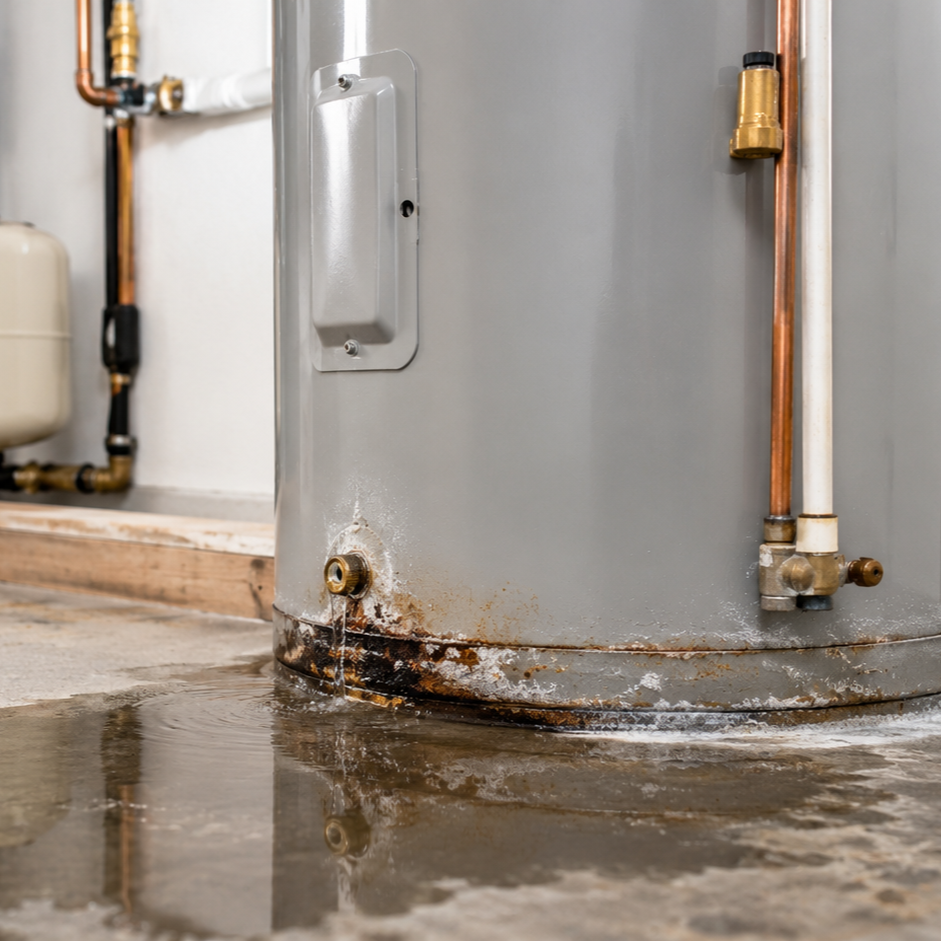
The floor around the water heater is wet. Not wet like a mop-bucket spill — wet like something has been dripping, maybe for a while, and nobody caught it. The puddle is small. The panic is not.
Panic is the wrong move here. A water heater leaking from the bottom can mean three different things, and only one of them demands immediate action. The other two are either a fast fix or a signal that needs a same-day phone call. Getting the sequence right — kill the power and water first, then figure out what's actually leaking — is what keeps a damp floor from turning into a flooded utility closet.
Shut it down first
Before touching anything else, get the heater into a safe state. Takes about three minutes.
1. Turn off the cold-water supply. The cold inlet pipe feeds into the top of the tank. There's usually an isolation valve right on that line. Turn it clockwise. On a gate valve, that's several full rotations; on a ball valve, a quarter turn.
2. Cut power at the breaker (electric heater) or turn the thermostat to PILOT (gas heater). Don't leave a gas heater on PILOT if there's any smell of sulfur or rotten eggs near the unit. See the warning below.
3. Let the tank cool before touching anything at the bottom. Water in a running heater is 120–140°F. Opening the drain valve or brushing the T&P discharge pipe on a hot tank releases scalding water.
4. If the puddle is spreading, put towels and a bucket near the drain valve port. That valve sits low on the tank and provides a controlled release point if water keeps coming in.
If there is any smell of sulfur or rotten eggs near a gas water heater, do not touch any switches or valves, do not turn on lights, and do not use a phone nearby. Leave the house immediately, leave the door open, and call the gas company from outside. A gas leak near an open flame or electric arc can ignite. Only return after the gas company has cleared the building.
Where the water is actually coming from
Once the heater is off and cool enough to handle, find the source. Leaks at the bottom come from one of three places — each with a different diagnosis and a different fix.
| Source | What to Look For | Urgency | Next Step |
|---|---|---|---|
| Drain valve | Drip at the hose-bib-style spigot near the base | Low — often repairable | Tighten or replace the valve |
| T&P discharge pipe | Water at the pipe that runs down the tank side to near floor level | Moderate | Pressure or temp problem — call a plumber |
| Tank seam/base | Rust staining, mineral deposits, or pooling directly under the tank body | High — tank is failing | Plan for replacement |
The drain valve: The fixable one
The drain valve is the threaded brass fitting near the base of the tank — looks exactly like an outdoor hose bib. These valves sit untouched for years at a stretch. The rubber seat inside dries out, corrodes, and eventually lets a slow drip through.
Before assuming the worst, check whether the valve is simply slightly open. A half-turn counterclockwise by a plumber who flushed the tank years ago — or a homeowner who tried it once and forgot — is enough to cause a slow weep. Tighten it clockwise by hand first.
If tightening doesn't stop it, the seat is gone. A plumber can swap the valve for well under $100 in parts and labor. But only if the tank itself is still sound. Replacing a drain valve on a tank that's already corroding inside is throwing money at the wrong problem.
Drain valves on tanks older than 8 years in the Phoenix area should be treated carefully. The hard water mineral scale that builds up on the threads can cause a valve to weep when disturbed. If the tank has never been flushed, ask a plumber to assess before attempting DIY.
The T&P valve discharge pipe: The pressure signal
The temperature and pressure relief valve is a safety device, not a drain. It's built to open only when the tank's internal pressure or temperature exceeds safe limits — 150 psi or 210°F, depending on the valve rating. When water drips from the discharge pipe running down the tank's side, something is pushing that valve open.
Most T&P discharges trace back to one of three causes: excess pressure from a failed expansion tank or a closed-loop system without a pressure-reducing valve; a thermostat running the tank above 120–125°F; or a T&P valve that no longer seats properly after years without being tested.
A replacement T&P valve runs $30–$60. But swapping it without checking the system pressure first just masks the problem. And a relief valve installed without confirming it seats correctly is a safety device that won't do its job when the tank actually needs it.
Tank corrosion: What it looks like and why it happens
A water heater tank is steel. Steel and water don't coexist for long without a barrier between them — which is why the interior is coated with a glass lining. That lining keeps the metal isolated from the water until it develops micro-cracks.
Glass linings crack. Heat cycling stresses them over the years of daily use. A crack forms, water reaches bare steel underneath, and rust starts. Hard-water minerals deposit at the same spot and eat through faster. Eventually, the rust punches through the wall, and water finds a way out at the seam or the base.
The staining around a leaking seam is usually orange-brown, with a white or gray mineral crust where water dried and left calcium behind. In Phoenix, where total dissolved solids run 200–400 ppm, that crust can look substantial even on a tank that isn't very old.
The anode rod is what's supposed to stop this. A magnesium or aluminum rod suspended inside the tank, it draws corrosion to itself, so the steel wall doesn't have to. Think of it as a sacrificial target — it corrodes so the tank doesn't. In hard water, anode rods deplete in 3–4 years instead of the typical 5–6. Most Phoenix tank heaters never get their rod replaced. By year 6 or 7, the steel is exposed and unprotected. By year 8 or 9, the rust has had years to work its way through.
A tank leaking from the body can't be fixed. Once water gets through the steel, replacement is the only option.
How long can this wait?
For a drain valve drip: a day or two, with the cold supply shut off. The valve can be replaced on a scheduled call.
For T&P discharge: same-day or next-day service. The valve opening is doing exactly what it should — but what's actually pushing it open needs to be figured out before something more serious happens.
For a leaking tank body: don't restore water supply to the heater. A corroded tank wall under pressure is unpredictable — a slow seep can become a full rupture with no warning. A 40- or 50-gallon tank releasing all at once floods a utility room in minutes. In Phoenix, where hard water accelerates corrosion enough to push tank failure to 8–12 years instead of the typical 10–15, any tank past year 8 leaking at the base is almost certainly finished.
Frequently Asked Questions
Not always, but where the water is coming from changes the answer completely. A dripping drain valve with the supply shut off can wait a day. Water from the tank body or the T&P discharge pipe should be assessed on the same day — both indicate conditions that can worsen quickly. When uncertain, shut off the cold supply and the power and call a plumber.
No. Turning the heater back on while a leak is active puts pressure on whatever is failing. For a tank-body leak in particular, that pressure increases the risk of a larger failure. Keep the cold supply closed and the heater off until a plumber has looked at it.
The T&P discharge pipe runs from the valve fitting on the tank's side down to near floor level, where it ends with a small gap above a drain or bucket. Water dripping from the end of that pipe — or mineral staining along its length — means the T&P valve is opening. The valve itself isn't broken; it's responding to a condition inside the system.
In Phoenix, yes. The Valley's water runs 200–400 ppm in total dissolved solids. That eats through anode rods faster and puts mineral deposits on the glass lining earlier than in soft-water markets. A tank that would last 12–15 years in low-mineral water often shows corrosion-related failure at 8–10 years here. Age matters less than what the water chemistry has been doing inside the tank.
A standard 40- or 50-gallon gas or electric tank replacement — parts, labor, and standard installation — typically runs $900–$1,500, depending on the unit and any code updates required (expansion tank, updated T&P discharge routing, seismic strapping). Tankless units run higher: $1,800–$3,500 installed, depending on fuel type and existing gas line capacity.
In humid climates, yes — condensation forms on cold tank walls when the heater first fills and can look like a drip. But Phoenix averages 10–30% relative humidity year-round. Condensation on a water heater here clears in minutes. If moisture under the tank persists after the unit has been running for an hour, it isn't condensation.
If the tank body is still sound, replacing the anode rod every 3–4 years and flushing sediment annually can push service life out by a few years. On a tank already 8-plus years old in the Phoenix area, those steps help at the margins — but the corrosion doing the real damage is usually inside the steel by then, not sitting on the rod waiting to be cleared.
What the source tells you
A weeping drain valve is a worn part. A T&P discharge pipe dripping is a pressure or temperature signal. Rust at the tank seam means the tank has run its course. Each source points in a completely different direction, and treating them the same way wastes time and money. Phoenix's water is harder on water heaters than most people expect when they move here. A tank that should have lasted 12 years lasts 8. The fix is the same either way — but knowing why it failed, and catching the signals earlier the next time, is what separates a planned replacement from an emergency call on a Sunday night.
Simba Plumbing's licensed technicians diagnose water heater leaks, replace drain and T&P valves, and handle full-tank or tankless water heater installations across the Valley. Simba Plumbing serves Phoenix, Scottsdale, Mesa, Chandler, Gilbert, Glendale, Peoria, Tempe, Surprise, Goodyear, Avondale, and surrounding Valley communities. (602) 500-2153.
