
Why Is My Water Bill Suddenly High With No Visible Leak?
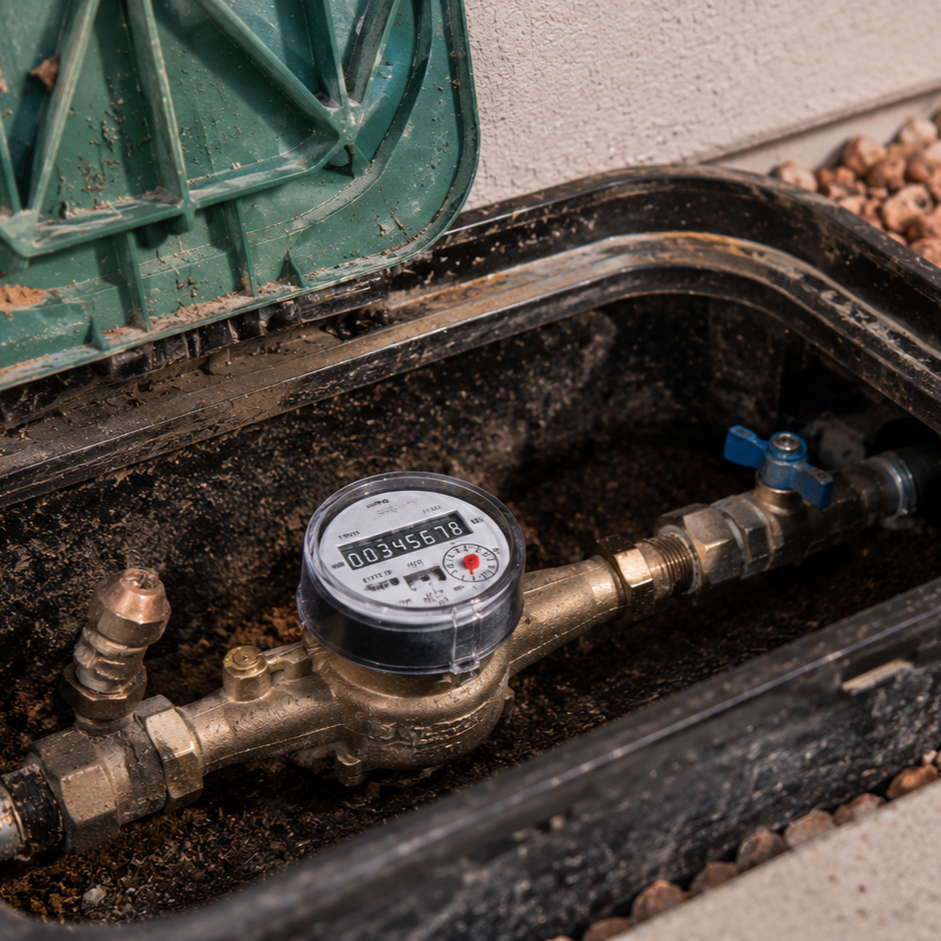
The bill arrived, and the number was wrong. Not off by a few dollars — doubled. Nothing looks different in the house. No dripping faucet, no wet carpet, no stain on the ceiling. The toilets flush normally. The water pressure feels the same. Yet somewhere between last month and this one, hundreds of extra gallons disappeared.
A spike with no visible source is one of the more deceptive plumbing problems a homeowner encounters, because most leaks don't announce themselves. They drain into soil, concrete, or walls. They run at night when nobody is listening. They waste water continuously while appearing to do nothing at all.
Confirm the spike is real — start at the meter
Before investigating causes, confirming that extra water is actually moving through the system is the right first step. Locate the water meter, typically at the street near the curb. Make sure all fixtures, appliances, irrigation zones, and any ice makers are off. Write down the meter reading — either the number on the dial or the digital display — and wait 30 minutes without using any water.
If the reading changed, water is moving somewhere it shouldn't be. If it didn't move, the spike may trace to a single high-use event last billing cycle — an irrigation zone running longer than usual, a guest staying for a week, a pool fill. A meter that moves with everything shut off points to a continuous leak in the supply system.
Most utilities log consumption by the day. Calling the water company and asking for a daily usage breakdown can narrow the timeline — a leak that started January 14th will show up as an obvious step change in the data.
Running toilets waste more water than most fixtures combined
A toilet that runs silently between flushes is responsible for the majority of residential water bill spikes. The flapper valve at the bottom of the tank is designed to seat against the flush valve and hold water until the next flush. When it warps, calcifies, or loses its seating due to age, water trickles continuously through the valve and down the drain.
The problem runs silently. There's no audible drip, no water on the floor — just a thin stream moving through the flush tube at all times. A toilet with a failed flapper can lose 200 gallons per day — roughly $20–$40 per month added to the bill from a single unit.
Desert hard water compounds the problem. At 200–400 ppm total dissolved solids, mineral deposits build on the rubber flapper seal within two to three years. The calcium deposits prevent the flapper from seating flat, leaving a gap that can't close completely, regardless of adjustment.
The dye test confirms the diagnosis in two minutes: drop food coloring or a dye tablet into the tank, wait ten minutes without flushing, and check the bowl. Color in the bowl means the flapper is leaking.
Dripping faucets and fixture leaks add up on an annual scale
A faucet that drips once per second wastes roughly 3,000 gallons per year. That number becomes more meaningful when converted to billing cycles — about 250 gallons per month from a single slow drip. In a two-bathroom house with two leaky faucets, that's 500 extra gallons per month before accounting for other sources.
Faucet cartridges inside single-handle fixtures are the usual failure point. The cartridge contains rubber o-rings and ceramic discs that manage water flow. Hard water accelerates wear on ceramic discs by depositing mineral scale inside the cartridge housing, increasing friction and eventually cracking the seating surface. A cartridge that no longer seats correctly allows water to bypass the valve and drip continuously.
Showerheads and tub spouts present the same pattern. The drip rate from a showerhead after a shower has ended may seem trivial, but a constant 10-drip-per-minute leak from a shower spout runs 525 gallons per year.
Irrigation system leaks disappear into the ground
An irrigation leak is among the hardest for a homeowner to detect because all the evidence goes directly into the soil. A cracked lateral line, a failed emitter connection, or a broken valve solenoid can dump dozens of gallons into the ground every time the system runs — and in the desert Southwest, irrigation systems run year-round.
Supply lines buried just below the surface are particularly vulnerable to caliche layers in desert soil. When caliche shifts seasonally or during construction disturbance, it can crack buried PVC runs. The crack doesn't surface. Water seeps down into the surrounding soil and eventually disappears.
Check the irrigation controller first. If the system is programmed to run at 4 a.m. across six zones for 20 minutes each, it's using significant water outside any visible window. Walk the yard while each zone is active, watching for geysers, pooling, or areas of unusually green or saturated turf. A zone with a broken head will either spray in the wrong direction or show no spray at all while still drawing water.
Appliance supply hoses fail quietly and out of sight
Washing machines connect to the household supply line through braided or rubber hoses at the back of the machine. Those hoses age the same way a garden hose does — the rubber becomes brittle, fittings loosen, and small weeps develop at the connections. A hose weeping at a connection point drips into the gap between the machine and the wall, hitting the floor behind the unit where no one looks.
Dishwashers can develop similar issues at the supply line connection under the sink. The connection point sits inside the cabinet, typically behind stored cleaning supplies. A slow drip from a loose compression fitting runs down the back of the cabinet floor, soaks into particle board, and wicks into the subfloor — never producing a visible puddle on the kitchen floor.
The annual volume from a weeping appliance hose connection is often modest — 100 to 300 gallons — but it's enough to register on the monthly bill and cause slow, invisible water damage to the subfloor in the meantime.
Slab leaks drain into concrete without surfacing
A slab leak develops when a supply line or drain line running under or through a concrete foundation develops a pinhole or crack. Water escapes the pipe and migrates through concrete, which is porous enough to absorb water without showing surface evidence for weeks or months.
The signs a homeowner can detect — a warm spot on the tile floor, the faint sound of rushing water with everything shut off, a persistent mildew smell near baseboards — come later. The water bill spike often appears first.
Think of the slab like a sponge. A pressurized supply line leaking at 60 PSI pushes water into the concrete continuously. The slab absorbs it, distributes it laterally, and only surfaces when it has fully saturated the surrounding material. By the time a wet spot appears on the floor or a baseboard shows moisture, the concrete has been wet for some time.
A slab leak left unaddressed for more than a few weeks can compromise the structural integrity of the foundation and lead to mold growth in wall cavities. Electronic leak detection locates the leak precisely before any excavation, limiting the repair footprint.
A water softener stuck in regeneration cycles continuously
Water softeners clean their resin beds through a regeneration cycle — pulling brine from the salt tank through the resin bed to flush accumulated calcium and magnesium and recharge the ion-exchange capacity. A standard regeneration cycle uses 25–65 gallons of water, typically running once every three to seven days.
When the control valve malfunctions, the unit can get stuck in continuous regeneration mode. It cycles over and over, pulling brine and water through the system without advancing to the next stage. Because most softeners are programmed to regenerate at 2 or 3 a.m., a homeowner can go two or three weeks without noticing the unit is continuously draining to the floor drain or utility sink.
Checking the softener takes less than two minutes: look at the brine tank salt level. If the tank is emptying faster than usual or shows a crust of dried salt at the bottom, the regeneration cycle is running too frequently. The control head display should show the current mode — if it reads "regen" repeatedly throughout the day, the valve is stuck.
Hot water recirculation systems can run longer than intended
A hot water recirculation pump keeps hot water circulating continuously through the hot water supply loop so it's available immediately at every fixture without running cold water down the drain first. When the pump operates on a timer, it consumes modest electricity and minimal water.
When the bypass valve at the far end of the loop fails open, the system draws cold water back through the hot water return line continuously, sending it to the water heater to be reheated. This doesn't create a visible leak — but the meter tracks every gallon cycling through the loop. A failed bypass valve on a recirculation system can register as a 50–100-gallon-per-day anomaly on the meter.
How a plumber traces an invisible leak
Electronic leak detection and pressure testing are the standard diagnostic tools when the source isn't obvious from a visual inspection.
A pressure test isolates sections of the supply system. The plumber pressurizes a section with air or nitrogen, monitors the pressure gauge, and watches for any drop. A drop in pressure indicates a breach in that section. By isolating branches — shutting ball valves to break the system into segments — the leak is narrowed to a specific zone.
For slab leaks, thermal imaging and acoustic detection are the reliable methods. Thermal cameras pick up temperature differentials in the slab surface caused by water movement underground. Acoustic sensors placed against the slab detect the frequency signature of pressurized water escaping a pipe. Both methods locate the leak to within a few inches without cutting concrete.
Irrigation and yard leaks often require a camera inspection of underground PVC lines or a zone-by-zone pressure test of the irrigation system with the heads capped.
Billing errors and estimated reads can mimic a leak
Not every high-bill spike traces to a physical leak. Utilities occasionally send estimated reads — particularly when a meter reader couldn't access the property — and the estimate can be wrong in either direction. If the previous month's estimate ran low, the corrected read the following month shows a spike that reflects two months of actual usage billed in one cycle.
Rate changes are another non-leak driver. Municipalities adjust water rates on a schedule, and a tier structure means consumption that crossed into a higher tier costs more per gallon than the previous bill cycle.
Confirming whether the reading was estimated takes one phone call to the utility. If the bill shows an actual read, comparing the meter number on the bill to the physical meter in the ground confirms they match. A mismatch can indicate the utility is billing the wrong address — uncommon, but it happens.
Frequently Asked Questions
A jump of 20% or more over the same month in the previous year warrants investigation. Seasonal variation accounts for some increase in summer months due to irrigation demand, but a spike that appears during cooler months or doubles the bill without a clear lifestyle explanation is almost always a leak.
Meter errors are uncommon, but they happen. A utility company will test a meter at the homeowner's request. If the meter registers high while all water to the house is shut off at the main, the meter is the problem. If the meter is accurate, the leak is on the property side of the main shutoff.
A flapper that leaks at a moderate rate wastes 200 gallons per day. A severely damaged or misaligned flapper can waste up to 4,000 gallons per day — at that rate, the spike on the next bill is unmistakable.
The supply line is under constant municipal pressure — typically 60–80 PSI. Every gallon that escapes through the crack in the pipe is replaced by incoming water from the street. The meter registers all of it. The concrete absorbs the water, but the supply line keeps flowing.
Start with the flapper. Turn off the supply valve to that toilet, flush to drain the tank, and remove the flapper. Inspect the seating surface for mineral accumulation, warping, or visible cracks. If the rubber is hard, stiff, or shows white calcium deposits, the flapper needs replacement. Also inspect the flush valve seat — if it's rough or pitted, the seat itself may need resurfacing before a new flapper will seal correctly.
Not always. A high bill can reflect a billing error, an extended guest stay, filling a pool or spa, or a single long irrigation run. The meter test — reading the meter before and after a 30-minute window with everything off — is the fastest way to confirm whether continuous flow is happening outside those explanations.
Indirectly, yes. Hard water accelerates wear on valve cartridges, flappers, irrigation components, and softener control valves — all of which are common sources of slow leaks. Hard water also shortens the effective lifespan of water heater elements and softener resin, causing equipment to behave erratically before it fails completely.
A plumber uses pressure testing and electronic detection to find leaks hiding in slabs, walls, and underground lines before they cause structural damage. Simba Plumbing serves Phoenix, Scottsdale, Mesa, Chandler, Gilbert, Glendale, Peoria, Tempe, Surprise, Goodyear, Avondale, and surrounding Valley communities. ROC #327259. Call (602) 500-2153.
