
What Size Tankless Water Heater Do I Need?
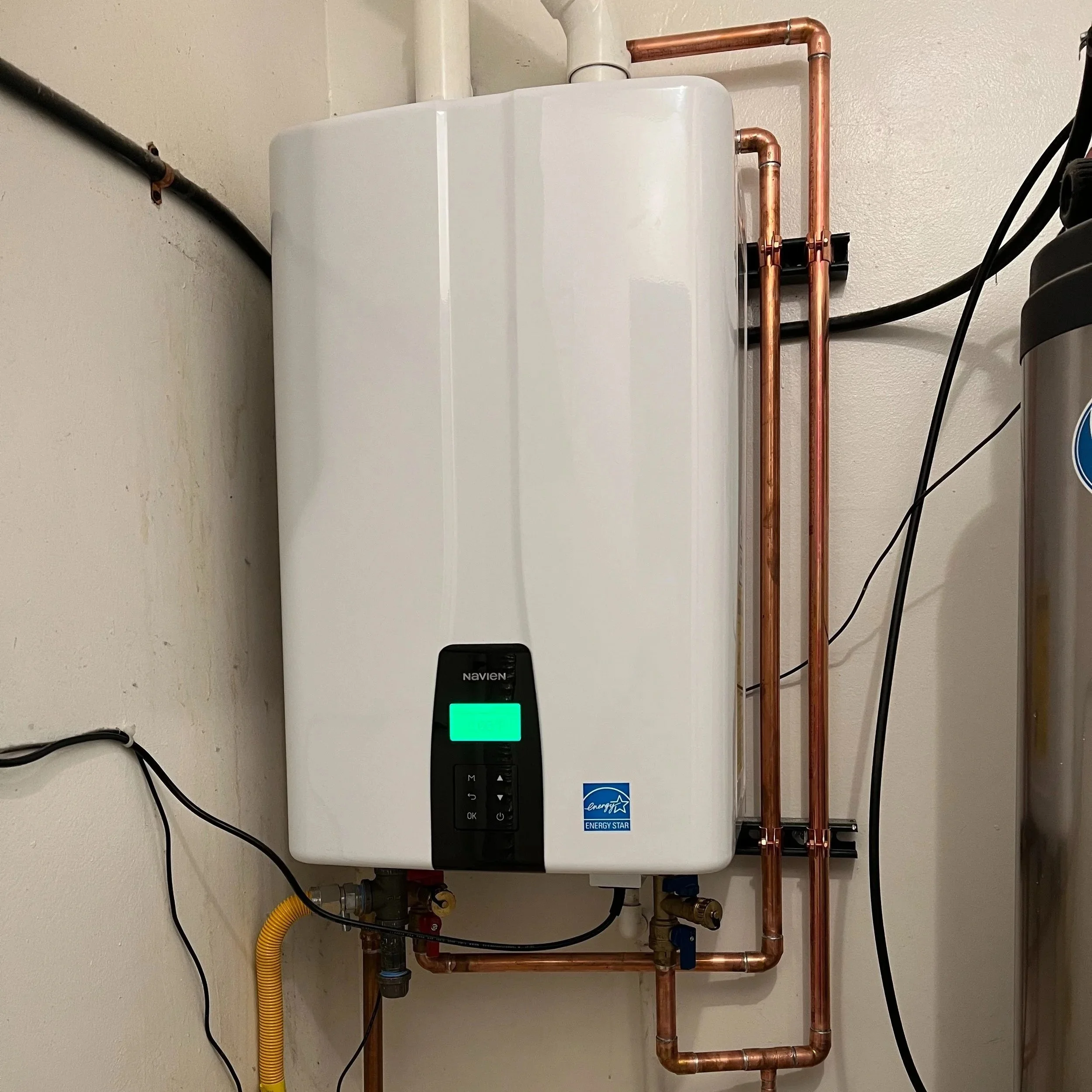
The fourth person in the house steps into the shower at 7:45 a.m. Two minutes in, the water goes cool, then cold. Everyone else finished their shower. This person got lukewarm at best. The tank is doing exactly what it was built to do: run out.
Switching to tankless solves that problem — but only if the unit is sized correctly. A tankless heater that's too small creates a different kind of frustration. Not cold water, but weak flow. Pressure drops, showerheads fall from a steady stream to a trickle, and fixtures compete for whatever hot water the unit can produce.
Sizing the right unit requires two numbers: peak demand and temperature rise. Here is how a plumber calculates both.
Forget gallons — tankless sizing runs on GPM
Tank water heaters are rated in gallons because they store hot water. A 50-gallon tank holds 50 gallons; when it's depleted, recovery takes 60 to 90 minutes.
Tankless units store nothing. They heat water the instant it flows through the heat exchanger, and the question isn't how much they hold — it's how fast they can work. That rate is measured in gallons per minute (GPM).
Think of it like a garden hose versus a fire line. Both deliver water, but only one can run multiple outlets simultaneously without pressure collapsing. A tankless unit's GPM rating is its capacity under simultaneous demand — the volume it can heat and push before demand outruns supply.
Every fixture and appliance in a house draws water at a specific rate. A standard shower pulls 2.0 to 2.5 GPM. A kitchen faucet runs at 1.0 to 1.5 GPM. A dishwasher uses 1.5 GPM; a washing machine, 2.0 GPM. Add up whatever fixtures run simultaneously on a busy morning, and that sum is the minimum GPM the unit must cover.
Step 1: Map the peak-demand scenario
The number that drives sizing is peak usage — the worst-case scenario for simultaneous demand. Average usage doesn't determine unit size; the busiest hour does.
For most households, peak demand occurs in the morning. Multiple showers, a dishwasher cycling, and someone running the kitchen faucet while another bathroom is in use. Mapping that scenario first gives the sizing baseline.
| Fixture | Typical Flow Rate |
|---|---|
| Shower (standard flow) | 2.0–2.5 GPM |
| Shower (high flow) | 2.5–3.0 GPM |
| Kitchen faucet | 1.0–1.5 GPM |
| Bathroom sink faucet | 0.5–1.0 GPM |
| Dishwasher | 1.5 GPM |
| Washing machine | 2.0 GPM |
| Bathtub fill | 3.5–4.0 GPM |
A household running two showers and a dishwasher simultaneously needs a minimum of 6.5 GPM. Three showers and a kitchen faucet reach 9.0 to 9.5 GPM. These sums establish the baseline; the next step adjusts them for local conditions.
Step 2: Calculate the temperature rise
GPM ratings on tankless units are not fixed numbers — they shift based on how much the unit has to heat the incoming water. The difference between the groundwater temperature entering the unit and the target output temperature (120°F) is called the temperature rise, or Delta T.
The colder the incoming water, the more the heat exchanger has to work to reach 120°F, and the less volume it can deliver per minute. A unit rated at 9.0 GPM in one climate may deliver only 5.5 GPM in a northern state where winter groundwater enters at 38°F. The hardware is identical; the performance is not.
Desert Southwest climates have a meaningful advantage here. Winter groundwater temperatures in Arizona range from 60°F to 68°F, depending on location, compared to 35°F to 45°F in the upper Midwest. At a winter inlet of 65°F, the temperature rise to 120°F is just 55°F. That same unit delivering 9.0 GPM locally might only produce 6.0 GPM in a colder market — a 33% reduction from groundwater alone.
The calculation is simple: 120°F (target output) minus the local winter groundwater temperature equals the required temperature rise. That Delta T value is applied to the manufacturer's sizing chart, which shows real-world GPM for each temperature-rise interval.
In warm-winter markets, the shorter temperature rise means a smaller unit often covers the same household load as a larger unit in cold climates. Sizing charts should always be read against local winter groundwater temperature, not the unit's theoretical maximum rating.
Step 3: Match the GPM needs to a unit
With peak demand calculated and temperature rise factored in, the target is clear. Most households fall into predictable ranges:
| Household Size | Typical Peak Demand | Recommended Unit Size |
|---|---|---|
| 1–2 people | 1–2 fixtures simultaneously | 6.5–7.5 GPM |
| 3 people | 2 fixtures simultaneously | 7.5–8.5 GPM |
| 4 people | 2–3 fixtures simultaneously | 8.5–10 GPM |
| 5+ people | 3+ fixtures simultaneously | 11+ GPM or dual-unit cascade |
These are starting points. A household with multiple high-flow showerheads, a large soaking tub, or compressed morning timing needs a higher number. Homes with low-flow fixtures on every outlet may need less.
Undersizing vs. oversizing: what actually happens
Undersizing produces a recognizable symptom. When demand exceeds capacity, the unit cannot produce hot water fast enough and maintains temperature by reducing flow. The result is a showerhead that drops from a full stream to a trickle while the water stays hot. It registers as a pressure problem. It's a GPM problem.
Oversizing carries no performance penalty and no efficiency penalty. A tankless unit modulates its burner output based on actual demand — it fires harder when usage is high, backs off when demand is low. A high-capacity unit in a smaller household consumes no more gas than a properly-sized unit under the same load. Gas consumption tracks demand, not model size. The only difference is the upfront cost of the larger unit.
Given the choice between undersizing and oversizing, a plumber always leans toward the larger unit.
When one unit isn't enough
Large households — typically five or more people — often exceed what a single tankless unit can reliably cover at peak. The solution is a cascading two-unit setup.
Two units plumbed together deliver combined flow rates of 14 to 16 GPM, which handles virtually any residential load. Modern condensing tankless units communicate digitally and stage up as demand increases, shutting down independently when demand drops. From the homeowner's perspective, performance is identical to a single high-capacity unit. The added benefit is redundancy: if one unit needs service, the other keeps the house in hot water.
Homes with significant distance between the water heater location and remote bathrooms sometimes benefit from a dedicated point-of-use tankless at the far end of the house, rather than relying on a single central unit to push hot water through 60 or more feet of pipe.
What else factors into sizing
Gas line capacity. High-output tankless units in the 160,000 to 199,000 BTU range require a 3/4-inch gas supply line with adequate inlet pressure. A home with only a 1/2-inch stub at the planned installation point needs a new gas line run as part of the job. A plumber evaluates this before any equipment recommendation.
Hard water and scale buildup. Desert Southwest groundwater contains 200 to 500 parts per million of total dissolved solids — primarily calcium and magnesium. Without annual descaling, mineral deposits accumulate inside the heat exchanger and reduce both flow capacity and heat transfer efficiency. A unit that performs at rated GPM when new will lose measurable capacity over several years of neglect. Sizing one step above the calculated minimum provides a buffer against gradual degradation between service visits.
Outdoor vs. indoor installation. Most gas tankless units in warm-winter climates are installed on an exterior wall. This eliminates combustion air requirements and simplifies venting. The unit must carry an outdoor rating, but in practice, outdoor installation is standard in the desert Southwest and often preferred by plumbers for access and airflow.
Frequently Asked Questions
A plumber starts by identifying which fixtures run simultaneously at peak — typically the morning rush. Each fixture has a known GPM draw. The plumber adds those numbers, then checks the local winter groundwater temperature to determine the temperature rise. That Delta T gets applied to the manufacturer's sizing chart, which shows real-world GPM output for the specific temperature rise in that climate.
In a warm-winter market, a 7 GPM unit can cover a household of four if peak demand stays at two simultaneous fixtures. In a colder climate that requires an 80°F temperature rise, the same unit may fall short because its real-world output drops significantly below its rated maximum. Households of four with multiple bathrooms and morning overlap typically size to 8.5 to 10 GPM.
No. Gas consumption in a tankless system is demand-driven. The unit fires at whatever rate is needed to heat the water flowing through it. An 11 GPM unit serving a household that peaks at 6 GPM consumes the same amount of gas as a properly sized 7 GPM unit under the same load. The larger unit simply carries unused capacity — not higher operating cost.
Pressure drops while temperature holds. The unit cannot heat enough water fast enough, so it reduces the flow to maintain the set temperature. A homeowner notices weak shower pressure or faucets that feel sluggish — not necessarily cold water. The unit is doing its best to keep the water hot; there just isn't enough volume per minute to satisfy all open fixtures.
Homes with five or more occupants, multiple concurrent shower users, or long pipe runs to distant bathrooms often require two units in a cascading configuration. Two units connected together can deliver 14 to 16 GPM combined. Some large homes use three units for maximum flow and redundancy. A plumber inspecting the home's layout and fixture count will determine whether one unit can cover peak demand or whether a cascade system is the right design.
It factors into the recommendation. Scale accumulation inside the heat exchanger reduces output capacity over time. In a high-mineral supply area, sizing one step above the calculated minimum adds buffer against gradual capacity loss. Annual descaling by a licensed plumber restores the unit to rated performance and prevents the kind of buildup that would otherwise force early replacement.
Yes. High-output tankless units require a 3/4-inch gas supply line with adequate pressure. If the existing gas line at the installation point is 1/2 inch, the cost of running new pipe gets added to the project. A plumber evaluating the installation site catches this before equipment is ordered — avoiding the situation where a unit arrives, and the gas supply can't support it.
Correct sizing requires a peak-demand calculation, local groundwater temperature, and a gas line evaluation before any unit is selected. Simba Plumbing installs gas tankless water heaters and handles the full site assessment, including gas line capacity and installation location, before recommending a model. Simba Plumbing serves Phoenix, Scottsdale, Mesa, Chandler, Gilbert, Glendale, Peoria, Tempe, Surprise, Goodyear, Avondale, and surrounding Valley communities. ROC #327259. Call (602) 500-2153.
