
How Does Hard Water Affect a Tankless Water Heater?
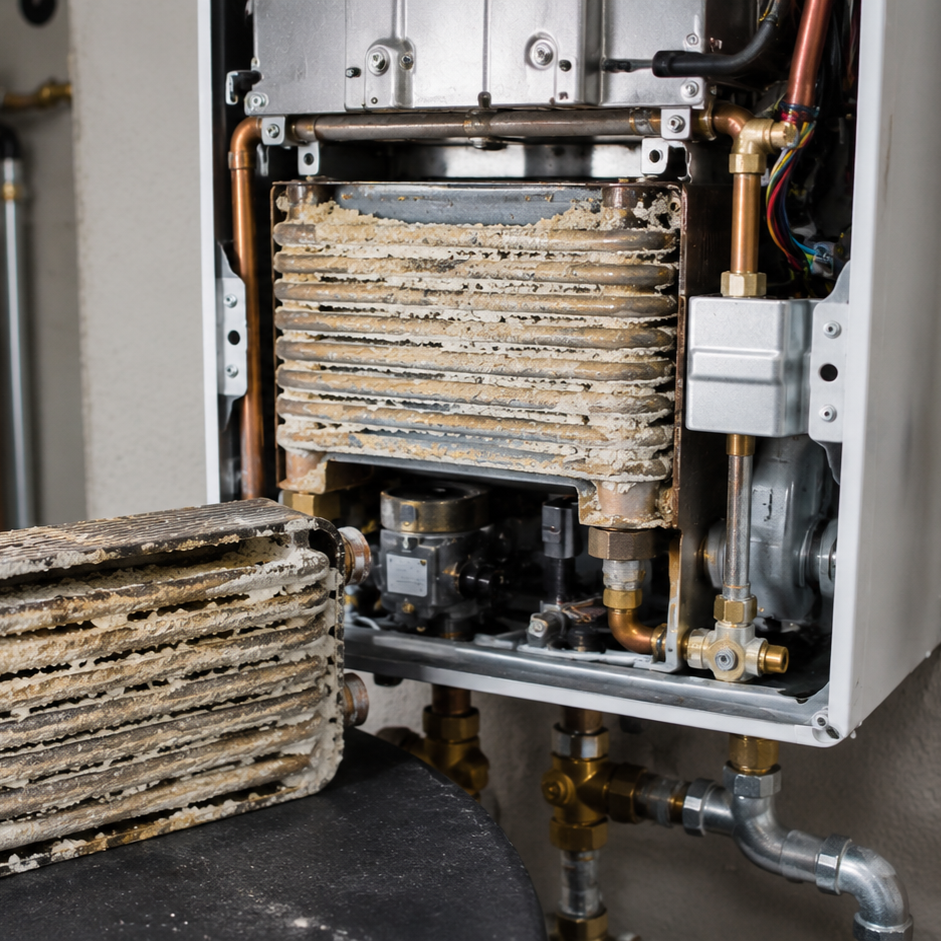
The white crust around the faucet base was there all along, but the homeowner didn't think much of it. Then the tankless unit started throwing error codes. The hot water pressure dropped. The unit that was supposed to last twenty years was struggling at eight. The scale that coated the faucet had been quietly doing the same thing inside the heat exchanger — one mineral layer at a time.
Hard water is the defining water quality condition across the Valley. At 200 to 400 parts per million of dissolved calcium and magnesium — equivalent to roughly 12 to 23 grains per gallon — the local municipal supply ranks among the hardest in major US metros. That hardness is manageable in the plumbing system overall. Inside a tankless water heater, it's a different story.
Calcium doesn't stay dissolved when the water gets hot
Hard water feels perfectly normal coming out of the tap. The minerals — predominantly calcium carbonate and magnesium carbonate — remain dissolved at cold temperatures because cold water holds them in suspension. Heat changes that equation.
When cold water enters a tankless unit and contacts the heat exchanger surfaces — which can reach 200°F or higher during operation — the calcium and magnesium ions rapidly lose their solubility. They precipitate out of solution and bond to whatever metal surface is closest. That surface is the heat exchanger.
The process happens on every heating cycle, every time the unit fires. It doesn't require neglect or unusual conditions. It's a predictable consequence of chemistry: dissolve calcium in cold water, heat it, and calcium wants to become solid again. In the Valley's water supply, there's an abundant supply of calcium to work with.
This is the mechanism that makes hard water and tankless heaters a long-term management issue, not a one-time event.
Why tankless heaters are more vulnerable than tank water heaters
Tank water heaters suffer from hard water, too, but the geometry of the problem is different. In a conventional tank, calcium precipitates and settles as sediment at the bottom of the tank. It's a problem — it insulates the burner from the water, wastes energy, and eventually corrodes the tank floor — but the deposits are somewhat diffuse. The tank has a large surface area. Sediment accumulates in layers and can be flushed out with relative ease.
A tankless unit has no tank. It has a heat exchanger: a compact coil of narrow tubing designed for maximum surface contact between the burner and the water passing through. The tubes are narrow by design — that tight geometry is what lets a small unit heat water on demand. Those same narrow passages are exactly where precipitating calcium wants to stick.
Think of it like arteries. A thin layer of buildup in a wide-bore pipe is trivial. The same thickness in a narrow passage restricts flow meaningfully. Tankless heat exchangers operate with tube diameters often under half an inch. Scale accumulates on the inner walls, and the effective passage diameter shrinks with every heating cycle that goes unaddressed.
A scale deposit just 1/32 of an inch thick — roughly the thickness of a credit card — can reduce heat transfer efficiency by 10 percent or more. The unit burns more fuel to deliver the same outlet temperature, and the metal itself runs hotter than it was engineered to handle.
What scale does inside the unit
The efficiency loss is the first consequence, and the most visible on a utility bill. But thermal stress is what kills units.
As scale insulates sections of the heat exchanger tubing, the metal in those areas overheats. Metal expands when it gets hot and contracts when it cools. A heat exchanger running within design parameters cycles through this expansion and contraction within predictable limits. One running hot due to scale insulation cycles more aggressively, and the metal fatigues faster. Hairline cracks form. Water contacts burner components it was never meant to reach.
Flow restriction compounds the problem. Most modern tankless units use flow sensors to modulate the burner — if the unit detects that the water isn't moving fast enough for the heat output, it reduces the burner rate or shuts down entirely. As the scale narrows the heat exchanger passages, flow sensors see erratic signals. The unit can't modulate correctly. That's the source of the temperature fluctuations — a shower that starts hot, goes cold, comes back lukewarm — that homeowners typically notice before they understand the cause.
Error codes follow. Navien units display an LC code specifically for scale-related heat exchanger issues. Rinnai and Noritz have equivalent indicators. These codes are the unit telling the operator that internal temperatures are exceeding safe limits because heat isn't transferring correctly.
Most major tankless manufacturers — including Rinnai, Navien, and Noritz — exclude scale damage from warranty coverage. Without a service log or a water treatment system on record, scale-related repairs come out of pocket regardless of the unit's age.
Left unaddressed long enough, the heat exchanger fails. In high-mineral environments, tankless units without any scale management may fail in 7 to 10 years. The same unit, properly maintained, routinely reaches 20 years.
Warning signs scale is building inside the unit
Calcium doesn't announce itself. But there are signals worth watching.
Temperature inconsistency is the most common complaint. Water goes from hot to cold to warm within the same shower. This often means scale is interfering with flow sensors or the burner's ability to modulate correctly. Plumbers sometimes call it the "sandwich effect" — a hot burst, then a cold drop as the unit cycles down, then warmth again.
Reduced hot water pressure compared to cold is a physical indicator. If a homeowner turns on the cold tap and the flow is strong, then switches to hot and the pressure noticeably drops, scale restriction inside the heater is a likely explanation. The cold water never passes through the heat exchanger; hot water does.
Unusual sounds — rumbling, whistling, a faint kettling similar to a boiling tea kettle — indicate water struggling to pass through scaled passages. The turbulence as the flow is restricted changes the acoustic signature of the unit.
White or chalky deposits on faucet aerators and shower heads are an indirect indicator. The same minerals coating the aerator screen are coating the inside of the heat exchanger. Scale on external fixtures is a visible proxy for what's happening internally.
Error codes on the display panel, particularly codes related to overheating or flow issues, warrant investigation. If the unit trips an LC or equivalent code with no obvious external cause, descaling should be on the checklist before other diagnostics.
Descaling: the maintenance interval that protects the investment
Descaling is the process of circulating a mild acid solution — typically food-grade white vinegar or a commercially formulated citric acid solution — through the heat exchanger to dissolve accumulated calcium deposits. Done correctly, it restores the heat exchanger passages to near-original diameter and eliminates the thermal stress caused by mineral insulation.
The process requires isolation valves — shutoffs installed on the inlet and outlet lines specifically for maintenance access. A descaling kit connects to these valves, a pump circulates the cleaning solution through the unit for 45 to 90 minutes, and the dissolved minerals flush out with the solution. Without isolation valves, there is no clean way to service a tankless unit in a hard-water environment. Any installation that omits them creates a long-term maintenance problem.
If a tankless unit was installed without isolation valves, adding them is a quick plumber task. It's worth doing before the first descale rather than after a problem develops.
In Valley water conditions — 200 to 400 ppm TDS — a tankless unit without any water treatment system should be descaled every six to twelve months. At the harder end of the local supply (above 300 ppm, or roughly 18 gpg), the six-month interval is the safer choice. Annual is a minimum, not a target.
At each descale, the inlet filter screen — a small mesh screen that catches debris and mineral chunks before they enter the unit — should be cleaned as well. This screen is easy to overlook but catches a meaningful amount of mineral material between service visits.
Water softener vs. scale inhibitor: two different approaches
A water softener using ion exchange is the most effective upstream solution. The system swaps calcium and magnesium ions for sodium ions before the water reaches any appliance. The heat exchanger receives softened water, precipitation doesn't occur, and the descale interval extends dramatically — typically to every two to three years rather than every six to twelve months.
Softeners have upfront cost — a whole-house unit typically runs $1,200 to $3,000 installed — and require periodic salt refills. In hard-water markets, the math on protecting a tankless unit (plus a water softener, dishwasher, and washing machine) usually favors the investment.
A scale inhibitor — specifically a polyphosphate cartridge installed in the water line feeding the heater — offers a middle-ground option. Polyphosphate is a food-grade compound that doesn't remove minerals but keeps them from bonding to metal surfaces. It's less effective than a softener, particularly at the upper end of local hardness levels, but it reduces scale accumulation meaningfully and costs substantially less upfront. The cartridges require replacement every six to twelve months.
| Approach | Upfront cost | Ongoing maintenance | Descale interval |
|---|---|---|---|
| No treatment | None | Annual to biannual descale | Every 6–12 months |
| Scale inhibitor | $100–$300 installed | Cartridge replacement annually | Every 12–18 months |
| Water softener (ion exchange) | $1,200–$3,000 installed | Salt refills | Every 2–3 years |
Neither approach eliminates descaling entirely, but both meaningfully extend intervals and reduce the thermal stress the heat exchanger accumulates over time.
Frequently Asked Questions
It can. Most major manufacturers include language in their warranty excluding damage from scale, lime buildup, or mineral deposits. A claim for heat exchanger failure in a hard-water area without a service log or water treatment history is likely to be denied. Homeowners who want warranty protection should maintain a service log or install a water treatment system that keeps hardness within the manufacturer's specified range — typically below 11 grains per gallon.
Given local water conditions of 200 to 400 ppm TDS, the minimum is once a year without any upstream water treatment. At the harder end of the local range or with heavy household hot water demand, every six months is a more appropriate interval. With a properly functioning ion-exchange water softener, every two to three years is typically sufficient.
Yes, provided the descaling schedule is maintained consistently. The trade-off is that the heat exchanger accumulates scale faster without upstream treatment, so the maintenance interval is shorter and the risk of early failure is higher if a flush is missed. Scale inhibitor cartridges provide meaningful intermediate protection without the cost and complexity of a full softener system.
Isolation valves are shut-offs installed on the cold water inlet and hot water outlet lines of a tankless unit, specifically to allow a descaling kit to be connected without shutting down the entire home's water supply. Not every tankless installation includes them — they need to be specifically specified at installation. Without them, descaling requires either partial replumbing or circulating solution through the unit's internal connections, which is more involved and time-consuming.
With no scale management, tankless units in hard-water markets typically fail in 7 to 10 years — well short of the 15 to 20-year lifespan the technology is rated for. With consistent descaling and upstream water treatment, reaching 20-plus years is realistic. The heat exchanger is the limiting component, and scale is the primary cause of its early failure.
The LC code on Navien tankless heaters is a scale-related warning indicating the unit has detected overheating conditions consistent with mineral buildup in the heat exchanger. It doesn't mean the unit is immediately inoperable, but it does mean descaling should happen promptly. Continuing to run the unit while the LC code is active accelerates heat exchanger damage. Rinnai and Noritz use different codes for similar conditions — the owner's manual will document which codes correspond to scale indicators.
If the heat exchanger has cracked or if scale has caused component failure beyond the exchanger itself, replacement is often more cost-effective than repair. Heat exchanger replacement alone can run $500 to $1,000 in parts, plus labor — approaching or exceeding 50 percent of the cost of a new unit in some cases. A plumber can assess the extent of damage after inspection and descaling. If a descale resolves the error codes and restores performance, the unit may have significant service life remaining.
Hard water is the single biggest factor shortening tankless unit lifespan in the Valley, and consistent maintenance is what separates a unit that reaches 20 years from one that fails in eight. Simba Plumbing serves Phoenix, Scottsdale, Mesa, Chandler, Gilbert, Glendale, Peoria, Tempe, Surprise, Goodyear, Avondale, and surrounding Valley communities. ROC #327259. Call (602) 500-2153.
