
How Do I Know If My Water Softener Resin Bed Needs Replacing?
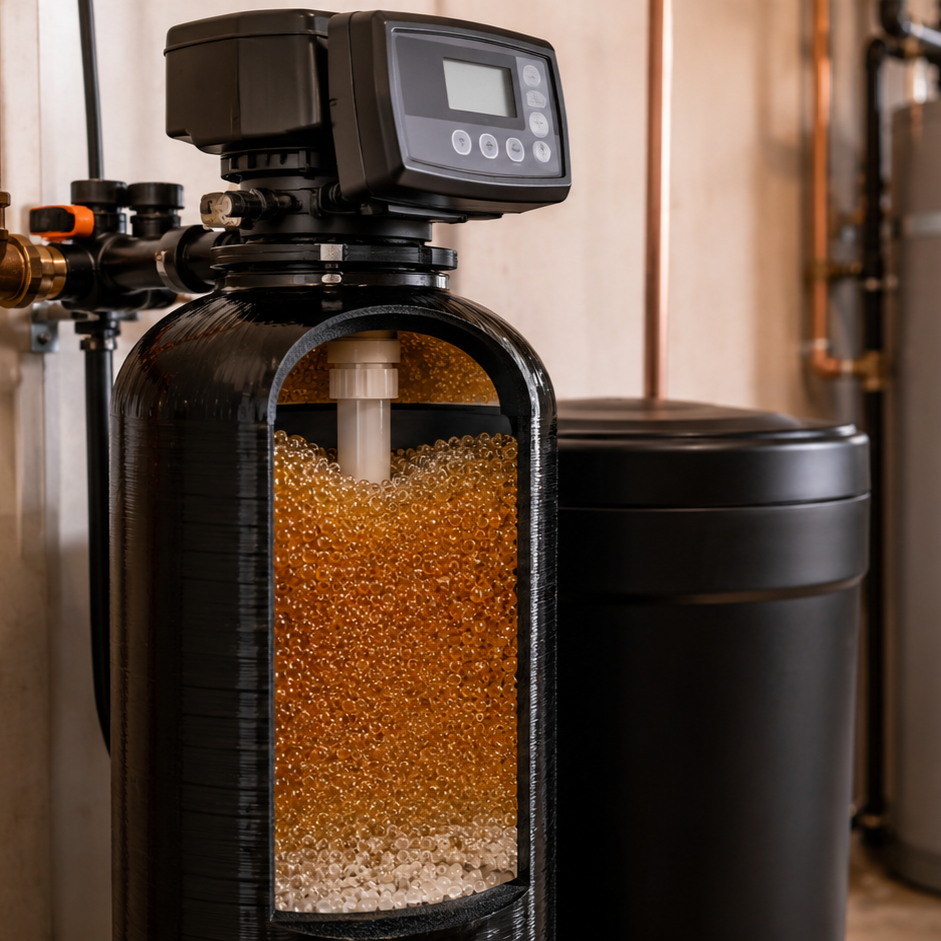
The showerhead has scale on it again. Not the kind that wipes off — the kind that sits in ridges around the spray nozzles and shrinks the flow down to half. The softener is set to regenerate every night. The salt tank has been filled. And yet the water feels hard again, the soap barely lathers, and the glassware is coming out of the dishwasher with a white haze that wasn't there a year ago.
That combination of symptoms rarely points to salt or programming. It almost always points to the resin bed.
What the resin bed actually does
Inside every ion-exchange water softener is a tank packed with millions of tiny polystyrene spheres — typically 0.3 to 1.2 mm in diameter — coated with negatively charged sulfonate groups. Hard water passing through the tank carries calcium and magnesium ions, both positively charged. Those ions bind to the sulfonate sites. Sodium ions from the brine solution swap in. The water leaving the tank has traded its scale-forming minerals for dissolved sodium.
Regeneration reverses the process. A concentrated salt brine flushes through the bed, floods those sulfonate sites with sodium, and forces calcium and magnesium off. The spent brine drains away, the beads reset, and the system is ready for the next service cycle.
Those beads can survive millions of exchange cycles. But they are not indestructible.
Three failure modes that destroy resin before its time
Think of each sulfonate group as a microscopic anchor point. A new bed has hundreds of millions of functional anchor points spread across the surface area of all those beads. As the bed ages, those anchor points break down — and three specific conditions accelerate the process far beyond normal wear.
Chloramine degradation. Phoenix's municipal supply uses chloramine rather than free chlorine, which is gentler on resin than free chlorine. But chloramine still attacks the polystyrene backbone of standard gel resin after years of continuous exposure. Research on resin chemistry shows chloramine can reduce effective resin life by 40 to 70 percent compared to chlorine-free water. With Phoenix tap water running 200–400 ppm TDS, the resin is already processing a heavy mineral load every day. That combination — continuous chloramine exposure plus high mineral throughput — shortens functional lifespan considerably compared to what the resin would achieve in a softer-water market.
Iron fouling. Dissolved iron entering the resin tank binds to exchange sites and oxidizes there, forming a reddish-brown coating on the bead surface. Unlike physical fracturing or chemical degradation, iron fouling blocks exchange capacity without actually destroying the beads — which makes it treatable, up to a point. Valley homes on municipal supply typically see low to moderate iron, but some outer-metro communities and older homes with galvanized supply lines can have elevated iron levels that accelerate fouling.
Physical fracturing from osmotic stress. Beads swell and contract with every regeneration cycle as water chemistry changes rapidly around them. After years of this thermal and osmotic cycling, beads crack. Fractured beads produce fines — very small particles that pack into the bed tighter with every passing month, restricting flow, and eventually passing through the distributor screen into the household plumbing.
Six signs a failing resin bed produces
Hard water is back despite normal operation
The most decisive sign: hard water has returned. Scale rings appear inside toilet bowls. Showerheads clog with white mineral deposits. Faucet aerators reduce to a trickle. Skin feels dry and tight after a shower that should have produced soft water. Glassware comes out of the dishwasher with a white film that doesn't respond to a second wash.
Phoenix tap water runs 200–400 ppm total dissolved solids. Without effective softening, calcium carbonate deposits on every surface it contacts — fixture aerators, water heater elements, tankless heat exchanger fins. A working resin bed keeps those deposits away. When the bed fails, they come back, and they come back fast. Most households notice the shift within two to four weeks once the bed drops below functional capacity.
A $10 hardness test strip kit from any hardware store provides instant confirmation. Test both the incoming water and the softener output side by side. If both readings are similar — above 3–4 grains per gallon (50–70 ppm) — the bed is not softening.
Regeneration frequency has climbed with no change in household use
A properly sized resin bed regenerates every two to four days for most households. As the bed degrades, it exhausts its exchange capacity faster — demand-initiated regeneration detects the depletion earlier and triggers cycles more often. A system that ran every three days and now regenerates daily without any increase in household water use is a measurable early indicator. Not a feeling. A pattern visible in the regeneration log.
Eventually, the softener regenerates every day, yet it still fails to produce soft water. At that stage, the bed has lost most of its functional capacity.
Salt consumption has increased sharply
More frequent regeneration burns more salt. A standard regeneration cycle uses roughly 6–8 lbs per cycle. Moving from a three-day cycle to a daily cycle triples salt consumption. If a brine tank that used to need refilling every six to eight weeks now needs it every two to three weeks — and household water use hasn't changed — the resin is the reason. That pattern often shows up in purchasing records before any other symptom becomes obvious.
Water pressure has dropped at multiple fixtures simultaneously
As resin beads fracture, their fragments pack together. Fines fill the voids between intact beads. A bed that once passed water at 60 PSI inlet pressure and 15 gallons per minute may restrict flow down to 8 GPM or less at the same inlet pressure. The drop shows up at multiple fixtures at once — not just one faucet with a clogged aerator, but reduced pressure throughout the home whenever the softener is in service.
The test: bypass the softener at its bypass valve. If household pressure improves noticeably with the softener bypassed, the resin tank is the restriction.
Fine particles or brownish discoloration at the tap
The distributor tube and basket screen inside the resin tank keep beads from entering household plumbing under normal conditions. When fracturing is severe, fines are small enough to pass those screens. They show up at taps as gritty particles in the water or as a brownish-orange discoloration when iron fouling is also present. Yellowish deposits appearing in dishwasher spray arms or coffee maker components are also a sign that resin fines have entered the plumbing.
Resin fines in tap water can damage washing machine pump seals and clog fixture aerators throughout the house. Bypass the softener immediately if visible particles appear at any tap, and have the resin tank inspected before returning it to service.
Soap and shampoo no longer lather
A working softener changes water chemistry so surfactants in soap and shampoo can do their job fully. Hard water reacts with soap to form calcium and magnesium stearates — soap scum — instead of lather. When the resin fails, lather drops back to hard-water performance: thin, quick to rinse, leaving a film on skin and hair. Some households attribute this to a product change. But it tracks consistently with the return of hard water, and a simple hardness test strips away the ambiguity.
Resin cleaning versus resin replacement
Not every underperforming bed needs full replacement. Iron-fouled resin often responds to a resin cleaner treatment — products using sodium hydrosulfite or citric acid dissolve iron deposits and restore exchange site access. Annual cleaning is legitimate maintenance for Valley homes with any iron in the supply.
But cleaning only works for iron fouling. Chloramine-oxidized resin cannot be restored — the polymer backbone damage is permanent. Physically fractured beads cannot be restored. No cleaning product puts broken beads back together. A plumber distinguishes between these failure modes by testing hardness before and after a fresh manual regeneration cycle, reviewing the regeneration log, and inspecting bead condition.
Standard gel resin in Phoenix's hard-water conditions typically lasts 8–12 years — shorter than the 10–15-year national average, because the Valley's continuous 200–400 ppm TDS load depletes exchange capacity faster than softer-water markets. High-capacity cross-linked resin can extend service life to 12–15 years and holds up better under prolonged chloramine exposure.
A system more than 10 years old showing returning hardness, increased salt use, and reduced flow simultaneously is almost always past the point where cleaning helps. Resin replacement restores full softening capacity at a fraction of the cost of a new unit — and the labor required to confirm the failure mode is the same as the labor needed to re-bed the tank.
What replacement involves and what it costs
Replacing resin is a half-day job. The technician removes the resin tank, extracts the old bead media (non-hazardous, standard waste disposal), inspects the distributor tube and basket screen for wear, loads fresh resin in the correct volume — typically 0.75 to 1.5 cubic feet for a residential unit — and reassembles the system. Control valve settings are verified against the new media's rated capacity. A manual regeneration cycle confirms the system is producing soft water before the technician leaves.
Resin media runs $100–$300 depending on type and tank size. Labor adds $200–$400. Full resin bed replacement in the Phoenix market typically falls in the $300–$700 range for parts and labor combined. Some suppliers quote $500–$1,000 for the complete professional service, including premium media.
For systems older than 15 years with a failing bed alongside signs of control valve wear or brine tank problems, replacing the entire water softener is often the better decision. A current-generation unit with demand-initiated regeneration recovers the cost difference in reduced salt use within a few years.
Hard water without effective softening accelerates damage to every water-using appliance in the home. Tankless water heaters in Phoenix without proper softening can accumulate enough mineral scale on heat exchanger fins to require descaling in two to three years. Tank heaters lose two to four years of rated service life from unchecked scale. Protecting the resin bed protects the whole system downstream.
Frequently Asked Questions
Standard gel resin in Phoenix's 200–400 ppm TDS conditions typically lasts 8–12 years. The Valley's hard water means the resin processes far more mineral load per gallon than in softer-water markets, which depletes exchange capacity faster. High-capacity cross-linked resin can reach 12–15 years and holds up better under continuous chloramine exposure.
Sometimes. Iron-fouled resin often responds to professional treatment using sodium hydrosulfite or citric-acid-based resin cleaners, which dissolve the iron coating and restore exchange site access. Resin damaged by chloramine oxidation or physical fracturing cannot be restored — replacement is the only fix. A plumber can tell the difference by testing hardness before and after a fresh regeneration cycle.
Resin bed replacement in Phoenix typically runs $300–$700 for parts and labor. Resin media itself costs $100–$300, depending on type and tank size. Labor adds $200–$400. Premium high-capacity media or larger tanks push the total toward the upper end.
Hard water passes through the softener untreated. Calcium and magnesium scale deposits on every water-contacting surface: water heater elements, tankless heat exchanger fins, dishwasher spray arms, fixture aerators. In Phoenix, an unprotected tankless heater may need descaling within two to three years of hard-water exposure. Tank heaters accumulate enough sediment to lose heating efficiency and fail ahead of their rated lifespan.
If the system is under 10–12 years old and the control valve and brine tank are in good condition, rebedding is the more economical repair. For systems over 15 years old with multiple component failures, full replacement often makes more financial sense. A licensed plumber can assess the control valve and brine tank condition during the same visit to make that determination.
Test the output water hardness with a hardness strip. Soft water should read below 1 grain per gallon (17.1 ppm). If the softener output reads similar to the incoming supply water, the bed is not softening. Tracking whether regeneration is occurring more frequently than the original schedule is a second reliable indicator.
Yes. Depleted or fractured resin does not introduce harmful contaminants. The beads are non-toxic polystyrene. The concern is exposure to unsoftened hard water, not chemical contamination. If fracturing is severe enough to push fines into tap water, bypassing the softener until it is serviced eliminates that nuisance.
A hardness test before and after a manual regeneration cycle tells a plumber whether the resin bed, control valve, or brine system is causing the problem. Simba Plumbing serves Phoenix, Scottsdale, Mesa, Chandler, Gilbert, Glendale, Peoria, Tempe, Surprise, Goodyear, Avondale, and surrounding Valley communities. ROC #327259. Call (602) 500-2153.
