
Does Expansive Soil Cause Underground Sewer Lines to Crack?
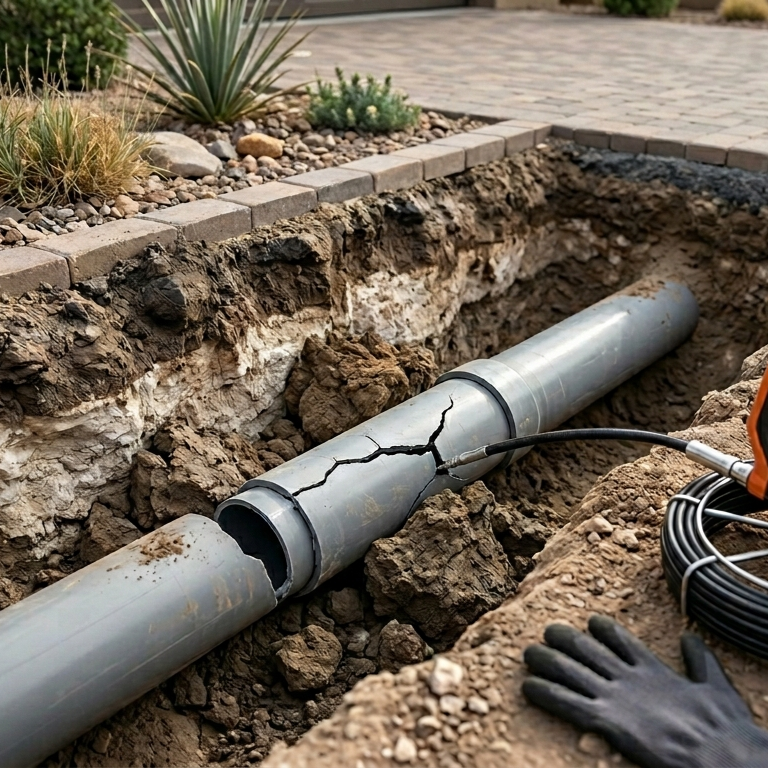
The drain backed up on a Tuesday. A plumber came out, ran a snake through it, and it cleared in twenty minutes. Two months later, same drain, same backup. This time, the plumber snaked it again and suggested jetting. After jetting, it cleared for six weeks. Then it backed up a third time.
That pattern — clear, wait, back up, repeat — is not a maintenance problem. It is a ground problem.
Phoenix soil is not ordinary desert ground
Valley soil looks sandy and inert on the surface. Underneath, the picture is different. The prehistoric lake bed that the Phoenix Basin once occupied deposited deep concentrations of bentonite clay across the metro area. Bentonite is one of the most volumetrically unstable geological materials on earth — it absorbs water and expands, then contracts when it dries. Communities like Central Phoenix, Scottsdale, Mesa, Chandler, Gilbert, and parts of Anthem and Goodyear sit on some of the highest-shrink-swell-potential clay soils in the state.
Under laboratory conditions, bentonite can expand by 10 percent or more after absorbing water. Applied across the full depth of soil surrounding a buried pipe — pushing from below, above, and all sides simultaneously — that expansion generates thousands of pounds of force per square foot against any rigid structure in its path. A sewer pipe is one of the most rigid structures that is buried. It doesn't flex. When soil moves enough, something else has to give.
Then there is the caliche layer. A dense band of calcium carbonate sits two to four feet below the surface across much of the Valley. Caliche doesn't absorb water — it deflects it sideways. When monsoon rain hits a caliche layer, it spreads horizontally and saturates the clay above it in uneven patches. Those patches expand at different rates, creating localized zones of intense soil movement. Residential sewer lines are typically buried three to six feet deep — right at the depth where clay and caliche interact most aggressively.
Phoenix's monsoon season runs from mid-June through September, delivering short, intense rain events that saturate the clay fast. The rest of the year is dry. That wet-dry cycle repeats every year, and it gets more disruptive with every irrigation system, swimming pool, and landscape change in the neighborhood.
How expansive soil breaks sewer pipes in four distinct ways
A sewer line is a precision instrument, not just a pipe. Gravity-flow residential drains require at least 1/4 inch of drop per foot of horizontal run to move waste consistently. A 4-inch line running 50 feet needs to drop at least 12.5 inches across that distance. When the pipe's slope is disrupted — even slightly — waste slows, stalls, and accumulates.
Think of the pipe as a straightedge laid across a surface that slowly, invisibly ripples. The straightedge doesn't bend. It eventually breaks at the point where the ground has moved the most.
Pipe bellies form when clay heave disrupts slope. Clay swells under a pipe section and pushes it upward. When the soil dries and contracts, the pipe settles — but rarely to exactly the original position. After several heave-and-settle cycles, a low spot, or belly, forms in the line. Waste hits the belly and stalls. Sediment accumulates. The line clogs. A snake clears it for a few weeks, then it clogs again at the same spot. Pipe belly formation is the most common sewer service call in the Valley for homes older than 20 years. It is almost always caused by cumulative soil movement, not by any single event.
Joint shearing opens gaps in segmented lines. Older sewer systems — clay tile from the 1950s and 1960s, cast iron from earlier decades — were installed in short two- to four-foot segments connected at joints. Those joints are the weak points. When soil on either side of a joint shifts in different directions, the segments shear apart. The joint opens, even by a fraction of an inch. Groundwater enters through the gap. Roots follow the moisture. Sewage leaks into the surrounding soil. The damage stays underground and invisible for years before the surface symptoms appear.
Root intrusion exploits every opening. Desert trees — mature Ficus, cottonwood, large citrus — send roots aggressively toward any moisture source. A joint opened a quarter inch by soil shear is a direct path into the pipe. Roots enter, grow over multiple seasons, and eventually block the pipe entirely. By the time backups become frequent, the root mass can be substantial — thick enough that snaking only punches through without clearing the problem.
Full collapse ends the line. Wet clay generates the highest soil pressure. A pipe already weakened by years of corrosion — older vitrified clay tile or thin-wall cast iron — can collapse entirely under the weight and lateral pressure of fully saturated, expanded soil. Total blockage. Sewage backs up into the lowest fixture in the home.
Six warning signs that soil movement has damaged the line
Most of the damage stays underground for a long time. The surface symptoms that do appear are easy to misread as unrelated problems.
Recurring backups at the same drain after clearing. A drain that keeps backing up at the same location — even after professional snaking or jetting — points to a structural problem, not just a clog. Either a belly is collecting waste at the low point, or an open joint is snagging debris every time it passes. Clearing removes the material but not the structural cause. Two or more backups at the same location within 12 months is a reliable trigger for a sewer camera inspection.
Sewage or sulfur smell in the yard. When a joint shears open or a pipe wall cracks, sewer gas vents into the surrounding soil and works upward. A rotten-egg odor in the yard — especially after monsoon rains when soil movement peaks — points to a breach somewhere underground. The smell is most concentrated above the pipe run itself.
Circular patches of unusually green or lush grass. A cracked or sheared sewer line fertilizes whatever grows directly above it. A ring of noticeably greener, faster-growing grass in an otherwise dry yard in late summer is a reliable surface marker for a failing line below. The pattern is often circular and limited to one area.
Persistently soft or soggy ground in dry weather. Standing water or spongy soil that keeps reappearing in the same area — days or weeks after rain — means moisture is rising from below, not pooling from the surface. A cracked sewer line or sheared joint is the most common underground source.
New cracks in the driveway or slab. Sewer lines run under or adjacent to concrete flatwork. When soil movement severe enough to shift a buried pipe also shifts the earth under a slab, surface cracks follow. Cracks that appear after heavy rain events and continue to grow deserve investigation as a possible indicator of sewer line damage below.
Water bills that creep upward without explanation. A fractured or sheared sewer line can allow enough water loss — from leaking supply connections or pressurized backpressure — to register on monthly billing. If meter readings have climbed without any obvious explanation, the underground sewer run is worth checking alongside supply-side possibilities.
Homes built in Phoenix before 1985 have a reasonable probability of still running on original clay tile sewer lines — a material completely unsuitable for sustained expansive soil conditions. A camera inspection before purchasing an older Valley home or undertaking any major renovation is one of the highest-value diagnostic investments available.
Traditional dig-and-replace repairs tend to fail in Arizona
The standard repair approach — excavate, remove the damaged segment, install new pipe, backfill — works in stable ground. Arizona's ground is not stable.
The compaction problem defines everything. Digging a trench in clay disturbs the soil on both sides of the excavation. Backfilled clay does not recompact to its original density for months or years. During that period, the newly disturbed material heaves and shrinks at different rates than the undisturbed earth surrounding the trench.
The result is what contractors call the accordion effect. The repair section holds, but the pipe at each end — where the new repair meets the original, undisturbed line — experiences a shear point. After one or two monsoon seasons, the line separates at exactly the boundary of the old trench. The repair fails where the excavation ended. Repeated excavation in clay soil progressively destabilizes the surrounding ground, making each subsequent failure more likely.
Camera inspection defines the repair
No repair decision should precede a sewer camera inspection. A high-definition camera fed through the cleanout access shows the location, type, and extent of every defect in the line: bellies, cracks, joint separations, root intrusion, partial or full collapse. That picture determines which repair is appropriate.
A belly with otherwise intact pipe walls may need only targeted replacement of that section. A pipe with joint separations but structurally sound walls may be a candidate for lining. A collapsed segment requires full replacement. Guessing at the repair type without a camera typically means spending money on a fix that addresses the wrong problem.
Trenchless repair methods hold up better in shifting soil
Two trenchless approaches have proven more durable in Arizona's expansive soil conditions than traditional excavation-based repair.
Cured-in-place pipe (CIPP) lining threads a flexible, resin-saturated liner through the existing pipe and cures it in place with heat or UV light. The result is a new pipe formed inside the old one — a single continuous piece with no joints for soil movement to shear. CIPP liners carry rated service lives of 50 years or more, and because no soil gets excavated, the surrounding ground compaction stays intact. The accordion effect never happens.
Pipe bursting replaces the existing pipe entirely without opening a trench. A cone-shaped bursting head is pulled through the old line, shattering it outward into the surrounding soil. Behind it, a new high-density polyethylene (HDPE) pipe pulls into place. HDPE has enough flexibility to absorb minor soil movement without cracking — a property that rigid PVC and clay tile entirely lack. The replacement line runs as one continuous piece, which eliminates the joint shearing vulnerability that caused the original failure.
Frequently Asked Questions
Not equally. Central Phoenix, Scottsdale, Mesa, Chandler, Gilbert, and parts of Anthem and Goodyear sit on the highest-bentonite-clay-concentration soils in the Valley. Properties near the foothills or in predominantly sandy desert areas carry a lower risk. Any home over 20 years old with original clay tile or cast iron sewer lines deserves a camera inspection, regardless of location, because even moderate soil movement compounds across decades.
Most are buried between three and six feet below grade, which is exactly where the expansive clay layer and the deflecting caliche layer interact most aggressively. That depth was standard for slope and local code requirements, though it places the pipe in the most geologically active zone of the soil profile.
Sometimes. If the belly is limited to a short section and the surrounding pipe is otherwise sound, targeted replacement of that segment or relining can restore proper slope. If the belly has created chronic sediment accumulation or caused joint damage in the upstream sections, a wider repair is needed. A camera inspection maps the full extent before any work begins.
Every 5 to 7 years is a reasonable baseline for homes with older piping materials. For properties with known clay soil issues, a previous slab leak, or a pattern of recurring drain backups, every three to five years makes more sense. Newer homes with PVC sewer lines face a lower immediate risk but should still be inspected before significant landscaping changes that redirect drainage patterns across the pipe runs.
Yes. Root systems from Ficus, cottonwood, and large citrus reach aggressively toward any moisture source. A joint opened even a quarter inch by soil movement becomes a direct entry point. Trees and large shrubs also require consistent irrigation, which pushes additional moisture into the soil over the pipe run and intensifies the heave-and-shrink cycles. Desert-adapted, shallow-rooted plants positioned well away from the sewer line's path are the lower-risk choice.
Yes, and they often do on properties with significant soil movement. The same heave-and-settle cycles that shift sewer lines also stress the pressurized supply lines running under the slab. A property with recurring sewer backups should also check for supply-side leak detection — particularly when water bills have climbed without a visible explanation.
Traditional excavation disturbs the clay surrounding the repair, which prevents the backfilled soil from recompacting to its original density for months or years. The result is differential soil movement at both ends of the trench — the accordion effect — which causes the line to shear at the old trench boundaries after the first or second monsoon season. Trenchless methods leave the surrounding soil undisturbed, eliminating that compaction problem entirely.
A camera inspection can confirm whether soil movement, root intrusion, or pipe material failure is causing the problem before any repair money is spent. Simba Plumbing serves Phoenix, Scottsdale, Mesa, Chandler, Gilbert, Glendale, Peoria, Tempe, Surprise, Goodyear, Avondale, and surrounding Valley communities. ROC #327259. Call (602) 500-2153.
