
How Do I Know If Tree Roots Are in My Sewer Line?
The bathtub draining steadily. The kitchen sink not far behind. A toilet that gurgles after every flush, and a faint sulfur smell from the laundry room floor drain that showed up two weeks ago and hasn't left. Four fixtures. Four separate problems — or so it seems.
They're all saying the same thing.
Root intrusion announces itself this way: not with a single dramatic failure, but with low-level symptoms that look unrelated until a plumber feeds a camera into the line and sees the mass growing inside.
How roots find their way into a sewer line
Tree roots don't punch through solid pipe. They follow moisture. A hairline crack at an older clay-pipe joint, a softened gasket on a PVC coupling, a slightly offset cast-iron hub — any of these creates a vapor seam thin enough for a fine root tip to thread through.
Inside that pipe, conditions are ideal. Warm, nutrient-rich wastewater runs 24 hours a day. No competing vegetation, no drought pressure, steady moisture. The root branches thicken and fill whatever space is available.
Think of it like a rusted screen on a window frame. The screen still keeps insects out when the rust is superficial, but every small gap becomes an entry point. Moisture loosens the frame; the gaps widen; the screen pulls back; and eventually the barrier is gone. The sewer pipe wall works the same way — the integrity holds until a joint or crack gives a root tip its opening, and from that point the intrusion is underway.
Most residential main sewer lines are 4 inches in diameter. That's a tight space to lose.
Slow drains in multiple fixtures at once
One slow drain is almost always a localized problem — grease in the kitchen p-trap, hair at the shower basket, or a foreign object in a branch line. Single-fixture issues. They don't say anything about the main sewer line.
Two or three fixtures draining steadily at the same time is a different situation. The blockage is in the main line, downstream from where all the branch lines converge. The partial obstruction reduces the pipe's effective diameter. Water still moves through — but the margin for error is gone. Heavy loads, like back-to-back toilet flushes or a full dishwasher cycle, push the line past what it can handle.
Root intrusion starts as a 4-inch pipe narrowed to 3 inches. Then 2.5. A main that's 50% blocked by root mass shows sluggish drains at every fixture without producing an obvious backup. At 70–80% blockage, a normal household load triggers sewage standing in the lowest fixture — typically the bathtub or the ground-floor floor drain.
Gurgling sounds after flushing
Gurgling at a drain that wasn't just used is the audible signal of displaced air in the system. In a clear sewer line, water flows freely, and the vent stack running up through the roof lets air enter and exit without pressure building. When a root mass partially blocks the main line, a toilet flush sends 1.28 to 1.6 gallons of water rushing past the obstruction, compressing the air pocket on the downstream side. That compressed air pushes back the only way it can — up through the nearest available drain.
The result: a gurgle from the tub after the toilet flushes. Bubbling in a floor drain when the washing machine drains. The toilet bowl water drops and then rises while the shower runs. Each of these is the same mechanism playing out in a different location.
Recurring clogs that keep coming back
A snake clears the blockage. Water flows. Three or four weeks later, the main line is slow again. That cycle — temporary clearing, rapid return — is the pattern plumbers associate most strongly with root intrusion.
Mechanical clearing cuts through the root mass, restoring flow. But it doesn't remove the root. The root is still anchored in the pipe wall at the breach point. New growth from the cut root tips fills back in over the following weeks, and each round of regrowth can be faster than the last because the root system is now established and drawing nutrition from the pipe.
If a main sewer clog returns within 30 days of being snaked, request a camera inspection before the next clearing. Repeated mechanical cutting without addressing the entry point accelerates pipe wear and delays the repair that actually solves the problem.
Sewage odors from floor drains
A persistent rotten-egg or sewage smell at floor drains — when no drain is actively backing up — points to a main line restriction. The root mass acts as a partial dam, holding wastewater behind the blockage. That standing water releases hydrogen sulfide into the sewer air. If the main line's ventilation is compromised by the same root intrusion, sewer gas finds its way back into the house through trap seals, particularly at the lowest-use drains in the home.
A floor drain that hasn't seen water in months may also have a dry trap producing the same smell. Pour a gallon of water into any unused floor drain first. If the odor returns within a few days, the dry trap isn't the cause — the restriction is.
Yard changes that point to a damaged line
Not every sign shows up indoors. When a root mass has damaged the pipe wall enough to allow seepage, the surrounding soil starts absorbing wastewater. What happens above that soil can be visible before any indoor symptom appears.
A patch of grass that's noticeably greener or growing faster than the surrounding lawn — directly above the sewer line's route to the street — is a telling indicator. Wastewater acts as fertilizer. If one tree in the yard is growing considerably faster than similar-sized trees nearby, its roots may have found a consistent nutrient source underground in the sewer pipe.
Wet or spongy ground over the sewer line route, with no rain in recent days, points to seepage. Soft spots or shallow depressions along that path form when sustained seepage erodes the compacted material around the pipe, leaving voids that collapse inward. A sinkhole forming directly above the sewer line's route means structural damage has progressed to the point of urgent repair.
What a camera inspection shows
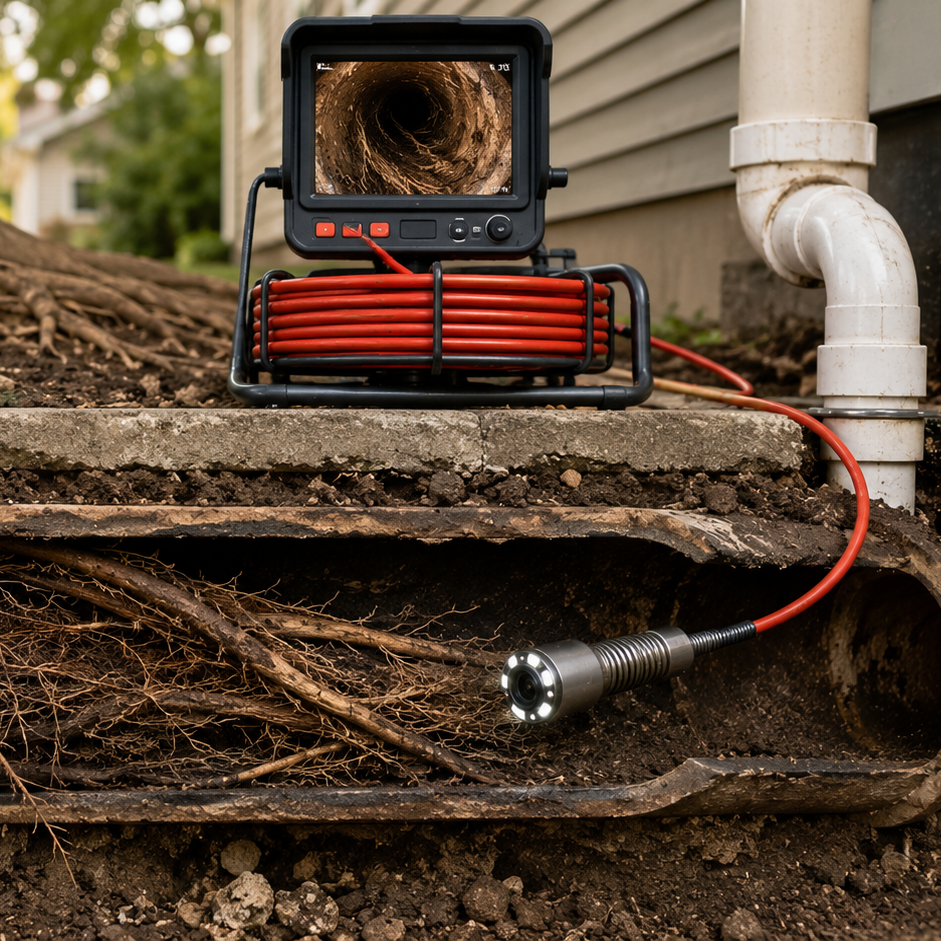
Visual confirmation requires a sewer camera inspection. The technician pushes a waterproof camera through the main cleanout — the threaded 4-inch plug typically located near the house foundation or in the yard — and feeds it toward the city connection.
At early stages, root intrusion looks like a spray of thin white filaments crossing the interior of the pipe. The pipe is still largely open, but the filaments catch debris with every flush. At moderate severity, the root mass is dense and irregular, filling 40 to 60% of the pipe diameter. Severe intrusion leaves only a narrow passage or none at all.
But the camera does more than confirm roots are present. It shows the breach point — the crack or joint failure that lets the root in. That assessment matters because it determines what comes next. A small crack in an otherwise sound pipe gets addressed with a spot liner. A section with multiple failed joints or significant corrosion needs pipe relining or replacement, regardless of how thoroughly the roots are cleared.
Trees most likely to cause problems
Willows are the most commonly cited culprits, and for good reason — their root systems extend 100 feet or more and can detect moisture gradients through soil. But willows aren't common in most residential yards in the Southwest.
The plumbers actually find near invaded sewer lines:
Cottonwood and poplar: aggressive horizontal root systems are common near irrigation channels and older neighborhoods
Ficus and ornamental fig: roots that adapt quickly to any moisture source
Eucalyptus: common in older subdivisions, with root systems known to extend 30 to 50 feet from the trunk
Mesquite and palo verde: native desert trees with roots capable of reaching deep water sources
Distance from the trunk matters less than species and water availability. A large ficus, 20 feet from the house, may have roots under the foundation if the sewer line is the nearest consistent moisture source. There's no safe distance that applies universally — proximity to the pipe route is the relevant variable.
What happens when root intrusion is not addressed
Roots don't stop growing. A line that's 30% blocked in spring can reach 60% by fall as root mass expands through the warm months. At that blockage level, a single large load — two toilets flushing in sequence, a full load of laundry, a dishwasher cycle — can trigger a sewage backup at the lowest fixture in the house.
Sewage backups carry raw waste: E. coli, Salmonella, and hepatitis A. The cleanup cost after a backup involving flooring and drywall runs $2,000 to $8,000, depending on the area affected. The plumbing repair is a fraction of that total — but only when it's addressed before the backup happens, not after.
Frequently Asked Questions
A camera inspection is the only way to confirm it. Symptoms such as multiple slow drains, gurgling sounds, and recurring clogs strongly suggest root intrusion, but other conditions — grease accumulation, a collapsed pipe section, or a foreign object — can produce identical symptoms. The camera shows what is actually inside the pipe and where the breach point is.
In many cases, yes. If the pipe itself is in good condition aside from the intrusion point, a plumber can clear the root mass with hydro jetting at 3,000 to 4,000 PSI, then line the affected section with a cured-in-place liner that creates a smooth, jointless interior the roots cannot re-enter. The pipe is not dug up, flow is restored, and the entry point is sealed permanently. If the pipe is deteriorating along a longer section, open-cut or trenchless replacement is the appropriate repair.
That depends on the species and how fast the specific root regrows. Plumbers typically treat known root-prone lines every 12 to 18 months as preventive maintenance. If camera inspections show rapid regrowth, the lasting fix is pipe lining or replacement, which eliminates the entry point entirely and ends the clearing cycle.
Tree removal stops new root growth but does not eliminate the existing roots already inside the pipe. Dead roots decay in place and can still restrict flow for one to two years after the tree is gone. The breach point in the pipe wall is also still there. A camera inspection and repair are still needed even after removal.
Cable snaking to cut through an accessible root mass typically costs $250 to $500. Hydro jetting is more thorough — it removes the root mass and flushes debris — and runs $300 to $600. If the pipe is lined afterward, cured-in-place pipe (CIPP) lining costs $80 to $250 per linear foot, depending on pipe depth and diameter. A full main line replacement ranges from $3,000 to $15,000, depending on length and repair method.
Clay pipe, common in homes built before 1980, has the most joints and is the most vulnerable — roots target the cement-sealed joints as they deteriorate over time. PVC pipe is more resistant because it has fewer joints and they seal more reliably. HDPE and cured-in-place liners have no joints at all, which is why lined sections stay root-free after treatment.
Copper sulfate root-killer products are sold at hardware stores and can slow root growth in early-stage intrusions when applied regularly — typically 1 pound flushed down a floor drain every 60 days. They work best as a maintenance tool after a professional clearing, not as a remedy for an active blockage. Keeping large trees well-irrigated reduces their drive to seek moisture from nearby pipes, but the most reliable prevention is lining or replacing any pipe section where root intrusion has already occurred.
If multiple drains are slow or a main line clog keeps coming back, a camera shows exactly what is inside the pipe and where the problem is. Simba Plumbing serves Phoenix, Scottsdale, Mesa, Chandler, Gilbert, Glendale, Peoria, Tempe, Surprise, Goodyear, Avondale, and surrounding Valley communities. ROC #327259. Call (602) 500-2153.
