
What Should I Do If a Pipe Bursts in My Home?
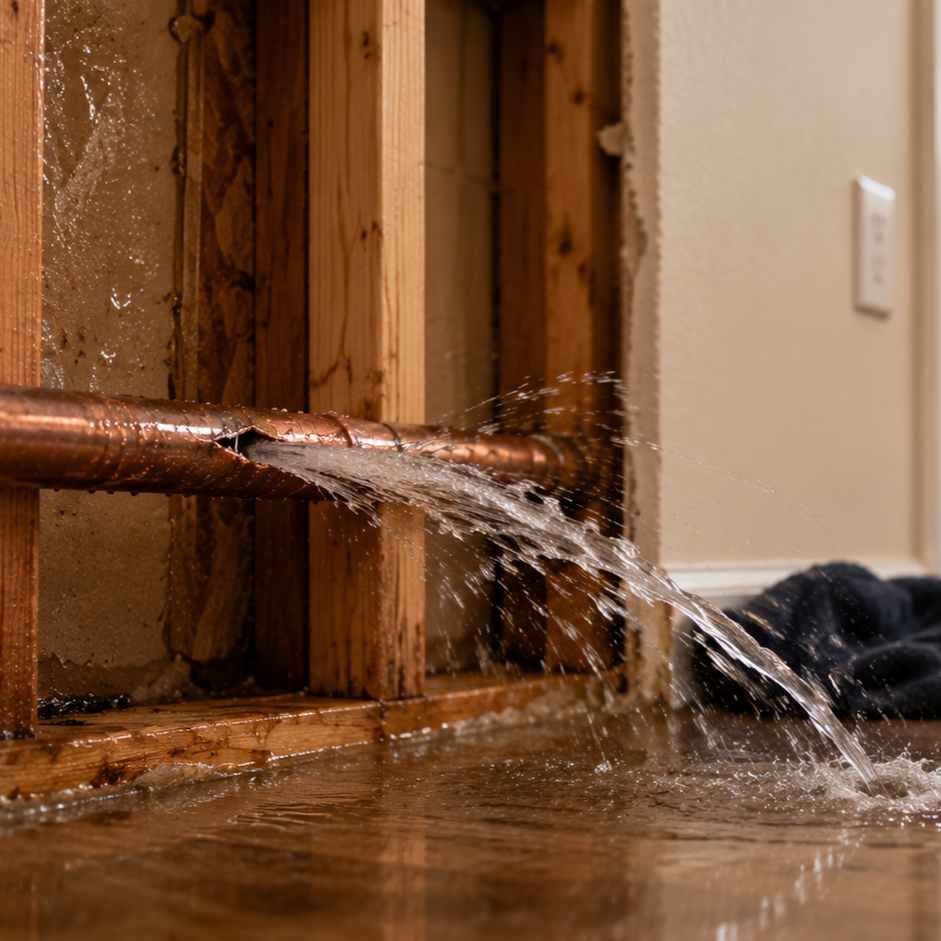
Water is spreading across the floor fast. The sound is hard to miss — a rush, a spray, pressure finding a way out somewhere in the wall or ceiling. A pipe has burst, and every second it keeps running is another gallon soaking into drywall, subfloor, and framing.
Stop reading and act. Here's the order.
Shut off the main water supply immediately — valve turns clockwise or a quarter turn for ball valves. Then cut electricity to affected areas, move valuables out of the water's path, and call a licensed plumber for same-day repair. Do not restore water until the pipe is properly fixed. Document all damage before cleanup for insurance purposes.
Step 1: Shut off the main water supply right now
Before moving furniture, before grabbing a phone — the water supply has to go off first. Every second the main stays open, more water pushes into the structure.
The main shutoff lives in one of a few spots in a Phoenix-area home: near the water meter at the street, inside a utility closet or garage, or along an exterior wall where the supply line enters the house. The meter box sits flush with the ground, usually near the curb. Gate valves turn clockwise until they stop. Ball valves need only a quarter turn — the handle sits perpendicular to the pipe when fully closed. If the main valve won't budge, don't strip it. Find the individual shutoff valves under the affected sink, behind the toilet, or near the water heater, and close those instead.
Before a pipe emergency happens, every household member should know where the main shutoff is and how to operate it. A 30-second test run now can save thousands in damage later.
Once the supply is off, open every faucet in the house — kitchen, bathrooms, all of them. This drains whatever water is still sitting in the lines and drops the pressure, which slows the bleed at the burst point.
Step 2: Cut electricity to any affected areas
Water near wiring is a real danger. If the burst pipe runs close to an electrical panel, outlets, or light fixtures — or if water has started coming through a ceiling where wires run — shut off those circuits at the breaker before anyone enters the room.
And if standing water has reached the electrical panel itself, leave it alone. Call an electrician before touching anything.
Do not enter a room with standing water if the area has exposed wiring, outlets near the floor, or an active electrical appliance that has gotten wet. The risk of electrocution from flooded rooms is real and immediate.
Step 3: Contain the spread while the water is still running out of the pipe
With the main off and electricity handled, the next job is limiting the water that's already out. Towels or blankets pushed along the edges of the pool will slow it from wicking into adjacent rooms. Buckets under active drips from the ceiling matter — a wet ceiling holds a surprising amount before it falls, and a bucket saves whatever's on the floor below. If water is confined to one room, rolling a towel against the base of the door slows migration into the next.
Don't use a standard household vacuum on standing water. Shock and fire hazard. A wet/dry shop vac works. A regular vacuum doesn't.
Move electronics, rugs, and anything upholstered out of the path. Hardwood floors start to cup and buckle within hours of saturation. Upholstered furniture soaks up water fast and is nearly impossible to dry without mold getting a foothold.
Step 4: Call a licensed plumber
A burst pipe isn't a patch-and-see situation. The line needs to be found, properly assessed, and repaired before the water comes back on. A rubber coupling or hose clamp from the hardware store may hold for an hour, but it won't hold under sustained household pressure — typically 60–80 PSI in the Phoenix metro — and it's not a finished repair.
A licensed plumber will find the burst, check whether adjacent sections of pipe are also compromised, and make a repair that holds. In older Valley homes with galvanized or polybutylene pipes, a burst at one spot often signals broader problems in the supply lines. A targeted repair may be the right call — or a plumber may recommend a fuller look at what else is aging in the system.
Step 5: Document everything before cleaning up
Before mopping, pulling up wet carpet, or cutting out damaged drywall — take photos and video first. Affected surfaces, damaged belongings, and the burst pipe itself. That documentation matters for a homeowner's insurance claim, and it disappears the moment cleanup starts.
Wide shots showing affected rooms in context, close-ups of the burst, and the water damage. A note of when the burst was discovered. Any call logs or texts showing when it was reported.
Don't discard damaged materials until an adjuster has seen them. A section of saturated drywall is evidence. Gone before documentation means a harder claim.
Why pipes burst in Phoenix homes
The standard burst pipe article is written for cold climates — frozen pipes splitting in January, ice expanding inside copper. That's mostly irrelevant in the Valley. The causes here are different.
Corrosion and age. Galvanized steel pipe, common in homes built before 1970, corrodes from the inside out. As mineral scale builds up, the pipe narrows, pressure climbs behind the blockage, and the weakest point eventually fails. Phoenix hard water — typically 200–400 ppm total dissolved solids — accelerates that process significantly. Galvanized pipe that might last 50 years in a soft-water market can fail in 30 to 35 years here.
High pressure and water hammer. Phoenix metro water supply runs at high pressure in many areas, sometimes creeping above the 80 PSI safe threshold. A pressure-reducing valve (PRV) that's starting to fail lets pressure surges into the home's supply lines unchecked. Every time a fixture opens and closes hard, a hydraulic shockwave travels through the pipes — water hammer — and that repeated stress fatigues joints and fittings until one gives. It's the plumbing equivalent of bending a paperclip back and forth. Eventually, it snaps.
CPVC in extreme heat. Many Valley homes from the 1980s and 1990s have CPVC supply lines. The material handles high water temperatures well — rated to around 180°F — but CPVC routed through attic spaces can sit in ambient temperatures above 130°F during Phoenix summers. Sustained heat over the years makes the plastic brittle, and pressure spikes that a new pipe would absorb without complaint can crack a heat-fatigued section cleanly.
Physical damage from other work. Pest control drilling, remodeling, landscaping, or even a nail through the wrong spot in a wall. A damaged pipe may not fail immediately — it can hold for weeks or months before pressure finally pushes through.
How fast does the damage get worse
Water moves faster than it looks.
Within two hours, water saturates drywall and starts working into insulation and wood framing. Within 24 hours, mold spores — always present in indoor air — find the wet surface and begin colonizing. Visible mold can appear within 48 to 72 hours under warm conditions. Phoenix summers provide exactly that environment.
Hardwood flooring soaked in the first hour can often be dried and saved. Left wet for a full day, it buckles and typically needs replacement. The difference isn't the material — it's how fast water extraction starts. Getting a plumber on-site and the extraction begun that same afternoon changes the outcome significantly.
For leak detection and water damage repair, the goal is to stop the source and start extraction the same day.
Frequently Asked Questions
No. Shutting off the water stops additional flooding, but doesn't repair the pipe. The break stays open and will resume leaking the moment the supply comes back on. A licensed plumber must assess the damage and complete a proper repair before water is safely restored.
A plumber can use acoustic listening equipment and thermal imaging to locate the source without opening every wall. These tools detect temperature differences and sound signatures from active leaks. A sewer camera inspection or pressure test can also help pinpoint the break before any drywall comes down.
Yes. After the main shuts off, water still sitting in the lines drains out for several minutes. Dripping from a ceiling or fixture will slow and stop as the lines empty. If it hasn't stopped within 20 to 30 minutes, the main shutoff may not be fully closed.
Usually, yes — sudden and accidental water damage from a burst pipe is covered under most standard homeowners' policies. Gradual leaks that the homeowner should have caught and fixed typically aren't. Document the damage thoroughly, report it promptly, and don't discard damaged materials before an adjuster reviews them.
A pipe repair clamp — available at most hardware stores — can slow or stop a burst on a straight, accessible section of pipe. A rubber patch held with hose clamps works similarly. Neither is a permanent repair, and neither is rated for sustained household pressure. A plumber should complete a proper repair before the water supply returns to normal use.
Yes, if drying doesn't happen fast. Mold can start growing within 24 to 48 hours on wet drywall, wood, and insulation. The risk is higher in Phoenix's summer, when warm indoor temperatures give mold exactly what it needs. Water extraction and drying that starts the same day as the burst cuts that risk significantly.
Pipe bursts need same-day repair before the water supply can be restored safely. Simba Plumbing serves Phoenix, Scottsdale, Mesa, Chandler, Gilbert, Glendale, Peoria, Tempe, Surprise, Goodyear, Avondale, and surrounding Valley communities. (602) 500-2153.
