
Should I Replace My Water Heater Before It Fails Completely?
The water heater has been running without complaint for nine years. No rust, no puddles, no cold showers. The question comes up anyway: replace it now on a planned schedule, or wait until it actually quits?
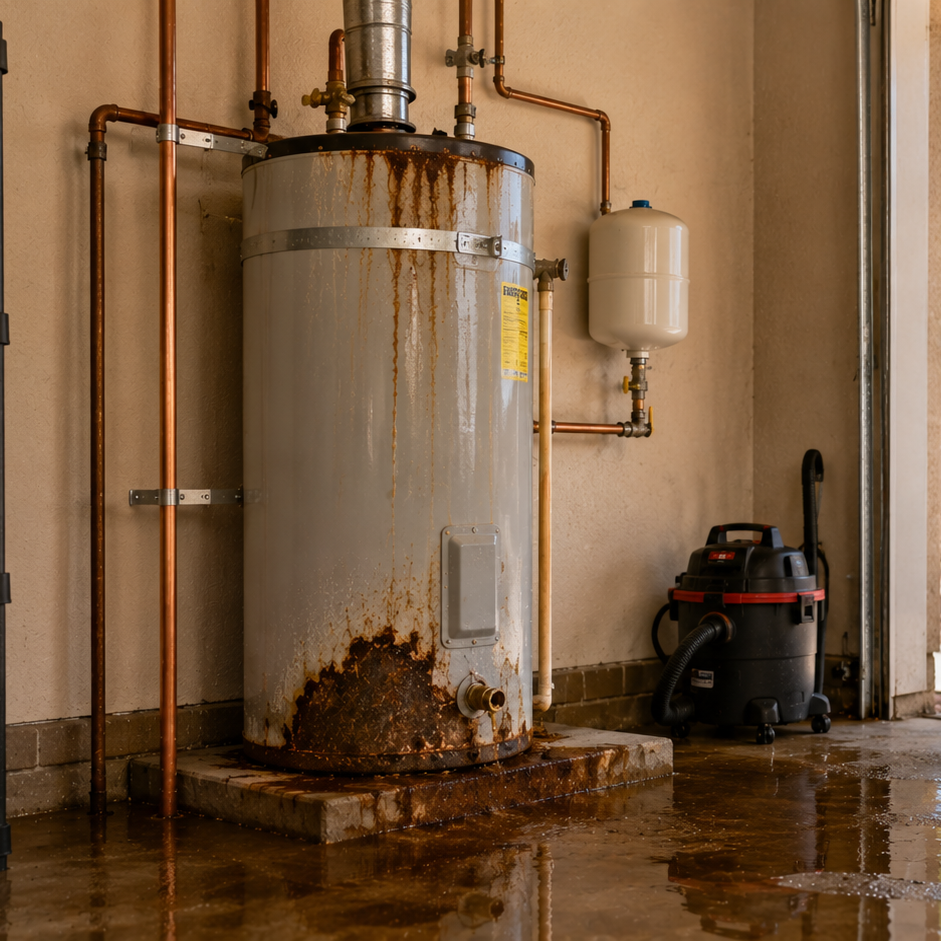
In a mild climate with soft municipal water, waiting is a defensible call. A unit that clears 10 years without incident in those conditions might have several years left. Phoenix is not that situation. Valley water does more damage to a tank heater in eight years than most markets see in twelve, and when a Phoenix unit finally lets go, it tends to go quickly — not with a slow, manageable drip but with a flooded garage floor.
How Phoenix water shortens a tank heater's useful life
The national average lifespan for a residential tank water heater is 10–15 years. In the Phoenix Valley, expect 8–12 — and for units without a water softener in hard-water zip codes, the lower end of that range is realistic.
Phoenix municipal water runs 200–400 ppm TDS (total dissolved solids), with calcium and magnesium as the main contributors. Every time the tank fires, heat drives those minerals out of solution. They fall to the bottom as calcium carbonate scale. A thin coat of scale is a minor inefficiency. Several inches of dense, hardened scale packed across the bottom of a 40- or 50-gallon tank is a different problem entirely.
Scale forces the burner to run longer to push heat through the insulating layer, which cooks the steel at the tank floor. It also traps steam pockets that pop and rumble when the burner fires — that hollow, rock-tumbler sound is the tank under thermal stress, not just background noise.
The other Phoenix-specific factor: anode rods. An anode rod is a sacrificial magnesium or aluminum core that corrodes instead of the tank wall. In soft-water regions, a good anode rod lasts six to eight years. In Phoenix hard water, it is gone in three to four. Once the anode is consumed, the steel tank begins oxidizing at the exposed wall surface. That process accelerates quickly.
Pull the serial number from the rating plate and check the manufacturer's date code. Most encode the year and month as the first three digits (e.g., "A22" = January 2022). If the unit is past year 8 and no anode rod replacement is on record, a professional inspection is worth scheduling before the next summer surge.
The five failure signs that mean act now
Not every symptom demands immediate replacement, but five in particular carry enough risk to justify moving quickly.
Rust-colored hot water. When the hot tap runs orange or brown and the cold runs clear, the source is the tank interior. Internal corrosion is not reversible. The steel wall has already been compromised, and the risk of a seam failure — releasing 40–80 gallons into the floor of a garage or utility room — is real.
Standing water at the tank base. A drip from a loose drain valve or a weeping T&P relief valve can be fixed cheaply. Water pooling at the base of the tank itself, however, almost always means a micro-crack or pinholes in the corroded steel floor. That type of leak starts small and does not stay that way.
Popping, rumbling, or banging during heat cycles. That sound is steam escaping through the cracked scale under pressure. It sithat gnals the bottom of the tank has been taking sustained heat damage. The unit may keep producing hot water for months, but structural failure is closer than the continued function suggests.
Recovery time has dropped noticeably. If a household that once had an hour of uninterrupted hot water now runs cold after 25–30 minutes with no change in occupancy, sediment has displaced usable capacity. The tank holds the same number of gallons, but a portion of that volume is a solid mineral deposit, not hot water.
Age past 10 years with no documented maintenance. A unit that has never had its anode replaced, has never been flushed, and is past the decade mark in Phoenix water is operating past its engineered design point. Every additional month is tank steel being converted to rust.
The financial case for planned replacement
The math on proactive replacement is clearer than most assume.
| Scenario | Typical cost range | Additional exposure |
|---|---|---|
| Planned replacement (40-gal gas, standard install) | $800–$1,400 | None — scheduled at a convenient time |
| Emergency replacement (same unit, after-hours) | $1,000–$1,800 | After-hours dispatch adds $150–$400 |
| Tank failure with water damage (drywall, flooring) | $3,500–$15,000+ | Depends on how long the water sat and what it contacted |
| Planned tankless upgrade | $2,500–$4,500 installed | Manufacturer rebates often available |
Phoenix garages and utility rooms are particularly vulnerable to secondary damage. Drywall wicks moisture fast in a climate where relative humidity spikes during monsoon season, and a tank failure that occurs while a household is traveling — common given Valley summer patterns — can mean three to five days of standing water before anyone notices.
Emergency service fees alone add $150–$400 to the same installation that would have run $800–$1,400 on a scheduled call. That delta makes proactive replacement financially neutral in most cases, and the avoided water damage risk makes it clearly positive.
When repair still makes sense
Not every aging water heater needs immediate replacement. A few repairs genuinely extend useful life.
Anode rod replacement on a unit under eight years old with an otherwise clean interior can add two to four years of service. The rod costs $20–$50; labor for a Phoenix call typically runs $100–$150. If the tank shows no rust and the rod is the only item due, this is a reasonable deferral.
Thermocouple or gas valve replacement on a unit under seven years old is usually cost-effective. These are component-level repairs that do not reflect tank integrity.
Heating element replacement on an electric unit under eight years old follows the same logic.
The line where repair stops making financial sense: when repair costs approach 40–50% of a new installation, or when the failure is structural — leaks, tank rust, visible corrosion on the shell. Those are replacement calls regardless of age.
A simple three-question check
A quick framework for evaluating the decision:
1. Age. Is the unit older than 8 years in Phoenix? If yes, any other positive answer below moves the call toward replacement.
2. Water color. Does hot water run orange, brown, or cloudy before clearing? If yes, replace.
3. Tank condition. Is there moisture, rust, or mineral staining at the base of the tank or on the tank shell? If yes, replace.
A unit that is 8-plus years old but passes all three conditions is a candidate for professional inspection — not automatic replacement, but not a passive wait-and-see posture either.
Do not ignore a T&P (temperature and pressure relief) valve that drips or discharges intermittently. This valve is the safety mechanism that prevents catastrophic overpressure failure. A dripping T&P means either the valve is failing or the system pressure is running above 80 PSI. Both conditions require a plumber's evaluation before the next heating cycle.
The best replacement window in the Valley
The ideal time to replace in Phoenix is late fall through early spring — cooler weather, lower demand on contractors, and no competition from emergency monsoon-season calls. A unit that fails in July competes with every other household whose aging heater could not survive the summer.
Planning a replacement in October or November for a unit that turns 9 in February is not over-caution. A homeowner who schedules on their own timeline chooses the unit type, compares brands, and avoids the emergency premium.
Frequently Asked Questions
Year 7 is a reasonable first inspection point. By that age, the anode rod in Phoenix hard water is likely consumed or nearly so. A licensed plumber can assess tank condition, flush sediment, and give an honest remaining-life estimate. If the unit is past year 8 with no maintenance history, schedule immediately.
Yes, meaningfully. Softened water reduces scale accumulation and spares the anode rod, which can extend tank life by three to five years in Valley conditions. A whole-home softener also benefits fixtures, appliances, and pipes throughout the house.
Planned replacement typically runs $800–$1,400 for a standard 40- or 50-gallon gas unit in Phoenix. Emergency after-hours replacement of the same unit runs $1,000–$1,800. That $200–$400 premium does not include any remediation costs if water reaches flooring, drywall, or adjacent systems.
Annual flushing removes loose sediment and helps slow scale buildup, but it does not reverse scale that has baked onto the tank floor. Think of it like changing the oil — maintenance that extends service but does not reset the clock. A unit past year 8 with a hard scale at the bottom needs more than a flush.
For Phoenix households, tankless is worth serious evaluation. Tankless units handle scale differently, last 15–20 years with proper maintenance, and qualify for manufacturer rebates. The upfront cost is higher — $2,500–$4,500 installed versus $800–$1,400 for a tank replacement — but the operating cost and longevity math often favors tankless over a 10-year horizon.
A T&P valve that drips intermittently, shows visible mineral crust on the discharge tube, or has never been tested in more than three years should be inspected. These valves are rated for 150 PSI / 210°F. Phoenix supply pressure commonly runs 60–80 PSI, and a faulty T&P is not a minor issue.
In Arizona, licensed plumbing work is required for gas appliance connections. Replacement involves gas line connections, flue venting for gas units, correct T&P valve sizing, and expansion tank evaluation for closed systems. Skipping any of these steps risks gas leaks, carbon monoxide exposure, and voided equipment warranties.
Simba Plumbing's licensed technicians assess the tank's condition, anode rod status, and sediment accumulation, then provide honest guidance on whether repair or replacement makes the most sense for the unit's age and condition. $100 off tankless water heater installation. Simba Plumbing serves Phoenix, Scottsdale, Mesa, Chandler, Gilbert, Glendale, Peoria, Tempe, Surprise, Goodyear, Avondale, and surrounding Valley communities. (602) 500-2153.
