
Gas vs Electric Water Heater: Which Is Better for My Home?
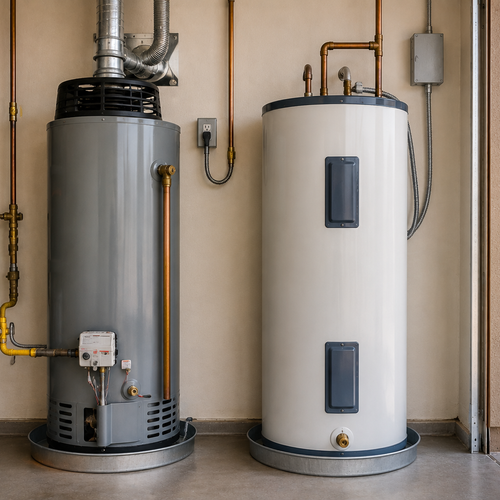
The question comes up at replacement time, during a kitchen remodel, or when a builder pitches a spec-house electric unit, and the buyer wonders whether to upgrade. Gas or electric — one of them is right for a specific house in a specific Phoenix neighborhood, and the answer turns on three variables: what fuel infrastructure already exists, what the household's hot-water demand looks like, and what the APS or SRP electric rate versus SW Gas rate means for the monthly operating bill.
Here is how each type works, what it costs, and where Phoenix conditions tilt the calculation.
How each type heats water
Gas water heaters burn natural gas (or propane in unserved areas) through a burner assembly at the tank base. Combustion gases vent through a flue pipe — either a traditional atmospheric draft system or a direct-vent or power-vent configuration for tight installations. The heat exchanger transfers combustion energy into the water column. A standing pilot or electronic ignition starts the burner when the thermostat calls for heat. Input ratings for residential gas tank units typically range from 36,000 to 50,000 BTU/hr, which gives them their speed advantage.
Electric resistance water heaters use two immersion heating elements — an upper and a lower, each 4,500 watts on most residential 240V units — submerged directly in the water. There is no combustion, no flue, no venting. The upper element fires first to restore temperature at the top of the tank; the lower element handles full-tank recovery. Because the heat transfers directly into the water rather than through a heat exchanger, electric resistance units are about 90–95% energy-efficient at the appliance level. But they are limited by wattage. A 4,500-watt element produces roughly 15,350 BTU/hr — about one-third the heat rate of a typical gas burner.
Heat pump water heaters (a third category increasingly relevant in Phoenix) extract heat from ambient air and move it into the water, rather than generating heat directly. They achieve 200–300% efficiency at the appliance level, meaning they produce $2–$3 of heat energy for every $1 of electricity consumed. That efficiency changes the operating cost math significantly, though it requires adequate installation space (minimum 700–1,000 cubic feet of unconditioned air) and ambient temperatures above about 40°F — not a limiting factor in most Valley homes.
Head-to-head comparison
| Factor | Gas (tank) | Electric resistance (tank) | Heat pump electric |
|---|---|---|---|
| Unit cost (40–50 gal) | $700–$1,100 | $500–$900 | $1,100–$2,000 |
| Installation cost (Phoenix) | $300–$700 | $200–$400 | $400–$700 |
| Conversion cost (no existing infra) | $1,500–$3,500+ (gas line + flue) | $200–$800 (panel circuit) | $400–$1,200 (circuit + space) |
| Recovery rate (50 gal, 90°F rise) | 30–45 min | 60–90 min | 60–80 min |
| Operating efficiency | 80–95% UEF | 90–95% UEF | 200–300% UEF |
| Monthly operating cost (Phoenix avg.) | $18–$35 (SW Gas rates) | $32–$55 (APS/SRP base rates) | $12–$22 |
| Lifespan (Valley conditions) | 8–12 years | 10–14 years | 12–16 years |
| Venting required | Yes | No | No |
| Works during a power outage | Yes (pilot ignition) | No | No |
Note: Cost ranges reflect 2025 Phoenix-area contractor pricing. Operating costs are estimates based on SW Gas residential rates (~$0.98/therm) and APS residential electric rates (~$0.14/kWh), with average household hot water usage of approximately 64 gallons per day.
The Phoenix hard-water variable
Phoenix water complicates the electric resistance picture specifically. In soft-water markets, electric heating elements last eight to 12 years with little maintenance. In Phoenix's 200–400 ppm hard water, calcium carbonate scale deposits on the element sheath at a faster rate.
Scale on an immersion element acts like insulation — the element has to run hotter and longer to transfer the same heat into the water. An element working at 20–30% scale coverage runs at higher surface temperatures, which shortens the element's operational life and raises electricity draw. A 4,500-watt element running inefficiently doesn't just cost more per month; it can fail in four to six years rather than ten.
Gas units are not immune to hard water. Scale still accumulates on the tank floor, reducing heating efficiency. But the burner mechanism itself sits outside the water column, so it doesn't experience the same scale fouling that takes out electric elements.
The mitigation in both cases is a water softener. For electric resistance units in particular, a whole-home softener in Phoenix is not optional equipment — it's what makes the element lifespan approach the manufacturer's rating.
For any electric water heater in Phoenix without a softener, plan on element replacement at year 4–6. Budget $150–$300 per service call. A water softener amortizes its cost quickly when it prevents premature element failures across the water heater, dishwasher, and washing machine.
When gas makes more sense
Gas is the right answer when a home already has a gas line and gas venting infrastructure. The cost to add gas service to a home that doesn't have it — running a new line from the street, adding a meter, installing a flue — easily runs $1,500–$3,500 or more, depending on distance and routing. That premium erases the operating cost advantage for years.
For households with high morning hot-water demand — four or more people showering back to back, a dishwasher cycling during the morning rush — gas recovery at 30–45 minutes versus electric's 60–90 minutes is meaningful. Running out of hot water mid-shower because a standard electric unit can't keep pace is a daily friction that wears on households.
Gas units also function during power outages on models with standing pilots. In Phoenix, summer monsoon brownouts and neighborhood outages are real occurrences. A gas water heater with a standing pilot keeps running when the grid is down.
When electric makes more sense
For a home being built or remodeled without existing gas infrastructure, electric avoids the full gas line and venting installation. The electrical circuit for a water heater — a 30-amp 240V circuit — typically runs $200–$400 to add. That is dramatically cheaper than running gas.
Electric units are also simpler to install in tight locations. No flue clearances, no combustion air requirements, no CO detection considerations. For a garage corner, a closet install, or a location where a vent through the roof would be difficult, electric removes a layer of complexity and inspection requirements.
Heat pump water heaters in Phoenix have a seasonal advantage: they draw heat from the surrounding air. In a Phoenix garage that runs 80–100°F from April through October, the heat pump is pulling essentially free heat out of space that would otherwise make the air conditioning work harder. An APS customer running a heat pump water heater in a hot garage may see monthly operating costs drop to $12–$18 — below what most gas units cost to run.
Heat pump water heaters dump cool, dehumidified air into the installation space as a byproduct of extracting heat. In a conditioned living space or laundry closet, that cold air dump actively fights the air conditioner in summer. Install heat pump units in unconditioned spaces — garages, utility rooms with exterior access — where the cold exhaust is not a problem.
The conversion question
Switching fuel types at replacement time is a common decision point. The cost to convert determines whether the switch makes financial sense over the remaining life of the new unit.
Electric to gas conversion requires a licensed plumber to run a new gas line to the heater location, install a flue vent, and verify combustion air. In an existing Phoenix home, that work typically runs $800–$2,500, depending on the distance from the gas main and the venting path. If a household is switching because of high electric bills, the payback calculation should account for the full conversion cost, not just the operating differential.
Gas to electric conversion requires capping the gas line at the heater location (or at the meter) and installing or upgrading a 240V circuit. If the panel has capacity, the circuit adds runs $200–$400. If the panel needs an upgrade, add $1,500–$3,500. For most Phoenix homes with gas already in service, converting to standard electric resistance typically does not pencil out unless the household also adds solar or has other reasons to reduce gas dependence.
Making the call: a practical framework
1. Start with existing infrastructure. Gas with an existing gas line and flue: Stay with gas unless there's a specific reason to convert. Electric with an existing circuit: Stay electric unless recovery time is a genuine daily problem.
2. Factor in household size. A two-person household rarely runs a standard electric tank dry. A five-person household in a busy morning routine will notice the recovery difference.
3. Consider a heat pump for Valley conditions. For any Phoenix home with a suitable garage or unconditioned utility space, a heat pump water heater at replacement time deserves a serious look. The operating cost advantage in Phoenix's climate is material.
4. Account for hard water. If there is no water softener in the home and there are no plans to add one, budget for more frequent electric element replacement or a somewhat shorter gas tank lifespan than the nameplate suggests.
Frequently Asked Questions
Gas is typically cheaper per month than electric resistance when running on SW Gas and APS/SRP standard rates — roughly $18–$35/month for gas versus $32–$55 for standard electric resistance. Heat pump electric narrows that gap significantly, running $12–$22/month in Phoenix conditions, where ambient air in unconditioned spaces is warm most of the year.
Both types accumulate calcium carbonate scale in Phoenix's hard water. Gas units scale at the tank floor around the burner. Electric units scale on the immersion elements themselves, which is more mechanically damaging — the scale acts as insulation, causing elements to overheat and shorten their lifespan. Without a water softener, expect electric element replacements every four to six years in Phoenix.
Switching from electric to gas requires running a gas line, installing a flue vent, and replacing the water heater. Total project cost typically runs $2,500–$5,000 in Phoenix, depending on distance from the gas main and venting complexity. At that conversion cost, a household would need seven to ten years of operating savings to break even.
A 50-gallon electric resistance unit with 4,500-watt elements will struggle with four or more back-to-back showers. Recovery at 60–90 minutes means the third or fourth person is likely getting lukewarm water. Options are: step up to a 75-gallon unit, add a second unit, switch to gas for its faster 30–45 minute recovery, or move to tankless.
Yes, particularly well-suited for Phoenix. Heat pump water heaters need ambient temperatures above 40°F to operate efficiently — Phoenix almost never dips below that threshold. A unit installed in a Phoenix garage runs in heat pump mode almost year-round. The caveat is installation space: the unit needs at least 700–1,000 cubic feet of unconditioned air around it to function, and it exhausts cool air, which is useful in a hot garage.
Yes. Gas appliance replacements in Arizona require permits and inspections by licensed contractors. Simba Plumbing handles permit pulls, installation, and inspection coordination as part of the installation process.
A straight replacement of the same fuel type takes two to four hours for a licensed plumber. A fuel-type conversion — adding gas infrastructure or a new electrical circuit — typically takes a full day and may require coordination with a gas utility for meter work.
Simba Plumbing's licensed technicians assess existing infrastructure, household demand, and operating costs to recommend the right unit type. $100 off tankless water heater installation. Simba Plumbing serves Phoenix, Scottsdale, Mesa, Chandler, Gilbert, Glendale, Peoria, Tempe, Surprise, Goodyear, Avondale, and surrounding Valley communities.(602) 500-2153.
