
Water Softener vs Salt-Free Water Conditioner: Which Is Better?
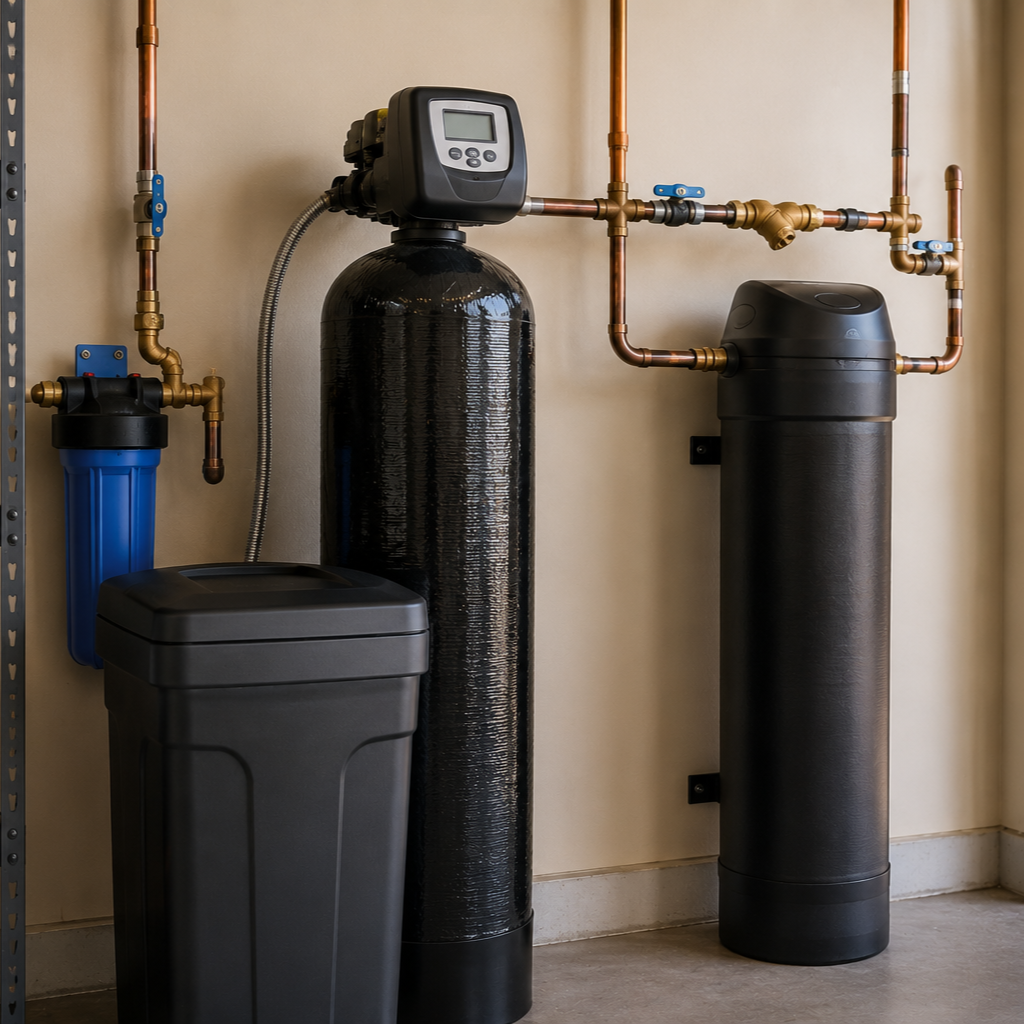
In Phoenix, a salt-based ion-exchange water softener almost always outperforms a salt-free water conditioner. Phoenix water typically registers 16–25 gpg — well above the 7–10 gpg range where TAC conditioners are most effective. A softener removes hardness minerals entirely; a conditioner only changes their form. For Valley homeowners dealing with scale, spotted dishes, or appliance wear, a softener is the more reliable solution.
The white crust around the base of the kitchen faucet. A showerhead clogged down to half its original flow. Glassware coming out of the dishwasher looking like it was washed in muddy water. Hard water leaves its fingerprints all over a home — and once the damage is visible enough to act on, most homeowners run straight into a marketing wall: "traditional water softener" versus "salt-free water conditioner."
Both products claim to fix the problem. Only one of them does, in most circumstances. The difference is chemistry. And once that's clear, the decision gets a lot simpler.
A salt-free conditioner doesn't soften water — it changes how minerals behave
The label "salt-free water softener" is marketing, not engineering. These products don't remove hardness minerals from water. What they do is change the physical form of calcium and magnesium ions so those minerals are less likely to stick to surfaces.
The technology behind most salt-free conditioners is called Template-Assisted Crystallization — TAC. Water passes through a bed of polymer resin media. The resin surface acts as a catalyst, drawing dissolved calcium and magnesium ions together and converting them into microscopic crystals. Suspended solid particles. These crystals flow through pipes, heat exchangers, faucet aerators, and appliances without adhering to surfaces and exit through drains.
But here's what's still in the water after that process: calcium and magnesium. Same minerals, same concentration. A hardness test at the inlet and outlet of a TAC conditioner will show the same number. Nothing was removed. The ions just changed shape.
An ion-exchange water softener works differently. Water passes through a tank of resin beads loaded with sodium ions. Calcium and magnesium bond to those beads — they are captured — and sodium ions swap out into the water in their place. The hardness minerals are gone. When the resin fills up, a regeneration cycle flushes it with brine, releasing the trapped minerals down the drain and recharging the beads. The water exiting a true softener contains no calcium or magnesium.
Phoenix sits at 16–25 gpg — above where conditioners are designed to perform
Hard water is measured in grains per gallon (gpg). The scale runs like this:
| Classification | Hardness |
|---|---|
| Soft | < 1 gpg |
| Slightly hard | 1–3.5 gpg |
| Moderately hard | 3.5–7 gpg |
| Hard | 7–10 gpg |
| Very hard | 10+ gpg |
Phoenix draws water primarily from the Colorado River through the Central Arizona Project canal system. Depending on the distribution zone and the season, that water typically registers 16–25 gpg — roughly 275–425 ppm total dissolved solids. Well past the top of the "very hard" classification.
TAC conditioners are designed to handle moderately hard to hard water. At 7–10 gpg, the crystallization process works well — crystals stay small, flow cleanly, and stop sticking to pipe walls. At 16+ gpg, the mineral load overwhelms the system. Crystals clump. Scale still forms on heating elements. The hard water symptoms that drove the purchase decision don't go away.
Conditioner manufacturers will note that their products "may struggle" with very hard or extremely hard water. In most of the Phoenix Valley, that caveat applies every day, not just occasionally.
How dissolved calcium wrecks appliances — and why removing it matters
Dissolved calcium and magnesium in ionic form are reactive. When water temperature rises — inside a water heater tank, at a heating element, inside a tankless heat exchanger — those ions precipitate out of solution and bond to whatever metal surface is nearby. That's limescale. It's not a cosmetic problem. It's an insulating layer between the heating element and the water, which forces the element to run hotter to do the same job.
Think of hard water minerals like sugar stirred into hot coffee. Invisible while dissolved. As the coffee cools or evaporates, the sugar re-crystallizes on the inside of the mug. Hard water minerals behave exactly that way — except their crystallization accelerates with heat, which is precisely what's happening inside water heaters and dishwasher elements every day.
TAC conditioning short-circuits this. It converts dissolved ions into solid crystals *before* they reach the heating surface. Pre-formed crystals don't precipitate the same way dissolved ions do — they stay suspended and flush through. That's a genuine mechanism. A well-functioning TAC system does reduce new scale formation on pipe walls.
And yet: the water exiting a conditioner is still chemically hard. Soap doesn't lather as fully. Dishes still spot. Skin and hair still carry the mineral residue after a shower. Those symptoms disappear only when the minerals are removed — which is the one thing a conditioner can't do.
The honest side-by-side comparison
| Feature | Salt-Based Softener | Salt-Free Conditioner |
|---|---|---|
| Removes hardness minerals | Yes — completely | No — minerals remain |
| Prevents scale on pipes | Yes | Partially (reduces new formation) |
| Improves soap lather | Yes | No |
| Eliminates water spots | Yes | No |
| Improves skin and hair feel | Yes | No |
| Effective at 16+ gpg | Yes | Reduced effectiveness |
| Salt required | Yes (~6–8 bags/year for average household) | No |
| Produces wastewater | Yes (regeneration cycle) | No |
| Requires electricity | Yes | No |
| Maintenance | Monthly salt checks, periodic resin cleaning | Minimal — media lasts several years |
| System lifespan | 10–15 years | 10–20 years |
| Adds sodium to water | Trace amounts (~30 mg per 8 oz) | No |
The sodium question comes up often — and the numbers put it in context fast. An 8-ounce glass of softened water treated to remove 18 gpg of hardness contains about 30 milligrams of sodium. Low-fat milk carries 120 milligrams in the same 8 ounces. For most people, the math ends there. Only someone on a strict, medically supervised low-sodium diet should weigh this at all — and those homeowners can run a reverse osmosis system at the drinking tap to remove the sodium, handling that concern without giving up the whole-house benefits of softened water.
Salt-free conditioners make sense in specific situations
At 7–10 gpg, a quality TAC conditioner prevents the worst scale accumulation in pipes and appliances without salt purchases, wastewater output, or regeneration cycles. For homeowners in areas with moderately hard water, or in jurisdictions that restrict brine discharge — several California cities have banned salt-based softener discharge outright — a conditioner is a defensible choice.
Salt-free also works for low-maintenance scenarios. No salt bags to haul in. No brine tank levels to check. No regeneration schedule to program around. Vacation properties and rental units where the owner isn't on-site do well with a conditioner handling basic pipe protection without requiring active management.
But there's a hard ceiling. A conditioner cannot eliminate the hard water symptoms homeowners actually notice. The water spots on the shower door. The film left on skin after washing. The soap that refuses to lather. Those problems require the minerals to be gone from the water — not just crystallized.
In the Phoenix Valley, a softener almost always makes more sense
At 16–25 gpg, Phoenix water runs beyond the design range of most TAC systems. Plumbers across the Valley see the pattern repeatedly: a homeowner installs a conditioner, the shower glass stays spotty, the water heater anode rod depletes ahead of schedule, and scale still shows up in sediment traps. The conditioner reduced the problem. It didn't solve it.
Phoenix's hard water already cuts tank water heater lifespan short — typically 8–12 years here versus the national average of 10–15. Tankless water heaters with compact stainless steel heat exchangers are particularly vulnerable. Navien and Rinnai both explicitly recommend ion-exchange softeners — not conditioners — for high-hardness installations, and scale damage on a tankless heat exchanger can void the manufacturer's warranty.
A properly sized water softener brings Phoenix tap water down to 0–1 gpg at the outlet. Scale stops forming. Anode rods — which burn through in 3–4 years in untreated Valley water — last their designed 5–6 year lifespan. Faucet aerators stop crusting. Laundry comes out softer. Glass comes out clear.
The DOE recommends sizing a softener with this formula: (people in household × 75 gallons/day) × hardness in gpg = grains of capacity needed per day. A family of four in Phoenix at 20 gpg needs about 6,000 grains per day — roughly 42,000 grains per week. A 40,000–48,000-grain unit fits most Valley homes.
What about magnetic and electronic water conditioners?
A third category appears in searches: magnetic or electronic descalers that strap to the outside of a pipe and claim to treat hard water using electromagnetic fields. No plumbing cut. No media. No chemicals.
Four separate studies — Purdue University (1985), the U.S. Army Corps of Engineers (2000), Penn State (2001), and the South Dakota School of Mines (1981) — found no scientific evidence that these devices properly treat hard water. The manufacturer's claims about scale prevention inside water heaters were characterized as unsupported. Magnetic descalers aren't an equivalent alternative to either TAC conditioning or ion-exchange softening. They're a different category entirely: unproven.
Pairing a softener with a filter for drinking water
A salt-based softener treats the water that reaches pipes, appliances, and fixtures throughout the house. Some homeowners add a reverse osmosis water filter at the kitchen sink for drinking and cooking. That combination removes the trace sodium softening adds, drops TDS further, and delivers clean drinking water from the tap — while the softener handles scale protection for everything else in the house.
It's a common setup in the Phoenix Valley. The two systems do different jobs. They don't compete with each other.
Frequently Asked Questions
For moderately hard water around 7–10 gpg, a quality TAC conditioner genuinely cuts scale formation on pipe walls and some appliance surfaces. The minerals stay in the water, so water spots, soap lathering, and skin and hair effects don't improve. In Phoenix, where water tests at 16–25 gpg, conditioners operate outside their effective range and rarely deliver what homeowners expect.
No. The sodium added during ion exchange is trace — about 30 mg per 8-ounce glass for water at typical Phoenix hardness levels. That's less than one-quarter the sodium in the same amount of low-fat milk. Most people can't detect it. If it's a concern, a reverse osmosis system at the kitchen faucet removes it completely.
A properly sized softener for an average Phoenix household goes through roughly 6–8 bags of salt per year. Demand-initiated regeneration models — which trigger a cycle only when the resin actually needs it — use significantly less salt than older timer-based units.
In Phoenix, strongly recommended. Tankless water heaters concentrate heating in a small heat exchanger, and scale builds faster there than in a tank-style unit. Navien, Rinnai, and Noritz all recommend treating incoming water when the hardness exceeds roughly 11 gpg. Phoenix's 16–25 gpg supply can void manufacturer warranties and shorten heat exchanger life considerably.
Fill a small, clear bottle with water from a softened outlet, add a few drops of liquid soap, and shake. If it lathers readily and the water stays clear rather than cloudy, the softener is doing its job. A simple home hardness test strip — a few dollars at any hardware store — should show 0–1 gpg at the softened outlet. Readings above that point to exhausted resin, a bridged salt tank, or a regeneration cycle that needs adjustment. A plumber can also run water softener repair diagnostics if the output quality has dropped.
A softener under 10 years old with a specific component failure — control valve malfunction, brine float issue, clogged injector — is usually worth repairing. Units past 12–15 years with declining output, resin fouled by iron or chlorine, or recurring salt bridges are better candidates for replacement. A plumber's look at the resin bed and control valve will settle the question.
Yes, but well water often contains iron alongside calcium and magnesium, which requires a different resin formulation and sometimes a pre-filter. Standard TAC conditioners aren't well-suited for well water with iron — the iron fouls the conditioning media. A hardness test that also measures iron content determines whether a standard softener resin, an iron-specific resin, or a pre-filter and softener combination is the right approach.
A licensed plumber can measure the home's hardness in grains per gallon and recommend the right treatment system for the supply. Simba Plumbing serves Phoenix, Scottsdale, Mesa, Chandler, Gilbert, Glendale, Peoria, Tempe, Surprise, Goodyear, Avondale, and surrounding Valley communities. ROC #327259. Call (602) 500-2153.
