
Do I Need a Water Softener If I Have a Tankless Water Heater?
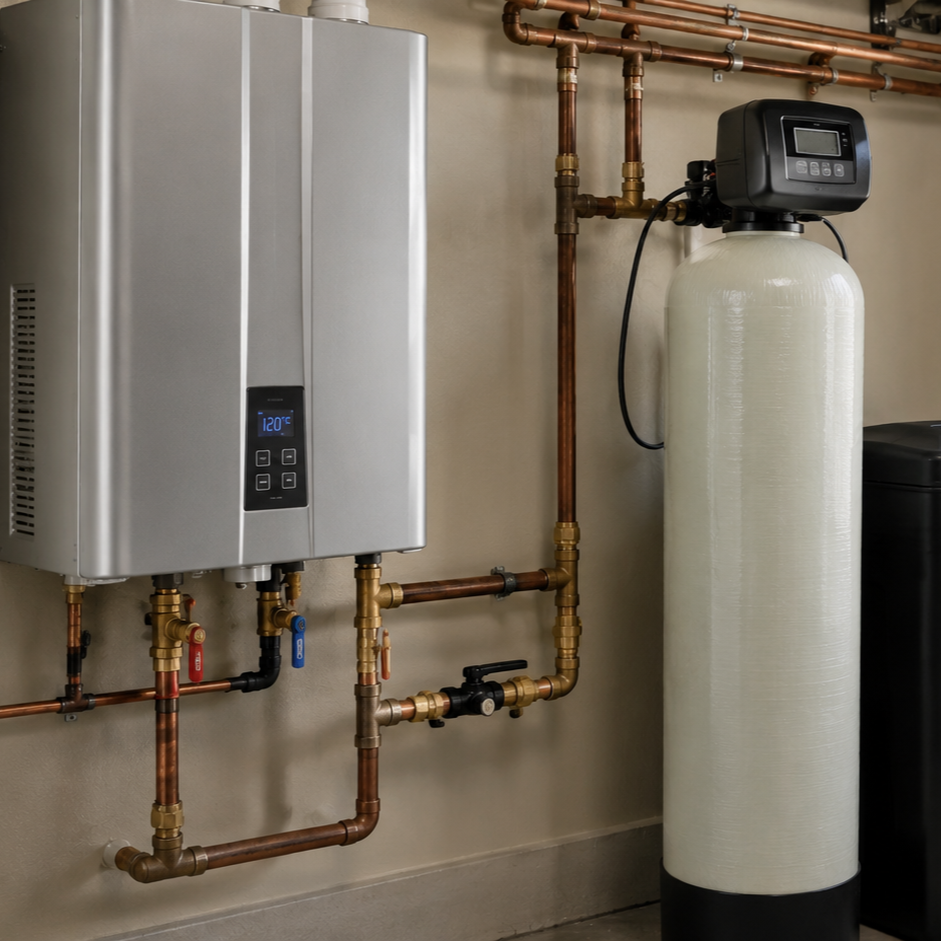
The call comes in around year four or five. A homeowner had a tankless water heater installed, was told it would last 20 years, and now the unit is throwing error codes and struggling to reach the desired temperature. A plumber opens the cabinet, pulls the heat exchanger, and finds it caked in white mineral deposits — the same calcium that leaves rings on shower doors. The homeowner was never told to install a water softener. Nobody mentioned Phoenix's water. The warranty claim gets denied.
That's not an unusual story in the Valley. Phoenix water is hard — among the hardest municipal supplies in the country — and tankless units are far more sensitive to mineral buildup than traditional tank heaters. The decision about whether to add a water softener comes down to the water, the unit, and how much a homeowner wants to spend on prevention versus recurring maintenance.
A tankless heat exchanger is the most scale-vulnerable component in a modern home
Traditional tank water heaters hold 40–80 gallons. When calcium and magnesium fall out of solution during heating, they settle to the bottom of the tank. That sediment causes real problems — reduced efficiency, accelerated corrosion — but it collects in a large, open space. A plumber can flush it out.
A tankless unit is different. Water moves through narrow copper channels inside the heat exchanger, heated by a gas burner or electric element firing directly beneath. Those channels can be 3–5 mm in diameter. When mineral-rich water gets heated fast — going from 55°F to 120°F in seconds — calcium carbonate precipitates and sticks to the copper walls. There's nowhere else to go.
Scale on a heat exchanger acts like a wool blanket wrapped around a heating element: it insulates the very surface designed to transfer heat. The burner fires longer to compensate. Water temperature fluctuates. Flow sensors misread. Eventually, the unit throws error codes — overheating faults, flow failures, temperature instability — that look mechanical but trace back entirely to mineral deposits.
A quarter-inch of scale inside a heat exchanger cuts thermal efficiency by 25–40%. In energy terms, that's roughly $50–90 added to the annual gas or electric bill. And that's before the heat exchanger starts cracking from localized overheating.
Phoenix water runs two to three times the threshold that triggers scale problems
The industry benchmark for tankless-safe water sits at roughly 11 grains per gallon (gpg). Above that, mineral content is aggressive enough that most manufacturers either recommend water treatment or require it as a warranty condition.
Phoenix municipal water — sourced primarily from the Colorado and Salt rivers — runs between 13 and 25 gpg depending on the season and the water source blend. In total dissolved solids (TDS), that's 560–800 ppm. The EPA's secondary guidance level for TDS is 500 ppm. Phoenix routinely exceeds it.
If water tests above 11 gpg, most major tankless brands classify water treatment as a warranty condition — not an optional upgrade. A professional water test takes 15 minutes and is often available at no charge through a licensed plumber.
Scottsdale water tends to run harder than Phoenix Central. Mesa, Gilbert, and Chandler draw from a mix of surface water and groundwater wells that can test even higher. Homes in those communities are almost certainly above the 11 gpg threshold year-round. Not sometimes. Consistently.
Hard water above 11 gpg voids most heat exchanger warranties
Tankless units carry two sets of warranties: a parts-and-labor warranty (typically 1–3 years) and a heat exchanger warranty, which is what actually matters. Heat exchangers are the most expensive component in the unit — replacement can run $700–1,200 in parts alone.
Navien, Rinnai, and Noritz all include warranty language tying heat exchanger coverage to water quality. The exact clause varies by brand, but the substance is consistent: if incoming water hardness exceeds 11 gpg and the owner can't document regular professional descaling or installed water treatment, the heat exchanger warranty is voided.
That creates real exposure for Phoenix homeowners without water treatment. Hard water damage to a heat exchanger leaves visible evidence — scale deposits, pitting, overheating marks. A warranty claim on a failed heat exchanger that shows scale damage, in a market where water tests above 11 gpg, can be denied outright. The inspection makes the case for the manufacturer, not the homeowner.
But there are two accepted remedies: a water softener or salt-free conditioner installed upstream, or professional descaling on an annual or biannual schedule.
A water softener installed upstream solves the problem before water enters the unit
A whole-house water softener removes calcium and magnesium from incoming water before it reaches the plumbing system. Hard minerals bind to resin beads inside the softener tank. The system regenerates periodically using a salt solution to flush the captured minerals out to drain.
The result: water entering the tankless unit carries little to no hardness, so scale doesn't form inside the heat exchanger. The unit runs at designed efficiency throughout its service life. And descaling appointments become optional instead of required maintenance.
Installing a softener alongside a tankless water heater requires a bypass valve on the softener — the heater draws from pre-softened lines. Sizing matters. A two-person home typically needs a 24,000-grain capacity unit; a four-person home needs 32,000–48,000 grains. In Phoenix, where hardness is high, erring toward the larger capacity reduces regeneration frequency and extends resin life. Getting undersized is a common mistake that results in insufficient softening between cycles.
Cost for a whole-house salt-based softener in Phoenix runs $800–2,000 installed, depending on grain capacity and brand. Annual salt cost adds roughly $100–200 per year.
Salt-free conditioners work differently — and have real limits in Phoenix's hardest water
Salt-free "conditioners" use a process called template-assisted crystallization (TAC) to change how calcium and magnesium behave in water. Rather than removing the minerals, they convert them into micro-crystals that stay suspended in the water and pass through without sticking to pipe walls.
| Feature | Salt-Based Softener | Salt-Free Conditioner |
|---|---|---|
| Removes hardness minerals | Yes | No — converts form |
| Prevents scale on the heat exchanger | Yes | Yes (moderate) |
| Requires salt or chemicals | Yes (salt) | No |
| Effective at 20+ gpg | Yes | Reduced effectiveness |
| Affects water taste/sodium | Minor sodium increase | None |
| Maintenance | Salt refills, resin ~10-year life | Filter cartridge changes |
Salt-free conditioners work acceptably for homes with moderate hard water (7–15 gpg). At 20+ gpg — the range some Valley wells regularly hit — their ability to prevent heat exchanger scale drops off. For Phoenix-level hardness, the salt-based softener is the higher-certainty choice.
Water filtration options also include whole-house reverse osmosis systems, which strip nearly all TDS from the supply and eliminate scale concerns for both the tankless unit and the rest of the plumbing. Whole-house RO runs $3,000–6,000 installed. It's the complete answer for households with serious water quality concerns beyond hardness alone — but most homes don't need to go that far.
Annual descaling is the maintenance path for homes without a softener
For a home that already has a tankless unit and no water softener, professional descaling keeps the heat exchanger clean. A plumber isolates the unit, connects a circulation pump, and runs a dilute acid solution — typically a citric acid blend — through the heat exchanger for 45–90 minutes. The acid dissolves calcium deposits without damaging the copper.
In Phoenix, annual descaling is the minimum interval for an unsoftened system. Homes testing above 18 gpg may need it every six months. Signs that descaling is overdue include fluctuating outlet temperatures, slower hot water delivery, and overheating or flow-related error codes.
The cost: $150–250 per service visit. Over a 15-year heater lifespan, annual maintenance visits cost $2,250–3,750. That's more than the installed cost of most whole-house softeners.
The math generally favors a one-time softener installation in the Valley. Exceptions exist — renters who don't own the plumbing, homes with very low tankless usage, and homeowners planning to move within a couple of years. For everyone staying in Phoenix long-term, protecting the heat exchanger from day one is the more economical path.
Frequently Asked Questions
A tankless water heater will operate without one, but in a hard-water market like Phoenix, it will accumulate mineral scale faster than in soft-water areas. The heat exchanger loses efficiency, requires more frequent descaling, and may fail well before its rated service life. Manufacturers recommend water treatment when incoming hardness exceeds 11 gpg — Phoenix's supply regularly runs above that threshold year-round.
It depends on the brand and what the homeowner can document. Most major tankless brands include warranty language tying heat exchanger coverage to water quality. A failed heat exchanger showing visible scale deposits — in a market where water tests above 11 gpg — can result in a denied warranty claim if no treatment was installed and no descaling history exists. The scale damage is visible on inspection, and manufacturers know how to read it.
A salt-based softener removes calcium and magnesium before the water enters the plumbing system. A salt-free conditioner leaves the minerals in the water but changes their crystalline structure, so they pass through without sticking to pipe walls. Both reduce scale. The salt-based softener does so more reliably at Phoenix's hardness levels, especially above 15–20 gpg.
At least once per year for an unsoftened system. Homes testing above 18 gpg may need it every six months to stay ahead of the buildup. Signs that descaling is overdue: fluctuating water temperatures, slower hot water delivery, and error codes tied to overheating or flow restriction.
No. There's no such thing as water too soft for a tankless unit. Some homeowners add a small bypass blend to maintain 2–4 gpg for taste preferences, but that's optional. The heater has no minimum hardness requirement.
If the heat exchanger has been descaled recently and is in good condition, adding a softener can extend its remaining service life and cut future descaling frequency. If the unit already shows significant scale damage or is past 10 years old under Phoenix conditions, it may be more practical to plan for replacement and install the softener alongside a new unit at the same time.
Softened water protects a tankless water heater's heat exchanger, maintains efficiency, and keeps the unit's warranty intact. Simba Plumbing serves Phoenix, Scottsdale, Mesa, Chandler, Gilbert, Glendale, Peoria, Tempe, Surprise, Goodyear, Avondale, and surrounding Valley communities. ROC #327259. (602) 500-2153.
