
What Is a PRV and Does My Home Need One?
Turn on the kitchen faucet, and the water hits the basin hard enough to splash. The toilet fills in under a minute. The ice maker sounds like it's under pressure every time it cycles. These details seem minor — even preferable — until a supply hose fails at 95 PSI instead of 60 and the washing machine turns into a fountain.
High water pressure doesn't announce itself. It works on the plumbing quietly and steadily, wearing down fittings, stressing supply lines, and shortening the life of every appliance and fixture connected to the system. A pressure reducing valve — PRV — is the device that stands between the city main and everything inside the home.
What a PRV actually is
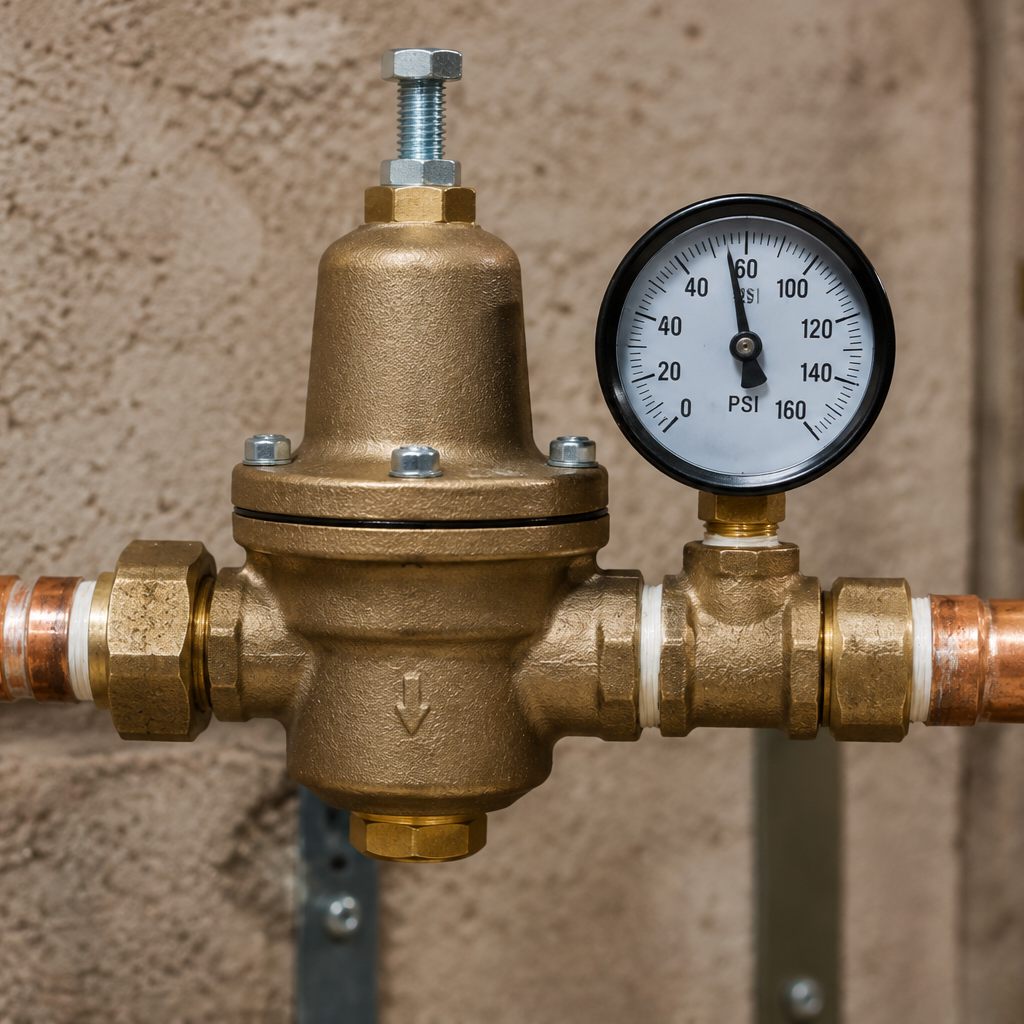
A pressure reducing valve is a spring-loaded mechanical device that installs on the main water supply line where it enters the house. Water enters the PRV body at the city main pressure. Inside the valve, a spring-controlled diaphragm pushes against incoming pressure and restricts flow through a small adjustable orifice. Water exits the downstream side at a lower, stable pressure — typically set between 50 and 60 PSI — regardless of how high the street-side pressure climbs.
The diaphragm responds to pressure changes on the downstream side. If pressure drops due to multiple fixtures opening simultaneously, the diaphragm relaxes slightly to allow more flow. If pressure would otherwise rise — during low-demand periods at night, for example — the diaphragm holds against it. The result is a household that stays within a consistent pressure band instead of swinging between whatever the city's main delivers at different times of day.
PRVs are self-contained, require no electrical connection, and have no moving parts that need external power. The only maintenance they require is periodic adjustment and eventual replacement when the diaphragm wears out or the spring fatigues.
Why city water pressure is often too high for residential plumbing
Municipal water systems are designed to serve entire neighborhoods and maintain pressure through multi-story buildings, fire hydrant demands, and peak morning usage hours. To do all of that reliably, the distribution system often runs at 80 to 100 PSI or higher. That pressure is appropriate at the main — it's too high for residential plumbing.
Residential supply lines, fixture connections, and appliance hoses are typically rated for safe operation at 60 to 80 PSI. Most plumbers recommend a household setpoint between 50 and 65 PSI. Water heaters, dishwashers, refrigerator ice makers, and washing machine hoses all carry pressure ratings — and sustained overpressure shortens their service life by accelerating seal wear and joint stress.
In Phoenix, city water pressure at the meter typically ranges from 80 to 100 PSI under normal distribution conditions. That's before accounting for elevation — homes at the low end of a pressure zone can see even higher readings during overnight low-demand hours when the main isn't pulling pressure down.
A water pressure gauge — available at any hardware store for under $15 — attaches directly to an outdoor hose bib. A 30-second test reveals the incoming pressure. Readings consistently above 80 PSI indicate a PRV is needed or the existing one has failed.
What high water pressure does to a home's plumbing
Pressure isn't just a comfort issue. At 90 or 100 PSI, water moves through the system with enough force to cause measurable wear over months and years.
Supply line hoses. The braided stainless hoses behind washing machines, refrigerators, and dishwashers are rated for a maximum working pressure of around 150 PSI — but that's static burst pressure, not the recommended operating range. Sustained high pressure stresses the end fittings and the rubber or EPDM lining inside the braid. Supply line failures are among the most common causes of serious residential water damage, and overpressure is a significant contributing factor.
Toilet fill valves. The plastic diaphragm inside a toilet fill valve wears out faster under high pressure. A fill valve that should last 7 to 10 years may start leaking or running continuously within 3 to 4 years at 90 PSI. The symptom looks like a failing fill valve — because it is — but the root cause is pressure.
Water heater. A water heater's temperature and pressure relief valve — the T&P valve — is designed to discharge if pressure inside the tank exceeds 150 PSI. Sustained incoming pressure that's already elevated creates a starting point that's closer to that threshold before thermal expansion adds its contribution. High incoming pressure also stresses the tank fittings and the dip tube connection at the cold inlet.
Fixtures and faucets. Faucet cartridges, mixing valves, and aerators all wear faster under sustained high pressure. Dripping faucets often trace back to worn cartridges — which wear out sooner when the water driving through them is at 90 PSI instead of 55 PSI.
Water hammer. High pressure amplifies water hammer — the banging sound when a valve closes suddenly, and the moving water column has nowhere to go. At 90 PSI, a quickly closing solenoid valve on a dishwasher or washing machine creates a pressure wave that reverberates through the pipe. That wave is harmless at 55 PSI; at 90 PSI, it accelerates wear on every joint in the line.
How to know if a home already has a PRV
On most homes built in the last 30 years in Phoenix-area municipalities, the plumbing code required a PRV at installation. It's typically a bell-shaped or dome-shaped brass fitting, roughly 4 to 6 inches long, installed on the main supply line near where the water enters the house. In slab-construction homes, that's usually near the front exterior wall, close to the hose bib or pressure-reducing regulator location.
If a PRV is present, look for an adjustment screw or locknut on top of the dome. That's the pressure setpoint adjuster. An older PRV will often show mineral deposits or slight discoloration from years of water contact.
Homes without a PRV are more common than people expect, particularly in older construction or homes that were built before PRV requirements were standard in a given jurisdiction. A plumber can check the incoming pressure at the hose bib in 30 seconds.
Signs a PRV has failed or needs adjustment
PRVs typically last 10 to 15 years. In Phoenix's hard water (200–400 ppm TDS), the diaphragm and seat see accelerated mineral deposition that can shorten their service life. Common signs of a failing or failed PRV:
| Symptom | What it suggests |
|---|---|
| High pressure throughout the house (over 80 PSI) | PRV has failed open or was never present |
| Pressure that fluctuates widely between fixtures | PRV diaphragm is failing — inconsistent regulation |
| Banging pipes (water hammer) that is new or worsening | Pressure rising above normal; PRV may be failing |
| Toilet fill valves and faucet cartridges failing frequently | Overpressure accelerating wear |
| Water heater T&P valve discharging | Pressure too high; PRV check needed immediately |
| Hissing or vibrating sound at the PRV body | Diaphragm wear, debris on the seat, or pressure spike |
A T&P valve discharging is a situation that needs a plumber the same day — not because of the T&P valve itself, but because it's flagging that the thermal expansion and incoming pressure combination has exceeded the safety threshold.
A water heater T&P valve that discharges frequently or continuously is not simply a worn valve. It is signaling that pressure or temperature inside the tank has exceeded the design limit. Replacing the T&P valve without diagnosing and correcting the pressure source is a dangerous practice — it removes the only safety device preventing a pressure-related tank failure.
PRV replacement: what the job involves
Replacing a PRV requires shutting off the main water supply, cutting out the old valve, and installing a new one. On a slab-foundation Phoenix home, the main shut-off is typically at the meter box near the street or at the PRV location itself. The replacement valve needs to match the existing pipe size — typically 3/4-inch or 1-inch for residential service.
After installation, the new PRV is adjusted to the target setpoint while water is flowing. A pressure gauge on a nearby hose bib confirms the downstream reading. Most plumbers set residential PRVs at 50 to 60 PSI unless specific conditions — a tankless water heater with a minimum inlet pressure requirement, for example — call for a slightly higher setpoint.
In Phoenix, a PRV replacement, including parts and labor, typically runs $250 to $500. High-end or hard-to-access installations push toward the upper end. PRV installation in a home that doesn't currently have one runs similarly — the primary variable is whether the installation point requires new pipe work to accommodate the valve body.
Frequently Asked Questions
The standard residential recommendation is 50 to 60 PSI. This range provides adequate flow for simultaneous fixture use while staying well below the stress range for supply lines, appliances, and fixtures. Some homes with tankless water heaters may need 65 PSI minimum to meet the heater's inlet pressure requirement — the heater's documentation specifies the minimum. Pressures above 80 PSI are too high for long-term residential plumbing integrity.
"Feels normal" isn't the same as being within a safe range. Incoming pressure of 90 PSI doesn't feel uncomfortable at a faucet — it can actually feel like good pressure. A gauge reading is the only way to know. In Phoenix, many homes see incoming pressure well above 80 PSI without any obvious symptoms until something fails.
Most PRVs are rated for 10 to 15 years. In Phoenix's high-mineral-content water, the diaphragm and internal seat experience accelerated scale deposits that can shorten service life. A PRV that was original to a 2005 construction is past the midpoint of its expected service life and warrants an inspection.
Adjusting a PRV setpoint requires loosening a locknut and turning the adjustment screw — clockwise raises the setpoint, counterclockwise lowers it. The catch is confirming the actual downstream pressure after any adjustment, which requires a gauge. Without one, it's impossible to know whether the adjustment reached the target. A plumber can adjust and confirm in one visit.
A PRV that fails open allows full city main pressure to enter the household system — the most damaging failure mode. A PRV that fails closed cuts off all water supply to the house, which is obvious immediately. In practice, most PRVs fail by losing regulation — they begin allowing pressure to creep above the setpoint before eventually failing open. That gradual loss of regulation is why periodic pressure checks catch problems before they become failures.
No. A water softener removes dissolved calcium and magnesium — the mineral content that causes scale and hardness. It does nothing to reduce water pressure. A PRV and a water softener address different problems and are often both installed in Phoenix homes for that reason.
