
Is a Smart Water Shut-Off Valve Worth It for Vacation Homes?
The locks are checked. The AC is set to 85 degrees. The neighbor has the spare key. But somewhere behind the drywall, a washing machine supply hose has been swelling for three years, and it has no idea the house is going to sit empty all summer.
That hose will fail on a Wednesday. It flows at 10 gallons per minute. By Friday, the laminate is lifting off the floor, the drywall is spongy to the knee, and the repair estimate opens at $25,000.
This is the scenario that sells smart water shut-off valves. Not the slow drip under the sink that somebody spots on Monday morning — the catastrophic failure nobody sees for days.
A burst supply line will not wait for the homeowner to return
The failure mode that wrecks vacation homes usually isn't a pipe. It's a supply line. The braided stainless hoses connecting washing machines, refrigerators, dishwashers, and toilet fill valves all carry full household water pressure at all times. When one fails, it opens like a tap: 10 to 12 gallons per minute until someone reaches the shut-off.
A Phoenix summer absence runs 90 days. At 10 gallons per minute, a supply line failure that goes unnoticed for two days dumps over 28,000 gallons of water inside the house. One inch of standing water in a 1,500 square-foot home can hit $25,000 in repairs once flooring, framing, drywall, cabinetry, and mold remediation are counted.
Standard point-of-use leak detectors don't solve this. The puck goes off. Nobody hears it.
How smart shut-off valves actually work
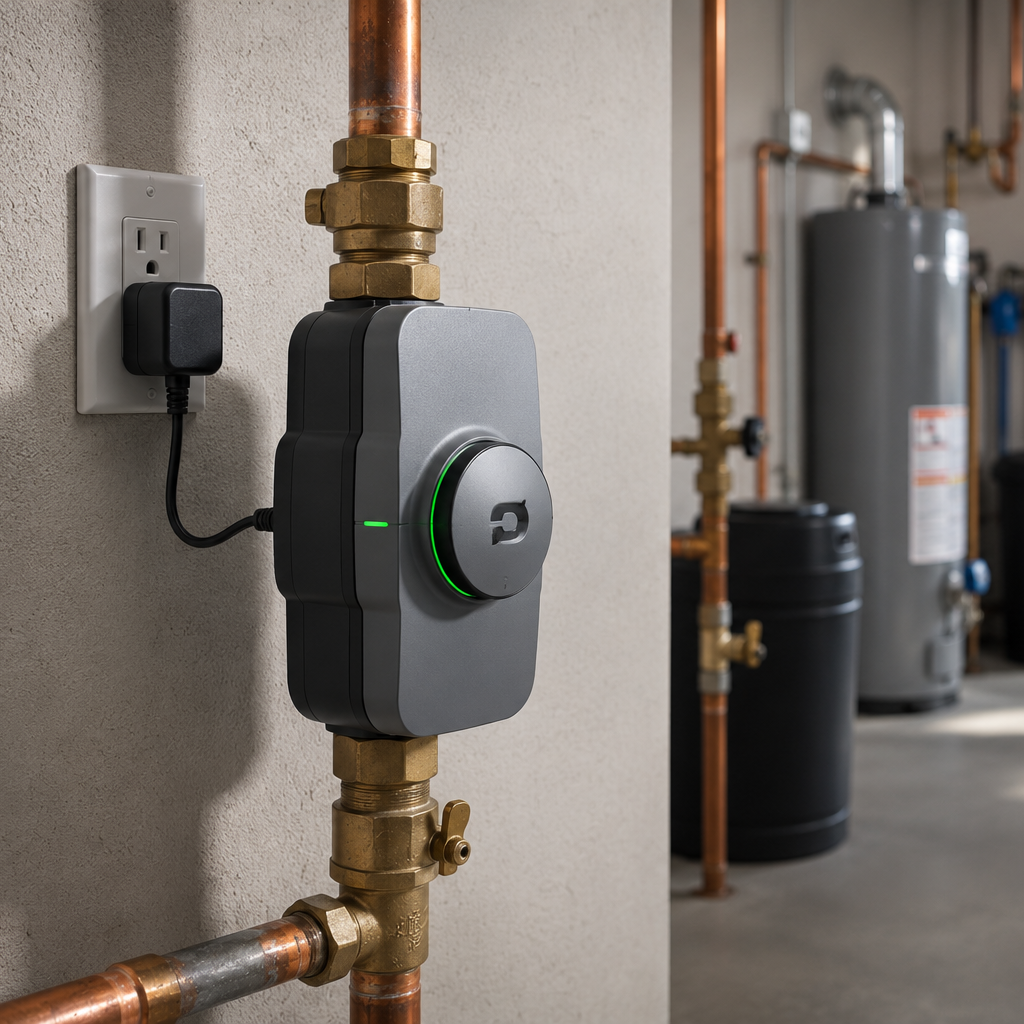
A whole-home automatic shut-off valve installation on the main water line where it enters the house — between the meter and every fixture, faucet, and appliance downstream. The device monitors water flow rate, water pressure, and pipe temperature continuously.
For the first seven to 10 days, the device runs in learning mode. It builds a usage profile — how long a typical shower runs, what the pressure looks like at 2 a.m. when nothing is moving, and how the washing machine changes its flow patterns during a cycle. After that learning phase, any reading outside the baseline triggers a response.
Most devices also run a daily health scan by briefly closing the main valve and watching whether system pressure holds steady. A pressure drop during that closed-valve test means water is moving somewhere — even if the main flow sensor reads zero. That's how a pinhole slab leak or a slow drip inside a wall gets flagged before it reaches the floor.
When an anomaly is detected, the system pushes an alert to the homeowner's smartphone. In away mode — which signals to the device that the house is vacant — it reacts more aggressively. If the alert goes unanswered past a set time window, the valve closes on its own. The house is in Phoenix. The owner is in a meeting in Chicago. The water shuts off.
A standard floor sensor is a smoke detector with no sprinkler system. A smart shut-off valve is both.
Point-of-use sensors vs. whole-home shut-off valves
| Feature | Point-of-use sensor | Whole-home shut-off valve |
|---|---|---|
| Detects leak location | Yes (where sensor sits) | No — flow anomaly detected; location confirmed later |
| Stops water flow automatically | No | Yes |
| Works when the home is vacant | Alert only — no one to act | Closes the valve automatically if alert goes unanswered |
| Catches supply line failure | Only after water reaches floor | Immediately — flow anomaly within seconds |
| Catches slab leaks | No | Yes — daily pressure scan |
| Approximate cost | $20–$80 per sensor | $400–$600 for the whole-home unit |
A vacation homeowner running only floor sensors is betting that any failure will produce standing water close enough to a sensor to trip it — and that someone will respond before the damage spreads.
The cost math
Moen Flo and Phyn Plus — the two most widely installed whole-home systems — cost $400 to $600 for the device. Professional installation runs $150 to $300, depending on access to the main line. All-in: $600 to $900.
The average water damage insurance claim runs $12,500 to $14,000. A prolonged exposure event with mold — the kind a vacant Phoenix home produces in summer — runs $25,000 to $80,000.
A 2020 study tracked 2,306 homes equipped with Moen Flo. Homes with a smart shut-off had 96% fewer water damage claim events than comparable homes without one. Where claims still occurred, leak severity dropped 72% — the difference between a $10,000 repair and a $2,800 repair. The device paid for itself in prevented damage before many owners completed their first month of use.
Water damage is six times more common than fire and eight times more common than theft. It's the second-most-common home insurance claim in the country.
Phoenix-specific conditions that change the calculation
Most smart shut-off valve content is written for cold-climate homes — frozen pipes, basements, crawl spaces. The Valley is different, and those differences affect both the stakes and the installation.
Slab construction. Nearly every Phoenix-area home sits on a slab. The main water line enters near the pressure-reducing valve (PRV), typically close to an exterior wall at the front of the house. That's where the shut-off valve is installed. The plumber needs to locate that PRV point and confirm a standard 120V outlet is nearby.
Extreme summer heat. Phoenix runs 110 to 118°F for weeks at a stretch. A vacant home held at 85 degrees still exposes supply lines in garages and tight undersink spaces to thermal cycling stress. Lines in service five years or more are at real failure risk during Phoenix summers — precisely when vacation homes sit empty.
Hard water. Phoenix tap water runs 200 to 400 ppm total dissolved solids. Calcium and magnesium build up on valve seats and internal sensors. A water softener installed upstream of the shut-off device cuts that mineral load and protects the valve's moving parts. In hard-water markets, annual inspection by a licensed plumber is worth scheduling.
Pressure. City water pressure in Phoenix can hit 80 to 100 PSI at the meter, above the 60 to 80 PSI residential norm. A PRV that fails while the home sits empty creates sustained overpressure downstream. A smart shut-off catches that pressure anomaly. Without one, a failing PRV stays invisible until something downstream gives.
Insurance discounts are real — but require direct inquiry
Carriers have clear actuarial reasons to discount homes with whole-home shut-off valves, and the discount isn't applied automatically.
Farmers Insurance and USAA both offer discounts for homes with qualifying devices. Nationwide, AIG, Amica, and Chubb have partnered with specific device manufacturers on discount programs. Some policyholders report modest percentage reductions; others report saving several hundred dollars per year. The device model, the carrier, and the state all factor into whether a discount applies and how large it is.
Call the insurer before buying the device. Confirm which models qualify and obtain written confirmation before installation. Ask specifically about "automatic shut-off valve discounts" — not generic "smart home" credits — as they're often handled as a separate line item.
Installation is a two-hour professional job
A whole-home shut-off valve is installed in the main water line. The meter shuts off at the street; the existing supply pipe is cut at the correct location; fittings are installed on both sides; the device is sealed and connected; water is restored; and valve function is confirmed. A standard 120V outlet and active Wi-Fi signal are required within reach of the installation point.
Cutting into the main line is a licensed plumber's job. For a standard slab-foundation home, installation typically takes 1 to 2 hours. One technical detail matters: ball valve design is the correct choice for these devices. A quarter-turn ball valve closes completely and reliably. Gate valves — common in older Phoenix homes — can leak when disturbed and aren't suited for a device that opens and closes on an automated schedule.
Frequently Asked Questions
Most devices lose remote monitoring and alert capability when Wi-Fi is unavailable. The valve may still respond to a severe local flow anomaly, but notifications and remote control both require an active internet connection. For vacation homes, enabling auto-reconnect on the router — or adding a cellular backup connection — closes that exposure.
Yes. The daily pressure scan briefly closes the main valve and checks whether the system pressure holds. A slab leak shows up as a pressure drop during that test — water is moving somewhere while the inlet is closed. The device flags that pressure is falling when it shouldn't be. A plumber then uses acoustic or thermal detection equipment to pinpoint the source.
One to two hours for most slab-foundation single-family homes. The plumber shuts off the main at the meter, cuts into the supply line at the correct location downstream of the PRV, fits the device, restores water, tests the valve, and walks through app setup before leaving.
The app displays the alert status and lets you reopen the valve with a single tap. If no water use was expected, the valve stays closed until manually reopened. Homeowners can grant a property manager or trusted contact app access to handle alerts locally without a phone call — which is useful for vacation properties with a neighbor or caretaker on site.
Phoenix water's high mineral content deposits calcium and magnesium on valve seats and internal sensors. A water softener installed upstream of the smart shut-off device cuts that accumulation and extends the life of the valve and sensor. In hard-water markets, annual inspection by a licensed plumber confirms the valve opens and closes cleanly, and the sensor is reading correctly.
The case is strong for any home where the occupants are at work during the day, but it's strongest for properties that sit vacant for extended periods. A supply line that fails while the owner is at the office causes less total damage than one that runs for three days in an empty vacation home. For primary residences, the daily monitoring and slab leak detection capability are the biggest ongoing benefits.
The decision reduces to one question
A smart water shut-off valve costs $600 to $900 installed. A missed supply line failure in a vacant Phoenix home costs 10 to 80 times that. The technology works, the installation is a two-hour job, and the risk it addresses is demonstrably real. For a vacation home sitting empty through a Phoenix summer, the question isn't whether the device is worth it — it's how soon to get it on the wall before leaving.
Schedule an installation — Simba Plumbing handles smart water shut-off valve installation across Phoenix, Scottsdale, Mesa, Chandler, Gilbert, Glendale, Peoria, Tempe, Surprise, Goodyear, Avondale, and surrounding Valley communities. If your vacation home is sitting empty this summer, we'll install the device, confirm the valve and app are working correctly, and walk you through the alert settings before you leave. ROC #327259. Call(602) 500-2153.
