
How Do I Know If My Water Heater Heating Element Is Failing?
The morning shower was fine on Monday. By Wednesday, it was lukewarm. By Friday, the water barely got above body temperature — and that's when the second breaker in three months tripped. The heater is only six years old. The tank shows no leaks. What changed?
In most of those cases, the answer sits inside the tank on a threaded metal rod that hasn't been thought about since the unit was installed: the heating element. It's the part that actually converts electricity into hot water, and when it starts to fail, the symptoms are specific enough that a plumber can usually diagnose the problem before pulling a single tool.
How electric water heater elements work
Electric water heaters contain two heating elements — an upper element near the top third of the tank and a lower element near the bottom. Each is connected to a thermostat that monitors the temperature at that level of the tank.
The upper element fires first when a tank is cold or heavily depleted. It heats the top portion of the water column, which allows hot water to be drawn off relatively quickly. Once the upper zone reaches its set point (typically 120–125°F), the upper element shuts off, and the lower element takes over, heating the larger volume of water in the bottom of the tank.
Think of it as a relay race. If the upper runner drops the baton, the lower runner never gets a chance to run. If the lower runner collapses mid-stride, the upper zone still works — but the tank's capacity drops by roughly 60–70%.
Each element is rated by wattage and voltage. Residential tanks almost universally run on 240V circuits with 4,500-watt elements. Higher-wattage elements (5,500W) are common in larger tanks. The element screws into the tank wall through a threaded port, with a rubber gasket sealing the connection.
What causes elements to fail
The failure mode depends on what's happening to the element itself:
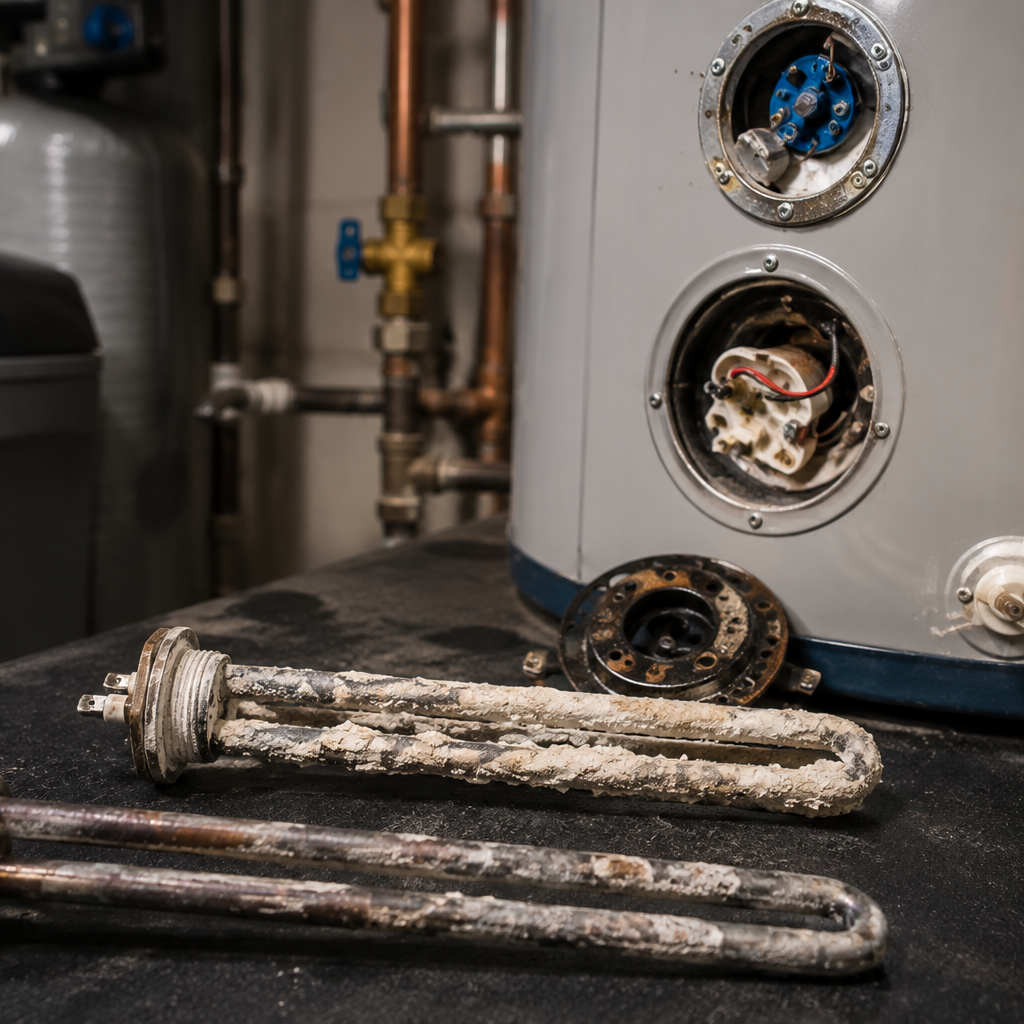
Scale calcification. Hard water carries dissolved calcium and magnesium. When water gets hot, those minerals precipitate out of solution and coat any surface they touch — including the element surface. That coating thickens with each heating cycle, insulating the element from the water. The element has to work harder and run hotter to transfer the same amount of heat. That extra thermal stress weakens the metal sheath, and eventually the element cracks or burns out internally. In the Valley, where tap water runs 300–500 ppm total dissolved solids, this process is the single most common reason elements fail prematurely. A tank in a hard-water market that hasn't been maintained can lose an element in 4–6 years. The national average lifespan without hard water stress is closer to 10–12 years.
Sediment dry-firing. Sediment — mainly calcium carbonate that has settled to the bottom of the tank — can bury the lower element entirely. When the element heats but isn't surrounded by water (it's insulated in sediment instead), it overheats. That's called dry-firing. A dry-fired element usually fails within weeks.
Electrical faults. A failing thermostat can lock the element on continuously, running it past its rated operating temperature. A loose wire connection at the element terminal creates resistance and heat at the connection point, which damages the terminal and sometimes the element itself.
Age and material fatigue. Elements are coated steel or, in higher-end units, Incoloy (a nickel-iron alloy). The coating degrades after years of thermal cycling — the constant expansion and contraction of heating up and cooling down. Once the coating cracks, the bare metal is exposed to the water and corrodes rapidly.
Symptoms of a failing or failed heating element
Lukewarm water at full demand
If the lower element has failed, the upper element still heats the top third of the tank. The first five minutes of a shower may feel normal because that hot water layer is drawn off first. As the tank depletes past the upper zone, the water coming in is cold and unheated — because the lower element can't do its job. The result is a shower that starts warm and turns cold faster than expected.
This pattern — hot water at the start, rapid cooldown — points directly to the lower element. A broken dip tube (the plastic pipe that directs cold inlet water to the tank bottom) can produce a similar symptom by letting cold water mix into the upper hot zone. A plumber testing the system will check both possibilities before replacing any parts.
No hot water at all
When the upper element fails, the thermostat below it may not call for the lower element at all (depending on the tank's wiring configuration). The result is a tank full of cold or barely warm water, regardless of how long it has been sitting. A fully failed upper element is the most common cause of waking up to no hot water in a house where the tank was working fine the night before.
Long recovery time
A tank with a scaled or weakened element doesn't heat as efficiently. What used to take 60–80 minutes to recover after heavy use now takes two hours. The element is present and partially functional, but the scale coating is slowing heat transfer. This symptom shows up before complete failure — it's an early warning that the element is degraded.
Tripped breaker on the water heater circuit
Each element connects to its own breaker leg on a dual-pole breaker (or, occasionally, to a single-pole dedicated circuit). An element that has developed an internal short will draw excessive current and trip the breaker. If the breaker trips once and resets without further incident, the cause might be unrelated. If it trips repeatedly — especially after the tank has been running for 20–30 minutes — the element itself is almost certainly the source.
Do not repeatedly reset a tripping water heater breaker without diagnosis. A shorted element left running can overheat the wiring at the terminal connections, and in rare cases damage the thermostat. Two trips on the same circuit without a clear cause warrant a service call.
Discolored or rust-tinged hot water
Once an element's outer coating has corroded through, the bare metal leaches into the water supply. The hot water will have a slight reddish or orange tint, sometimes accompanied by a metallic taste. This is distinct from the rust that indicates tank corrosion — rust from a failing element tends to appear only in hot water, not cold, and clears up after an element replacement. Rust from tank corrosion doesn't clear up.
Visible damage on the element sheath
An element removed for inspection can reveal its own condition: cracks in the outer sheath, pitting, or burn marks on the metal surface are signs of thermal stress or corrosion damage. A new element surface is smooth and intact. Hard-water scale appears as a white or gray chalky coating over the sheath — heavy enough buildup can be chipped off in flakes. Any cracking, scorching, or pitting in the sheath itself means the element is past its service life, regardless of what a resistance test shows.
Popping or sizzling sounds during heating cycles
Sediment piling up around the lower element makes noise. As the element heats, the water trapped in pockets of sediment flashes to steam and escapes — the same crackling and popping heard when water hits a hot cast iron pan. A sizzling sound can also come from moisture in the terminal connections. Neither sound is normal, and both indicate conditions that accelerate element failure.
How a plumber tests an element
A licensed plumber tests heating elements with a multimeter set to resistance (ohms). The process requires shutting off the water heater breaker, draining enough water to expose the element ports, and disconnecting the wiring from the element terminals.
A functioning residential element reads approximately 10–30 ohms of resistance — the exact value depends on wattage rating (a 4,500W/240V element measures around 12–13 ohms; a 3,500W element reads closer to 16–17). An element that reads zero ohms has shorted internally. An element that reads infinite resistance (OL on a digital meter) has an open circuit — the heating wire inside has burned through. Both conditions mean the element needs replacement.
The plumber will also check for continuity between the element body and the outer sheath using the meter set to continuity mode. Continuity between those two points indicates the element has grounded — the internal wire is making contact with the metal sheath. That condition trips breakers and poses an electrocution risk.
If one element tests failed, request that both elements be replaced at the same time. The labor cost is nearly identical — the second element takes about 10 minutes to swap once the plumber is already there with the tank drained and the tools out. A second service call for the other element typically costs as much as doing both at once.
Element replacement vs. tank replacement
A single heating element costs $20–$50 in parts. With a licensed plumber's time, the total service typically runs $150–$350, depending on the tank configuration and accessibility. That's a reasonable repair — if the tank itself is sound.
The calculus changes when the tank is already old, or the elements have failed because of severe scale buildup inside the tank. Replacing elements in a tank with two inches of calcified sediment at the bottom is a short-term fix. The new element will be operating in the same hostile environment that destroyed the previous one.
A plumber evaluating the repair will factor in the tank's age, the anode rod's condition, and the amount of sediment at the bottom. If the tank is older than 10 years in a hard-water market, element replacement alone rarely makes financial sense — the tank may need to come out within a year or two regardless.
Frequently Asked Questions
Replacing a heating element involves working on a 240-volt appliance while managing water pressure and managing a partially drained tank — tasks that carry real risk of electrical injury and flooding if not done correctly. A licensed plumber can complete the job in 45–90 minutes, test the electrical connections, and verify that the new elements are operating at the correct temperature.
In moderate-mineral water, a quality element lasts 10–12 years. In markets with 300–500 ppm total dissolved solids — typical for the Valley — the realistic lifespan without softened water or routine flushing is 4–8 years. Low-watt density elements (sometimes called "low-watt" or "LWD") run at a lower surface temperature, which means scale deposits at a reduced rate and element life extends noticeably in hard-water conditions.
If the symptom is lukewarm water or rapid cooldown during a shower, replacing the element usually resolves it. If the symptom is slow delivery — hot water takes a long time to arrive at the tap — that's a pipe length and volume problem, not an element issue. No amount of element work changes how long it takes hot water to travel from the tank to the fixture.
Both elements failing simultaneously is uncommon, but it does happen when sediment heavily buries the lower element (dry-firing it) while scale simultaneously degrades the upper one. The result is a tank full of cold water with no active heating. A plumber testing both elements will find one or both failing and can confirm whether the tank itself is still worth servicing.
Yes. A thermostat that's locked in the off position will prevent the element from firing even if the element itself is functional. A plumber testing the system will check both the thermostat and the element — a resistance test at the element terminals is only meaningful if voltage is actually being supplied to them. A good diagnostic process rules out thermostat failure before condemning the element.
Hard water deposits calcium carbonate (limescale) on the element surface. The scale acts as thermal insulation — heat that should transfer to the water stays trapped inside the element sheath instead. That raises the element's operating temperature above its design range, accelerating metal fatigue and shortening the coating's lifespan. A softener that reduces water hardness below 7 grains per gallon extends element life significantly in markets like the Valley.
Popping almost always traces to sediment — calcium carbonate that has settled to the tank floor and surrounds the lower element. As the element heats that sediment layer, trapped water vaporizes and pops through the crust. The element may still be functional when that sound starts, but the sediment conditions accelerating failure are already present. Flushing the tank won't remove hardened calcified sediment; a full tank evaluation is warranted once the popping starts.
