
PEX vs Copper Pipe: Which Is Better for Repiping?
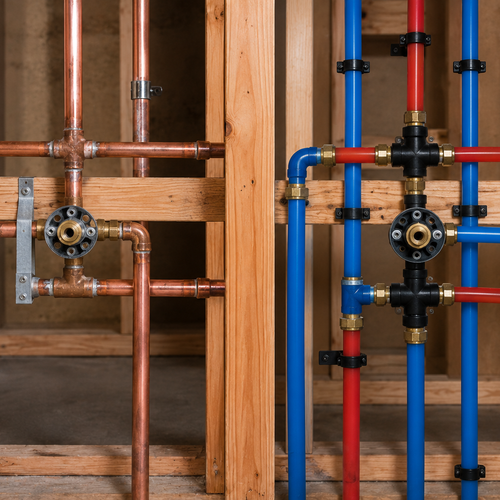
The galvanized pipes in a 1970s home run fine for decades — until they don't. A pinhole leak behind the kitchen wall. Low pressure that gets worse every year. Rust-colored water on the first draw of the morning. When those signs stack up, a plumber usually delivers the same news: the pipes need to come out. And then comes the question every homeowner asks: PEX or copper?
Both materials carry water. Both meet code. Both get installed in residential homes every day. But they behave differently, cost differently, and hold up differently in a hot, hard-water climate — and that last part matters more here than in most of the country.
Why pipe material choice matters in hard-water markets
Water hardness is measured in milligrams of calcium carbonate per liter, or equivalently in parts per million (ppm). Municipal water in the Valley typically runs between 200 and 400 ppm — some areas push higher. At those levels, calcium and magnesium salts deposit on every surface water touches. Inside the copper pipe, the scale accumulates on the inner wall and doesn't stop.
A fresh ¾-inch Type M copper supply line has an inner diameter of about 0.811 inches. A decade of hard-water scale in a high-mineral market can reduce that opening by 10–15%, raising flow resistance and increasing water pressure demands at every fixture downstream. The corrosion process accelerates when water chemistry tips acidic — when pH drops below 7.0, copper leaches into the water supply, and the pipe wall itself begins to thin.
PEX (cross-linked polyethylene) doesn't react with mineral content the way metal does. The smooth polymer interior doesn't give scale a surface to bond to in the same way copper does. That's one reason the material gained favor quickly in high-hardness service areas.
The three types of PEX — and why the differences matter
Not all PEX pipe is the same. There are three manufacturing methods, and the resulting pipe behaves differently under pressure and temperature.
PEX-A is made using the Engel peroxide method. Cross-linking happens while the polyethylene is above its melting point, producing the most uniform molecular structure of the three types. PEX-A is the most flexible, tolerates the widest temperature range, and is the only type that can be repaired using the "heat memory" method — a kinked section can be re-straightened with a heat gun. It requires expansion-style fittings and a specialized crimping tool.
PEX-B is cross-linked after extrusion using a silane moisture-cure process. It's stiffer than PEX-A, somewhat less expensive, and connects using crimp or clamp fittings that are widely available. PEX-B has slightly higher chlorine resistance than PEX-A, which matters in heavily chlorinated municipal systems.
PEX-C uses electron-beam radiation cross-linking. It's the least flexible of the three and more prone to kinking during installation. Most plumbers working on residential repipes don't use PEX-C as a primary material — it has more industrial applications.
For a whole-house repipe, the typical choice is PEX-A or PEX-B, depending on the plumber's preference and the fittings they stock. Either performs well in residential supply lines.
Cost comparison: what a whole-house repipe actually costs
The cost difference between PEX and copper is significant.
| Factor | PEX | Copper |
|---|---|---|
| Material cost per linear foot | $0.50–$1.00 | $3.00–$5.00+ |
| Typical whole-house repipe | $4,000–$8,000 | $8,000–$15,000 |
| Installation time (standard home) | 1–2 days | 2–4 days |
Copper prices track commodity markets and have been volatile. The cost per linear foot can shift between the time a homeowner gets a quote and when work begins. PEX pricing is more stable.
Labor accounts for 60–70% of a repipe job. PEX installs faster because the material bends through walls and around obstacles without an elbow fitting at every turn. A single continuous run from the manifold to a fixture eliminates multiple solder joints — and fewer joints mean fewer potential leak points and less labor per linear foot.
For a 3-bedroom, 2-bathroom single-story home, a PEX repipe typically runs $4,000–$7,000 with licensed labor. The same home in copper typically runs $9,000–$14,000. The gap narrows on large homes where both materials require substantial runs, but PEX maintains the cost advantage throughout.
How PEX and copper handle desert heat
Freeze resistance gets most of the attention in pipe material comparisons — and in cold-climate markets, it's decisive. In a hot-climate market, the concern runs in the opposite direction.
Copper handles high temperatures well. Type M copper, the standard for residential supply lines, is rated for continuous service up to 200°F at 100 PSI — well above any domestic hot-water temperature. Copper doesn't soften, doesn't off-gas, and performs identically at 115°F ambient temperature in an attic as it does at 40°F.
PEX is also rated for service up to 200°F, but the material has one limitation that copper doesn't: UV sensitivity. PEX cannot be used in any application with direct sun exposure. Supply lines that run through an unconditioned garage, along an exterior wall with any gap, or in areas where sunlight can reach them need protection — or a short copper or CPVC transition for those sections.
The other heat consideration is the unconditioned attic. In desert climates, attic temperatures routinely reach 150–160°F during summer. Both materials tolerate those temperatures, but PEX requires support at closer intervals than copper — roughly every 32 inches for horizontal runs versus every 48 inches for copper — to prevent sagging as the material softens at peak temperatures.
Durability: what the lifespan numbers actually mean
Copper pipe in favorable conditions lasts 50–70 years. That track record is real — homes from the 1950s and 1960s still have functioning copper supply lines in low-mineral markets. The caveat is "favorable conditions." Acidic water, chloramine-treated municipal supply, and high hardness can cut that lifespan considerably. In markets where water quality varies by source or changes seasonally, copper longevity becomes less predictable.
PEX carries manufacturer ratings of 25–50 years, depending on the grade, based on accelerated lab testing. The material hasn't been in widespread residential use in the US long enough to confirm 50-year real-world performance across all climates. What field data does show: PEX installed in the 1990s and early 2000s has held up well in residential applications without widespread failures.
Think of it like this: copper is a rigid metal pipe fighting a slow chemical war with the water inside it. PEX is chemically inert to that same water. The question isn't which material is theoretically longer-lived — it's which material will hold up in the specific water chemistry running through the house.
For most homes in a high-hardness market, PEX installed at grade (PEX-A or PEX-B) will likely outperform copper that has spent 20 years fighting 350 ppm water.
When copper is still the right call
Copper makes sense in specific situations despite the higher cost.
Homes with outdoor supply lines that can't be protected from direct sunlight need copper or another UV-stable material for those exposed sections. Copper is also the standard for gas lines — PEX is not rated for natural gas supply — so a home repiping both water supply and gas will use copper regardless.
Some high-end construction projects specify copper for consistent material quality throughout. A custom build where all mechanical systems are specified to a premium standard often gets copper supply lines to match. That's a legitimate choice when the budget supports it.
There's also the installer variable. A plumber who has done copper work for 25 years and carries all the tooling and stock on hand may produce a better copper repipe than a rushed PEX job from someone less experienced with the material. Installation quality matters regardless of what the pipe is made of — proper pressure testing, correct support spacing, and watertight connections determine whether a repipe lasts.
PEX vs copper comparison
| Factor | PEX | Copper |
|---|---|---|
| Material cost | Lower (roughly 1/3 of copper) | Higher, commodity-market variable |
| Labor cost | Lower (faster installation) | Higher |
| Lifespan | 40–50 years (rated) | 50–70 years (ideal conditions) |
| Hard-water resistance | Strong (scale doesn't bond) | Moderate (scale and corrosion risk) |
| UV/sun exposure | Not suitable without protection | Suitable for outdoor use |
| Heat tolerance in the attic | Good with proper support spacing | Excellent |
| Manifold/home-run system | Ideal material for this layout | Cost-prohibitive |
| Gas lines | Not rated | Standard choice |
For most homes being repiped from galvanized or polybutylene supply lines, PEX is the more practical choice — lower cost, better hard-water resistance, and faster installation with fewer joints throughout the system.
Frequently Asked Questions
PEX handles the majority of supply line work in most homes. Exceptions include any section with direct UV exposure — exterior risers, lines running through open garages, or outdoor sections — where copper or CPVC transitions are typically used. Gas lines also require copper or corrugated stainless steel tubing (CSST); PEX is not rated for natural gas.
New PEX can impart a mild plastic taste to water for the first few weeks after installation. Running the tap for a minute before drinking eliminates it during that period. The taste fades as the material cures and is not a health concern. Copper can leach trace amounts of metal into water in homes with acidic supply water, which can produce a metallic taste — particularly noticeable in the first year after new copper installation.
A PEX repipe on a standard single-story 3-bedroom, 2-bathroom home typically takes one to two days. Copper takes two to four days for the same home due to the more labor-intensive soldering process at every joint. Larger homes, two-story layouts, or homes with slab penetrations can add a day to either estimate. Water is off for the duration of active work each day and restored before the crew leaves.
Access is needed at strategic points — near fixture rough-ins, at transitions, and where pipe routes change direction. Plumbers doing a full repipe work to minimize wall damage, but some patching will be required. That drywall repair is typically the homeowner's responsibility unless included in the quote. Clarifying this before work begins avoids surprises after the job.
A PEX manifold system routes individual lines from a central hub — usually located near the water heater — directly to each fixture. Think of it like a circuit breaker panel for water: each fixture gets its own dedicated line and its own shutoff. The advantage is isolation — turning off water to one bathroom sink doesn't affect the rest of the house. Building that same layout in copper is cost-prohibitive because rigid pipe requires multiple fittings at every turn. PEX's flexibility makes the manifold design practical on a repiping budget.
Most repipes follow the general path of the existing supply lines since the fixture locations don't change. In a PEX manifold system, the plumber routes individual lines from the manifold location to each fixture, choosing paths with the fewest obstacles and the smallest number of wall penetrations. The goal is to get from the manifold to the fixture with the shortest run and the least disruption to finished surfaces.
In most cases, yes. Corroded or scaled supply lines create a flow restriction that reduces pressure at every fixture. New pipe — regardless of material — eliminates that restriction. PEX manifold systems improve pressure further because each fixture gets a dedicated line rather than sharing a trunk line with other fixtures. A house that had consistently low pressure at multiple fixtures often shows measurable improvement after a full repipe.
Aging galvanized, polybutylene, or heavily scaled copper supply lines all warrant a professional evaluation before problems get worse. Simba Plumbing serves Phoenix, Scottsdale, Mesa, Chandler, Gilbert, Glendale, Peoria, Tempe, Surprise, Goodyear, Avondale, and surrounding Valley communities. (602) 500-2153.
