
What Is a Water Hammer and How Do You Fix It?
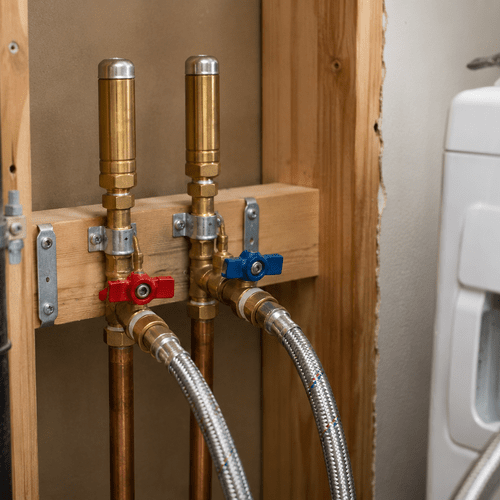
The bang hits at 10 p.m. — a sharp crack inside the wall behind the washing machine, loud enough to make someone look up from whatever they were doing. It happened last week, too, and the week before.
That sound is water hammer, and it doesn't go away on its own.
What water hammer actually is
Water hammer is a pressure surge — sometimes called hydraulic shock — that occurs when flowing water abruptly stops or reverses direction. The force involved is not trivial. Water traveling through a 3/4-inch supply line at a typical household velocity carries real momentum. When a solenoid valve on a washing machine closes in a fraction of a second, there is nowhere for that momentum to go. The water column slams into the closed valve like a piston hitting a dead stop, and the resulting pressure spike travels back through the pipe as a shockwave.
Think of it like a garden hose nozzle suddenly kinked mid-flow. The water behind the kink has to go somewhere — it either expands the hose or rebounds backward. Inside copper supply lines, it rebounds, and the pipe is rigid enough to transfer that energy straight into the wall framing, which is what creates the banging noise.
Pressure spikes during a water hammer event can briefly reach 10 times normal operating pressure — well above the 80 psi limit at residential meters. That kind of momentary force stresses fittings, loosens threaded joints, and can crack soldered copper connections after years of repeated shock cycles.
Why solenoid valves are the most common trigger
Older faucets close steadily. Turning a handle through a quarter-turn over a second or two gives the water column time to decelerate, and the shock dissipates before it becomes a problem.
Modern appliances work differently. Washing machines, dishwashers, ice makers, and toilet fill valves all use solenoid valves — electrically operated gates that snap shut in milliseconds when the control board cuts power. There is no gradual deceleration. The column stops at full speed.
That is why homes with older plumbing that never had water hammer problems start experiencing it after a new appliance gets installed. The supply lines are the same. The trigger changed.
The three physical causes
Waterlogged air chambers
Most residential plumbing built after the 1950s includes short capped stub-outs near the hot and cold valves for washing machines and dishwashers. These are air chambers — vertical dead-ends where air, not water, is supposed to sit. When the water column stops suddenly, the trapped air compresses like a spring and absorbs the shock.
They work well until they fill with water. Air dissolves into pressurized water at the molecular level, and the air pocket in each chamber shrinks over months until it disappears entirely. Once the chamber is full of water, it provides no cushioning. The bang returns.
High supply pressure
Water hammer gets dramatically worse at higher operating pressures because the kinetic energy in the water column scales with pressure. At 60 psi, a valve slam produces a manageable shock. At 100 psi, the same slam produces roughly 2.8 times the stress on pipes and fittings.
Residential supply pressure is supposed to stay between 40 and 80 psi. A pressure regulator at the main line handles that in most homes — but regulators fail, and municipal pressure can spike during demand cycles. Any supply pressure over 80 psi makes water hammer more likely and more destructive.
Loose pipe supports
Supply lines that are not strapped properly do not just amplify water hammer noise — they allow the pipe to physically move when the shockwave hits. A pipe slapping against a joist or stud makes a different, softer thump than the sharp crack of hydraulic shock, and it is worth distinguishing the two because the fixes differ. Running a hand along accessible pipe in the basement or crawlspace often reveals a loose strap quickly.
What water hammer damages over time
Water hammer does not destroy a plumbing system overnight. The damage is cumulative. Soldered copper fittings develop hairline cracks after years of repeated shock cycles. Compression fittings loosen. Rubber seals inside toilet fill valves wear out faster than normal. Flexible braided supply lines — especially those connecting appliances — see accelerated fatigue at the threaded ends.
In slab-on-grade homes, a fitting that cracks under the foundation creates a slow leak that may go undetected for months before it appears as a wet floor or an unexplained spike on the water bill.
In hard water markets, the inside of copper pipe carries a mineral scale layer. Desert-region supply water often runs 200–400 ppm total dissolved solids, which deposits scale that progressively reduces interior pipe diameter. A line already narrowed by scale concentrates the pressure surge further, accelerating fitting stress beyond what a plumber in a soft-water market would expect from the same pipe age.
The damage extends to appliances too. Washing machines, dishwashers, and refrigerators with ice makers all have internal solenoid valves that absorb the rebound from each hammer event. Repeated shock shortens valve life and degrades rubber seals, sometimes triggering appliance failures well before the unit would otherwise have needed repair.
How to fix water hammer
Drain and re-pressurize the system
If the home has air chambers installed, this is the first step. Shut off the main water valve, then open the highest faucet in the house — typically a bathroom sink on the top floor. Open a faucet on the lowest level as well to allow air back in. Let the system drain completely, then close both faucets and reopen the main valve. The air chambers will refill with air as water pressure re-establishes.
This fix costs nothing and sometimes resolves the banging entirely, particularly if the chambers have not been waterlogged for long. If the banging returns within a few weeks, the chambers may be damaged or sized too small for the demand.
Test and adjust supply pressure
A standard water pressure gauge threads onto a hose bib and costs about $12 at any hardware store. A reading taken when no fixtures are running shows the static supply pressure. Anything over 80 psi warrants attention. Anything over 100 psi is actively damaging pipe joints even when water hammer is not audible.
Adjusting a pressure regulator is a plumbing call most licensed plumbers handle in under an hour. The regulator — a bell-shaped fitting near the main shutoff — has an adjustment screw accessible without cutting pipe. If the regulator is older and not responding to adjustment, replacement runs $150–$300 in parts and labor.
Install water hammer arrestors
A water hammer arrestor is a sealed, spring-loaded device — roughly the size of a large marker — installed between the supply valve and the hose connection for an appliance. Inside is a sealed air chamber separated from the water side by a piston. When the valve slams shut, the piston compresses the air on the opposite side and absorbs the shock.
Unlike old-style air chambers, a sealed arrestor cannot waterlog. The trade-off is that the piston wears out over time — most manufacturers rate units at roughly 500,000 cycles, which translates to 10–15 years of daily use on a washing machine. Replacement is inexpensive.
Washing machine connections require two arrestors — one for the hot line and one for the cold — because both supply solenoids fire on fill cycles.
Arrestors are standardized by pipe size and rated by a capacity number that matches the peak pressure they are designed to absorb. The most common residential size fits 1/2-inch connections. The installed cost for a pair of washing machine runs $80–$150, depending on access.
Secure loose pipe runs
Plastic pipe straps every 6 feet on horizontal copper runs is the standard minimum. A strap placed directly upstream of a solenoid valve — within 4 feet — dampens physical pipe movement even when the hydraulic shock itself persists. Plumber's tape (perforated metal strap) works on most pipe materials and is available at any supply house.
When a plumber needs to step in
Arrestors and pressure adjustments handle the majority of water hammer cases. The situations that require a plumber are narrower.
If arrestors do not quiet the banging, the supply line may be undersized for the run length. A 1/2-inch line traveling more than 30 feet from the main loses enough pressure that water velocity at the appliance rises to compensate, worsening the hammer. Upsizing to 3/4-inch corrects that.
Old-style air chambers that have failed structurally — cracked or corroded stub-outs — need to be cut out and replaced with proper arrestors. That is a wall-open job unless pipes run through an accessible basement or crawlspace.
Persistent water hammer in a home where pressure is normal, arrestors are in place, and pipes are strapped suggests the cause is upstream: a failing pressure regulator, a check valve no longer holding, or a supply line layout with too many abrupt turns. Diagnostic work in those cases typically runs $100–$200 before any repair.
Frequently Asked Questions
Water hammer is a genuine stress on plumbing systems, but it rarely causes sudden catastrophic failure. The risk is cumulative — fittings loosen, seals wear, and joints eventually crack from repeated shock cycles. Homes where the banging has gone on for years without attention tend to develop slow leaks more often than homes where the cause was addressed early.
The most common reason is a new appliance. If a dishwasher, washing machine, or ice maker was recently installed and the banging started shortly after, the solenoid valve on that appliance is almost certainly the trigger. The second most common reason is a failed pressure regulator — when the regulator stops controlling pressure, the supply pressure climbs until water hammer appears at the first fast-closing valve it reaches.
PEX is more flexible than copper, which allows it to absorb some of the pressure surge rather than transmitting it rigidly through the wall. Homes that have been repiped in PEX tend to have less severe water hammer noise for that reason. The hydraulic force is still present, however, and arrestors are still worth installing at appliance connections regardless of pipe material.
Not necessarily, but it reduces its severity significantly. Pressure reduction addresses the energy that drives the shock wave. In many cases, applying supply pressure of 60–65 psi stops the banging without additional hardware. In homes where a fast-closing solenoid valve is the primary cause, arrestors are typically still needed even at lower pressures.
Draining and refilling the system takes about 20 minutes. Installing a pair of arrestors at a washing machine connection takes under an hour for a plumber with access to the valves. Adjusting or replacing a pressure regulator is typically a 1–2 hour call. More involved work — cutting in new stub-outs, adding straps to inaccessible runs — is usually a half-day job.
An air chamber is a sealed stub of capped pipe installed during original construction — air fills it and cushions the shock when the water column stops. The problem is that air dissolves into pressurized water at the molecular level, so chambers waterlog and stop working after some years. A water hammer arrestor is a sealed, serviceable device with a piston and spring that provides the same cushioning without ever waterlogging. Arrestors cost more upfront but maintain their function reliably until the piston eventually wears out.
Yes. Tank water heaters connected to high-pressure lines absorb hammer events at the cold-water inlet. Repeated shocks stress the dip tube, the pressure relief valve mounting, and the connections on the tank itself. In hard-water markets where scale is already shortening tank life, water hammer adds another variable that pushes failures earlier.
Licensed plumbers can test supply pressure, inspect air chambers, and install arrestors at appliance connections to stop the banging for good. Simba Plumbing serves Phoenix, Scottsdale, Mesa, Chandler, Gilbert, Glendale, Peoria, Tempe, Surprise, Goodyear, Avondale, and surrounding Valley communities. (602) 500-2153.
