
Is Trenchless Sewer Repair Worth It vs Traditional Excavation?
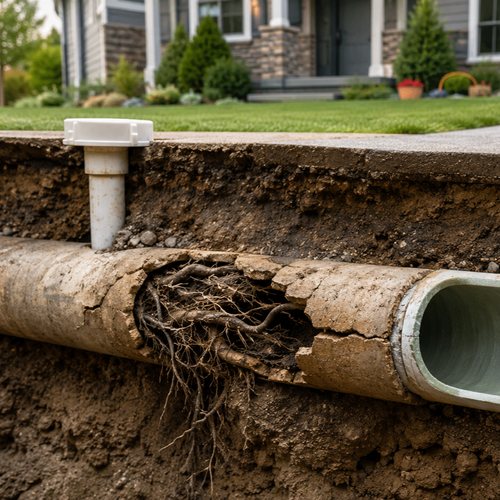
The plumber's camera clears the cleanout and starts moving through the 4-inch pipe. Forty feet in, the image shows a wall of compacted roots threading through a cracked hub joint — and a section of pipe that's lost its round shape entirely. That one image determines which repair method makes sense.
Trenchless repair and traditional excavation are both legitimate options for a failed sewer line. They are not interchangeable. Each works under specific conditions, and picking based on price alone often creates more problems than it solves.
What a camera inspection reveals before any decision is made
No reputable plumber should quote a repair method without first running a camera through the line. The camera reveals the pipe material, the type of failure, and the location of damage relative to structures above grade — three details that drive the method decision entirely.
Pipe material matters because not every material holds a liner. Older orangeburg pipe — a tar-and-wood-pulp composite used in homes built before the 1970s — is typically too deteriorated to accept cured-in-place lining. Clay tile with badly separated joints may or may not qualify, depending on how far the sections have shifted. ABS and PVC lines in sound condition are usually ideal candidates for trenchless methods.
Failure type matters more. A cracked pipe with an intact cross-section is a fundamentally different problem from a pipe that has collapsed under soil movement. The first is usually repairable without digging. The second is not.
How trenchless repair works
Trenchless repair accesses the line through one or two small entry points — typically a cleanout near the foundation or at the property line. No trenching across the yard. No breaking up the driveway.
Two techniques are used, depending on the pipe's condition.
CIPP lining (cured-in-place pipe) inserts a felt tube saturated in epoxy resin into the damaged pipe. Think of the liner like a plaster cast applied from the inside out: the tube is inflated so it presses flush against the pipe wall, then cured with hot water, steam, or UV light. When the resin hardens, it becomes the pipe — the crack sealed behind it, root intrusion locked out. The finished interior diameter is reduced by about 5–10 millimeters, which has no meaningful effect on flow capacity for a standard residential 4-inch line.
Pipe bursting is used when the pipe needs full replacement rather than rehabilitation. A hydraulic bursting head is fed through the damaged pipe from one access point. As it's pulled through, it fractures the host pipe outward while simultaneously pulling a new HDPE pipe in behind it. The result is a complete replacement without excavating across the run.
Both methods typically finish in a single day. The line is usually back in service the same afternoon.
How traditional excavation works
Excavation exposes the damaged pipe by digging a trench from surface level down to the line — typically 5–8 feet deep in residential work, depending on the original installation depth. The failed section is cut out, new pipe is installed, the trench is backfilled, and any surface above — concrete, asphalt, pavers, or landscape — is restored afterward.
Excavation is more disruptive, but it gives the plumber complete visibility. Collapsed pipe, severe lateral offset, sections that have shifted so far that one pipe end sits beside rather than inside the other — all of these get resolved cleanly with excavation in a way trenchless methods cannot fully address.
Restoration is the cost that doesn't always show up in the initial quote. Breaking a concrete driveway or walkway to reach the pipe adds expense before and after the repair itself. Landscaping, irrigation lines, and hardscape all require rebuilding after the trench is filled.
In Valley soils with dense caliche layers, excavation can be significantly more expensive than in other regions. Caliche is a calcium carbonate hardpan that resists digging and sometimes requires jackhammering, which slows the work and adds to labor costs.
Trenchless vs. excavation: where each method fits
| Condition | Trenchless (CIPP or pipe bursting) | Traditional excavation |
|---|---|---|
| Cracked or root-intruded pipe, structurally intact | Preferred | Rarely needed |
| Collapsed pipe or crushed cross-section | Not possible | Required |
| Offset joint — sections shifted laterally more than 30% | Usually not suitable | Required |
| Pipe runs under the concrete driveway or patio | Preferred — avoids restoration costs | Very expensive |
| Pipe runs through an open landscaped yard | Either method works | Can be cost-effective |
| Pipe needs upsizing (e.g., 4-inch to 6-inch) | Pipe bursting can upsize | Excavation also works |
| Multiple failure points across a long run | Either method | Sometimes more practical |
When trenchless is the better call
The strongest case for trenchless repair is a sewer line running under hardscape. Breaking a concrete driveway to excavate adds cost and timeline, then adds it again at restoration. Trenchless avoids both. When the line runs under a paved driveway, covered patio, or tiled surface, the restoration savings alone often offset any premium in the trenchless quote.
Root intrusion into an otherwise sound pipe is the second-strongest case. CIPP lining seals every crack and joint in the treated section simultaneously. Roots cannot penetrate cured epoxy resin, and any intrusion points are locked out rather than just cut back.
Lines that pass under the main structure of a home — where excavation would require working inside the house or disrupting the slab — are also strong trenchless candidates. Two access holes at the cleanouts are far less invasive than opening the floor.
Typical costs for CIPP lining on a 40–60 foot residential line run $3,000–$7,500. Pipe bursting on a comparable run is generally $4,000–$9,000, depending on depth and access conditions.
When excavation is the right call
A collapsed pipe has no interior space to work with. There is nothing to push a liner through, and nothing for a bursting head to fracture cleanly. Excavation is the only option.
Severe lateral offset — where pipe sections have shifted sideways at the joint so one end sits beside rather than inside the other — also requires digging. A liner cannot bridge that kind of gap without solid structural support on both sides.
If the camera footage shows a long run with multiple complete failures rather than isolated problem sections, full replacement by excavation sometimes makes more economic sense than attempting trenchless on a deteriorated line segment-by-segment.
Before committing to either method, a plumber who has reviewed the camera footage can provide a side-by-side quote for both approaches. The gap between those two numbers, factored against restoration costs, usually makes the right call obvious.
Traditional excavation for a 40–60 foot residential sewer run typically costs $4,000–$12,000 for the repair itself. Restoration — concrete, pavers, irrigation, landscape — is additional, and on jobs where the pipe runs under a paved driveway, restoration alone can reach $3,000–$8,000.
What the total cost difference actually looks like
Trenchless repair often quotes higher than excavation for the repair portion alone. That gap narrows or reverses once restoration costs are counted.
Concrete restoration runs roughly $6–$12 per square foot. Breaking and replacing a 200-square-foot driveway section adds $1,200–$2,400 minimum — before accounting for the concrete saw, haul-off, and cure time. A landscaped yard is cheaper to restore, but turf, irrigation, and plants don't recover the day the trench is filled.
When the pipe runs through open ground with minimal surface features, excavation and trenchless are often close in total cost. When the pipe runs under anything of value — a driveway, a patio, a mature landscaped yard, an irrigation system — trenchless nearly always costs less when the full picture is factored in.
Frequently Asked Questions
Yes. The liner seals cracks and small voids from the inside of the pipe. Once cured, it prevents both the outflow of wastewater and the inflow of groundwater at the crack location. Stopping both simultaneously is one of the main advantages of lining over a patch repair.
Field data and industry testing support a 50-year service life for properly installed CIPP liners. The epoxy resin is chemically resistant to sewage, root acids, and soil moisture. It cannot corrode the way cast iron, clay, or Orangeburg degrade over time.
Pipe bursting fractures the host pipe outward, pushing fragments into the surrounding soil. Before any pipe bursting job, the plumber should pull utility locates for gas, electric, and water lines running parallel to the sewer. If another utility runs within 12–18 inches of the sewer line, bursting may not be safe, and excavation is the more controlled option.
Camera inspections are highly accurate at identifying failure types, but may not capture every detail over the long run. If a liner is started and a section won't accept it due to a collapse mid-run, the repair typically becomes a hybrid approach — lining the viable section and spot-excavating the failed section. A reputable plumber will discuss this possibility before starting the job.
Hot-water cure on a CIPP liner takes roughly 2–4 hours. UV-light cure is faster — typically under 2 hours for a residential run. Once the plumber confirms the cure is complete and inspects the finished liner with the camera, the line is ready for normal use.
Yes. Hydro jetting is almost always performed before lining to clear grease, scale, and root debris from the pipe walls. The liner bonds to the host pipe surface, so a clean surface is necessary for the resin to adhere properly. The camera inspection that maps the failure also confirms the pipe is clean and ready for lining.
Caliche can complicate excavation significantly — dense caliche layers sometimes require jackhammering rather than standard digging equipment, adding labor time and cost. If the camera shows the line is a candidate for trenchless repair, caliche in the soil above is one more reason to avoid excavation. If the pipe requires digging regardless of the method, a plumber familiar with local soil conditions can plan accordingly.
A camera inspection shows exactly what's happening inside the line before any repair method is chosen. Simba Plumbing serves Phoenix, Scottsdale, Mesa, Chandler, Gilbert, Glendale, Peoria, Tempe, Surprise, Goodyear, Avondale, and surrounding Valley communities. (602) 500-2153.
