
Cast Iron vs PVC Sewer Pipes: What Should Older Homes Have?
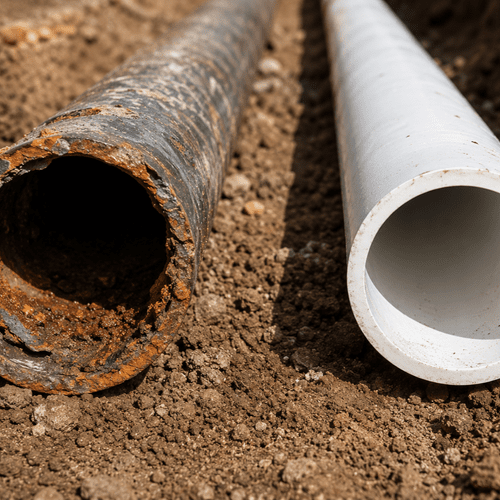
The camera inspection report shows orangey-brown buildup coating the inside of the pipe, with a crack running along the bottom third. The plumber says the cast iron is failing. Now comes the decision no homeowner wants to face: what goes in its place, and is replacement even necessary yet?
Cast iron and PVC are the two materials most homeowners encounter when sewer line work comes up on an older home. Both carry waste out of the house. Beyond that, they behave very differently — which one makes sense depends on what's actually failing, how much of the line is affected, and what the soil conditions look like.
What older homes actually have underground
Not every pre-1975 home has the same pipe material. Before the cast iron versus PVC question gets answered, it helps to know what's actually in the ground.
Homes built before the 1950s may have vitrified clay pipe — fired ceramic sections joined with mortar. Clay is chemically inert and corrosion-resistant, but the mortar joints deteriorated, and the rigid sections cracked under root pressure or soil movement. Homes built in the 1940s and 1950s sometimes have Orangeburg pipe, a pressed-wood-fiber product that was cheap and widely available during World War II material shortages. Orangeburg softens, deforms, and collapses under soil load — there is no relining it, only excavation and replacement.
Cast iron is by far the most common legacy material in residential sewer systems. It handles the comparison with modern PVC on its own terms.
How a cast iron sewer pipe works and why it eventually fails
Cast iron pipe dominated residential sewer construction from roughly the 1890s through the early 1970s. The material was poured into molds, cooled into dense, heavy-walled sections, and joined with lead-and-oakum hub-and-spigot connections. A 4-inch cast iron drain pipe weighs around 10 pounds per foot. It was built to last, and it did — for a while.
The problem is chemistry. Sewage releases hydrogen sulfide gas as organic matter breaks down. In a properly vented drain system, that gas is supposed to exit through the roof stack. When ventilation is reduced — a partially blocked vent pipe, a slow drain that creates a vapor pocket — the gas lingers inside the pipe. Bacteria in the upper portion of the pipe convert it to sulfuric acid. Sulfuric acid attacks iron.
The corrosion happens from the inside out, starting at the top of the pipe where gas accumulates, and the pipe is least likely to be submerged in flowing water. On camera, it looks like pitting, scaling, and eventually perforations or full collapse of the upper wall. A pipe that looks structurally intact on the outside can be paper-thin on the inside.
The timeline depends heavily on how the home was plumbed and what flows through it. Cast iron in a well-vented system with consistent flow can remain serviceable for 80 to 100 years. In a poorly vented or older home where slow drains have been chronic, interior corrosion can become serious within 40 to 50 years.
How a PVC sewer pipe works
PVC (polyvinyl chloride) entered residential sewer construction in the late 1960s and became the dominant material by the early 1980s. Schedule 40 PVC is used for indoor drain, waste, and vent runs. SDR 35 (a thinner-wall specification designed for trench burial at soil loads) is standard for underground sewer laterals.
PVC does not corrode. Hydrogen sulfide gas has no chemical effect on it. Sulfuric acid that would pit cast iron in a decade does not touch a PVC pipe. Roots that find a hairline crack in a cast iron joint or a deteriorated lead-and-oakum connection can also find PVC joints — but PVC joints, when properly installed with solvent cement, have no seam for roots to exploit. The failure points in a PVC sewer are mechanical: a bad glue joint, improper bedding that allows the pipe to sag, or a puncture from a foreign object during excavation.
PVC is also smoother than cast iron. The Manning roughness coefficient for cast iron is roughly 0.012; for PVC, it's around 0.009. That 25% difference in friction means a PVC pipe of the same diameter and slope moves more volume at a higher velocity. Less opportunity for solids to settle and stick.
Cast iron vs PVC: a direct comparison
| Factor | Cast iron | PVC |
|---|---|---|
| Typical install era | Pre-1975 | 1975–present |
| Expected lifespan | 50–100 years (condition-dependent) | 75–100+ years (no in-ground track record beyond ~50 years) |
| Corrosion resistance | Poor (sulfuric acid attack from inside) | Excellent |
| Sound dampening | Very good — dense material absorbs drain noise | Moderate — transmits flushing sounds more readily |
| Flow characteristics | Good (rougher interior) | Excellent (smoother interior) |
| Root intrusion risk | Moderate — deteriorated joints are vulnerable | Low — solvent-welded joints have no gap |
| Weight (4-inch) | ~10 lbs/linear foot | ~0.7 lbs/linear foot |
| Replacement cost | — | $75–$200/linear foot for open-cut replacement |
| Relining (CIPP) | Good candidate | Not typically relined |
| Cold-weather brittleness | No | Yes (rare concern in desert climates) |
| Caliche and expansive-soil resistance | Moderate — settled joints can offset under soil movement | Good — flexible joints tolerate moderate movement |
What actually lives inside an old cast iron drain
Cast iron does not fail all at once. A sewer camera inspection typically reveals a spectrum. The below-grade horizontal run from the house to the street might be in reasonable shape — buried deep, consistently wetted by flow, not exposed to gas accumulation in the same way. The vertical stacks within the walls and the horizontal runs beneath the slab are often where the worst corrosion occurs.
The inside of an old cast iron sewer looks like the underside of a skillet left in a wet garage for 40 years. The original pipe was fairly smooth. Decades of scale, corrosion products, and occasional grease deposits have left a rough, narrowed channel. A 4-inch pipe that originally had a 3.75-inch internal clearance may be down to 2.5 inches. Flow slows, solids accumulate, and the homeowner starts dealing with sluggish drains that seem to be everywhere at once.
Corroded cast iron with perforations or collapsed sections cannot be reliably relined. The lining needs a structurally intact host pipe to cure against. A camera inspection before any lining quote is non-negotiable.
The relining option: not a replacement for replacement
Cured-in-place pipe lining (CIPP) is a process where a felt or fiberglass tube saturated with epoxy resin is inserted into the existing pipe and inflated against the wall. The resin cures into a smooth, joint-free liner inside the old pipe. On a cast iron line that is structurally intact but showing interior corrosion and scale, relining can add 30 to 50 years of service life at a fraction of the excavation cost.
The cost: $80 to $250 per linear foot for CIPP, depending on pipe diameter, access conditions, and the extent of prep work (descaling, root removal). A 50-foot lateral from foundation to street might run $4,000 to $12,000 lined versus $6,000 to $18,000 excavated and replaced with PVC.
Relining is not appropriate when:
The pipe wall has perforated — the liner has nothing to bond to
The pipe has collapsed, requiring excavation regardless
Root intrusion is so severe that a pre-lining clean would take the wall out with it
The pipe has joint offsets greater than about 10 degrees, which prevents the liner from negotiating the bend
When those conditions are present, open-cut excavation and PVC replacement is the only viable path.
What happens when cast iron and PVC need to connect
Older homes undergoing partial sewer replacement often end up with sections of both materials in the same drain system. That is a routine situation. A rubber no-hub coupling with stainless bands — called a "Fernco" after the dominant brand — connects the two materials without chemical incompatibility. The transition is watertight and flexible enough to accommodate the slight movement at pipe joints.
The issue to watch: cast iron pipe in an older home may have been installed at slopes that no longer meet current minimum standards. The minimum slope for a 4-inch sewer line is 1/8 inch per foot. Many older homes were installed at 1/16 inch per foot, which was acceptable under previous practice. When partial sections are replaced with PVC, the plumber has to work with whatever slope exists. A low-slope section can be functional if maintained, but it is more vulnerable to solids accumulation than a properly graded line.
When to replace the whole line vs. targeted sections
The answer comes down to what the camera shows and how much of the line is affected. A professional sewer camera inspection produces footage of the entire run, with footage markers so problem zones can be located for excavation. From that footage, a plumber can categorize each section by condition.
Ask for a written copy of the camera inspection footage and the plumber's written assessment before agreeing to any repair or replacement scope. That documentation belongs to the homeowner and is useful for insurance claims, home sales, and comparing bids.
Targeted excavation and spot repair makes sense when one or two isolated sections have problems — a collapsed joint, a root-infiltrated section — and the rest of the line is in serviceable condition. Full lateral replacement makes sense when corrosion is general throughout the run, when the pipe has multiple perforations, or when the line has chronic root intrusion across multiple joints.
A home built in the 1950s with all-original cast iron plumbing still running in 2025 is unlikely to get a clean bill of health from a spot repair. That pipe is 70-plus years old. The corrosion timeline suggests there is degradation happening beyond whatever the camera flagged.
Frequently Asked Questions
Not necessarily. Age alone does not determine when cast iron needs to go — condition does. A sewer camera inspection will show the actual state of the pipe interior. Cast iron that is scaling but structurally intact may have years of service left, particularly on sections that run with consistent flow. Sections showing perforation, collapse, or severe corrosion need to be addressed regardless of age.
Yes. Rubber no-hub couplings (commonly called Fernco couplings) are the standard way to transition between cast iron and PVC. The connection is watertight, code-compliant, and in common use across the country. Partial replacement using PVC on sections that have failed while retaining intact cast iron is a routine repair approach.
PVC has been in the ground in residential applications for about 50 years. It has not failed the way old cast iron has, and its chemical resistance to the acids that destroy cast iron is well established. Whether PVC will outlast cast iron in buried applications is not something the industry has a definitive answer to yet — it simply has not been in the ground long enough to reach end-of-life data. For new installations, PVC is the current standard.
Sewer lateral work generally requires a plumbing permit in most jurisdictions. The permit triggers a rough-in inspection before the trench is backfilled, which verifies pipe slope, connection methods, and that the work was done correctly. A licensed plumber handles the permit application as part of the project.
Cast iron is noticeably better at absorbing drain noise. A toilet flush in a cast iron stack is nearly silent compared to the hollow rush of water audible in a PVC stack. This matters most in multi-story homes where drain lines run through finished living areas. Some new construction and high-end renovations use DWV cast iron inside the house for exactly this reason, then transition to PVC for the underground lateral.
Schedule 40 has a thicker wall and is the standard for above-ground drain, waste, and vent work inside the home. SDR 35 is a thinner-wall specification designed for buried lateral lines — its wall thickness is proportional to the pipe diameter rather than a fixed measurement. SDR 35 is adequate for the soil loads on a buried sewer line. Schedule 40 is used where pipes may be subject to impact or where fittings make handling stress more likely.
Industry estimates place PVC sewer pipe life at 75 to 100 years or longer under normal conditions. The material does not corrode, root penetration at properly glued joints is rare, and it is not subject to the hydrogen sulfide attack that degrades cast iron. The actual in-service record for PVC sewer pipe only goes back to the 1970s, so projections beyond 50 years are based on accelerated testing and material science rather than field history.
A licensed plumber can assess the full lateral and identify exactly which sections need attention. Simba Plumbing serves Phoenix, Scottsdale, Mesa, Chandler, Gilbert, Glendale, Peoria, Tempe, Surprise, Goodyear, Avondale, and surrounding Valley communities. (602) 500-2153.
