
How Plumbers Find a Hidden Leak Without Tearing Up Walls
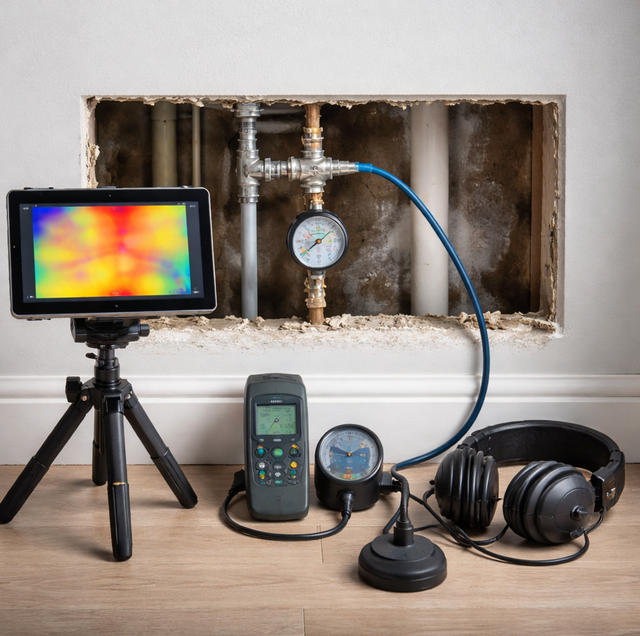
Quick Answer: Plumbers confirm a leak with a pressure or meter test, then narrow it down with acoustic listening, thermal imaging, moisture meters, or tracer gas until they can mark the exact spot. Only a small area gets opened, which protects the rest of the wall or floor.
A damp spot on the ceiling, a water bill that climbed for no reason, the faint sound of running water when every faucet is off. A hidden leak announces itself in small ways long before anyone sees the pipe. The frustrating part is that the wet drywall or the warm floor tile is almost never sitting right on top of the leak. Water travels along framing, follows a pipe run, and surfaces feet away from where it actually escaped. Guessing wrong means cutting a hole in the wrong place, and then another, and then another.
The good news is that a plumber does not have to guess. Modern leak detection reads the pipe the way a doctor reads a body with a stethoscope and a scan before anyone picks up a scalpel. The plumber gathers evidence from the outside first, narrows the search to a small zone, marks the exact spot, and only then opens a patch the size of a paperback book instead of a whole wall.
Confirm First, Then Locate, Then Pinpoint
Good leak detection follows three stages, and skipping any one of them is how walls get chewed up needlessly.
Confirm means proving a leak exists at all and figuring out which system is losing water. A stain could be condensation, a past leak that already dried, or a roof problem rather than a plumbing one. Before any tool comes out, the plumber verifies that pressurized water is actually escaping.
Locate means narrowing the leak to a general area, often a few feet of pipe run inside one wall bay or one section of slab. This is where the search shrinks from an entire bathroom to a small window.
Pinpoint means marking the exact inch. That final mark is what lets the repair open a small access hole rather than a trench. Every tool below belongs to one of these three stages, and the sequence is what keeps the damage small.
The Meter Test That Confirms a Leak Exists
The simplest confirmation uses the water meter, and a homeowner can safely run this step.
With every faucet, toilet, and appliance shut off, the small triangular or gear-shaped flow indicator on the water meter should sit perfectly still. If it creeps, water is moving somewhere it should not.
A plumber takes this further with a static pressure test. They isolate a section of pipe, bring it up to normal household pressure with a gauge attached, then shut the supply and watch the needle. Pressure that holds steady means that section is tight. Pressure that bleeds down over several minutes proves a leak in that section, with no digging required to know it is real. This test also separates a genuine plumbing leak from a fixture that simply runs, like a toilet flapper that never seals.
Acoustic Listening for Slab and In-Wall Leaks
Water escaping a pressurized pipe makes noise. It hisses through the crack, and it drums against soil, concrete, or framing as it sprays. Human ears cannot hear most of it through a wall, but the right microphone can.
Ground Microphones and Sonic Amplifiers: A plumber places a sensitive ground microphone on the floor and moves it across the slab in a grid. Electronic amplifiers raise the faint sound of escaping water to a level the technician can hear through headphones, and the volume peaks directly over the leak. On a slab-under-concrete leak, this is often the primary method, since the pipe is buried and invisible to a camera. For in-wall lines, a contact probe pressed against the drywall or a stud picks up the same rushing signature. The technician sweeps the area, listens for where the sound is loudest, and marks it.
Acoustic work rewards a quiet house. Pros often listen at night or ask that the HVAC and appliances be switched off, because a refrigerator compressor or a running fan can drown out the very hiss they are hunting.
Thermal Cameras for Hot-Water Lines
A leak on the hot side of the system carries its own giveaway: heat. Water leaving a hot line warms the surrounding drywall, subfloor, or slab, and that temperature difference is invisible to the eye but obvious to an infrared camera.
The thermal camera renders a wall as a map of temperature, painting warmer areas in one color band and cooler ones in another. A hot-water leak shows up as a bright plume spreading out from the pipe, often in a shape that traces the water's path through the material. Cold-water leaks can register too, because evaporating moisture cools a surface below the temperature of the dry drywall around it, leaving a cool signature instead of a warm one. The camera does not see water directly, so a plumber pairs it with a second method to confirm before opening anything, but it is fast for scanning a large ceiling or floor and spotting where to look closer.
Moisture Meters That Map the Wet Zone
Once the search has narrowed, a moisture meter answers a precise question: exactly how far does the wet area reach, and where is it wettest? Two styles do the job.
A pinless meter presses a flat sensor pad against the surface and reads moisture a short depth into the material without marking it. A pin-type meter uses two small probes that press in slightly and measure electrical resistance, since wet material conducts more readily than dry. The plumber walks the meter outward from the suspected spot in every direction, watching the reading climb toward a peak and fall off past it. That peak marks the core of the wet zone, which sits close to the leak itself. Mapping the edges also tells the repair crew how much material dried out and may need attention once the pipe is fixed.
Tracer Gas for the Leaks That Stay Hidden
Some leaks refuse to make noise or show heat, especially a slow weep, a leak under a thick slab, or a drain line that only leaks when water is flowing through it. For those, plumbers turn to tracer gas.
The technique introduces a safe, non-toxic gas blend, commonly a mix of hydrogen and nitrogen, into the emptied and isolated pipe. The gas molecules are far smaller than water, so they escape through the same opening the water uses and rise up through the slab or wall to the surface. A handheld gas detector then sweeps the floor or wall and alarms at the exact point where the gas surfaces. Because the gas follows the true path of the breach rather than where water pools, tracer gas is one of the most precise pinpointing methods available, and it works on lines that are otherwise silent.
Isolating Supply Versus Drain, Hot Versus Cold
A leak is easier to find once the plumber knows which pipe to blame, and separating the systems is part of the detective work.
Supply versus drain: Supply lines stay under constant pressure, so they leak whether or not anyone is using water, and they respond to a pressure test. Drain lines only carry water when something upstream is draining, so a leak there shows up when a sink runs or a tub empties, then stops. If a stain appears only after a shower, the drain or the shower pan is the suspect, and the plumber may run a controlled flow test while watching the moisture meter rather than pressurizing the line.
Hot versus cold: On the supply side, shutting off the water heater's output and re-testing tells the plumber whether the losing line is hot or cold. A leak that persists with the heater isolated is on the cold side. This split matters because it points the thermal camera and the ground microphone at the right pipe from the start, which shortens the search and shrinks the hole.
Why Pinpointing Saves the Wall and Floor
The whole reason for this careful sequence is the size of the eventual opening. A blind approach cuts wherever the stain is and hopes the pipe is behind it. A pinpointed approach cuts a single small access hole exactly over the marked spot, so the repair reaches the pipe on the first try.
That difference is the whole value. One neat drywall patch is a quick paint-and-forget repair. A slab leak marked to the inch means a small core through the concrete rather than a torn-up floor. Tile, hardwood, cabinetry, and finished basements all survive intact when the plumber knows precisely where to reach. Less demolition also means less to rebuild afterward, and the repair itself proceeds faster because nobody is chasing water blindly through the structure.
Repair Options Once the Leak Is Found
With the leak marked, the fix depends on the pipe and its location. A pinhole in an accessible copper or PEX supply line is often handled with a section cutout and a coupling or a short splice. A leak inside a slab may be repaired at the spot through a small core, or, for a line that has failed in more than one place, rerouted through the wall or ceiling so the old buried run is abandoned and a fresh line takes over. A leaking drain joint may need the fitting reworked rather than the pipe replaced.
There is a safety line to draw here. Leak location and repair are pro work, and one situation raises the stakes.
Water near outlets, switches, or a panel is a shock hazard. If a leak has reached anything electrical, cut the power to that area from a dry spot before going near the water, and keep the electrical and plumbing work in the hands of licensed trades.
The meter test and the main shut-off are fine for a homeowner to handle; opening walls around live wiring is not.
Frequently Asked Questions
Yes. A pressurized supply leak can be confirmed by pressure loss on a gauge long before any moisture reaches a visible surface, which is common with a leak spraying into open soil under a slab or into a wall cavity with good drainage. In those cases, the acoustic listening and tracer-gas methods do the locating, since there is no stain to guide the search at all.
On a clear signal, acoustic and tracer-gas methods routinely mark a leak to within a few inches, tight enough to open a single small access hole. Accuracy drops when the site is noisy, when multiple leaks overlap, or when the pipe sits under thick or reinforced concrete, so a careful technician cross-checks two methods before marking the final spot rather than trusting one reading.
It does. Metal pipes such as copper carry acoustic sound farther along the run, which can make the leak seem to be in a slightly different place than it is, so the plumber accounts for that travel. Plastic lines like PEX and PVC dampen sound more, so tracer gas or thermal imaging often does better on them than listening alone.
No, those are two separate jobs. Repairing the pipe stops new water from escaping, but the drywall, insulation, framing, or flooring that already got wet still has to dry out and may need replacement to prevent mold. This is why the moisture-mapping step matters beyond finding the leak, since it defines how much material was soaked and needs drying after the pipe is sound.
You can safely do two things: run the meter test with all water off to confirm something is leaking, and shut off the main supply to stop the loss while you wait. Beyond that, resist opening walls or probing near wiring. Note when the leak appears, such as only during a shower or constantly, because that timing tells the plumber whether to suspect a drain or a supply line before arriving.
A slab leak is buried in concrete, so a plumber cannot use a pipe camera or a visual scan and must rely almost entirely on ground microphones and tracer gas. Concrete also carries and reflects sound, which can smear the acoustic signal, so slab work usually takes longer and relies more heavily on cross-checking two methods than a wall leak that can be probed and listened to directly.
Hear water running behind a wall — book a non-invasive leak locate before it spreads. Simba Plumbing LLC serves Phoenix and the Valley. ROC 327259. Call (602) 500-2153.
