
What Causes a Water Heater to Leak From the Bottom?
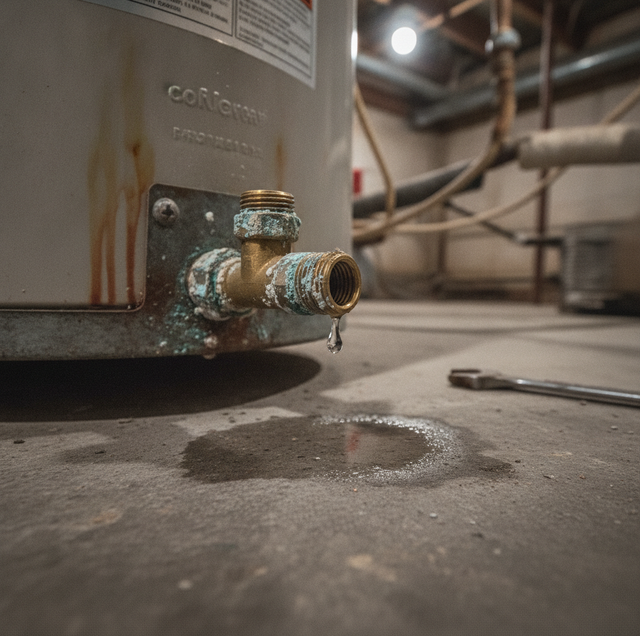
A puddle spreading under the water heater sends most people straight to worst-case thinking, and understandably so. The trouble is that a wet floor tells you almost nothing on its own. The same puddle can come from a fitting you can tighten by hand or from a tank wall that has quietly rusted through. Those two endings are worlds apart, yet the water looks identical either way. What separates them is not the size of the puddle but where the drip actually starts.
So before you write a check or write off the heater, trace the water back to its origin. The list of things that leak at the base of a tank is short, and once you know it, reading your own heater is a matter of ruling suspects out one at a time.
Water at the Base Comes From a Short List of Sources
Water at the bottom of a heater almost always traces to one of four things: the drain valve near the base, the temperature-and-pressure (T&P) relief valve, a loose pipe or fitting on the connections above the tank, or the steel tank itself corroding through. The first three are individual parts, and when one leaks, you replace or tighten it, and the heater keeps running. The fourth is different in kind, not degree. The tank is the vessel that holds every gallon, so once its wall gives out, there is nothing left to repair.
That is why tracing the source matters. A drip from a valve and a seep from a seam feel like the same problem while you are mopping the floor, but one is an afternoon repair, and the other is a new appliance.
The Repairable Causes
Start with the drain valve, the spigot-like fitting near the bottom used to empty the tank for maintenance. It sees little use; its washer or seat can dry out, and a slow weep from it lands right at the base, exactly where a scary leak would show up. A snug quarter-turn or a replacement valve often ends it, and neither touches the tank.
Next is the T&P relief valve, usually threaded into the top or upper side of the tank with a discharge tube running down toward the floor. This is a safety valve; its purpose is to open and release water if pressure or temperature inside the tank climbs past a safe threshold. Water at the bottom of that tube is worth reading carefully, because the valve may be doing exactly what it should rather than failing.
Finally, look higher than the tank. The cold-inlet and hot-outlet connections, the nipples, and any flex line above the heater can loosen and drip. That water runs down the outside and gathers at the base, so a leak born a foot up can pose as a bottom leak. Wiping those upper fittings dry and watching which one beads again usually settles it.
The Leak With No Repair: A Corroded Tank
The failure nobody wants is the tank wall itself. A steel tank fights rust from the inside for its entire life, protected by a glass lining and a sacrificial anode rod that corrodes in the water's place. Once that protection is spent, the steel gives up, and the weakest spots are low on the tank and along the welded seams, where sediment settles and holds moisture against the metal. When corrosion finally opens a pinhole, water weeps from the body rather than from any fitting you can name.
There is no fix for this. You cannot tighten a rusted-through wall or swap it like a valve, because the wall is the tank. The sign is water that appears to come from the shell or a seam, with every valve and connection above it bone dry, usually on an older unit. When that is what you see, the conversation is about replacement.
Why Hard Water Speeds the Whole Thing Up
In many areas, the water is hard, and hard water is unkind to tanks all year, not for one season. Every gallon carries dissolved minerals that drop out as sediment on the tank floor. That layer does two quiet kinds of damage. It bakes onto the bottom above the burner or element, forcing the heater to work harder and hotter, and it traps water against the steel while burning through the anode rod faster, the exact chemistry that rusts a tank from the inside.
Flushing is the countermeasure, and it earns its keep here. Draining the sediment on a regular schedule keeps the layer thin, spares the anode, and gives the tank a real shot at its full service life. It will not resurrect a wall that has already rusted through, but on a healthy heater, it is the single habit that most reliably buys years. A leak from the body of an older, hard-water-fed tank, by contrast, is usually the sediment story reaching its end.
Where the Water Starts, and What It Tells You
| Where the drip begins | What it means |
|---|---|
| Drain valve near the base | Loose or worn valve, usually a repair |
| T&P valve discharge tube | Safety release or faulty valve needs a look |
| Fitting or flex line above, running down | Loose connection, repairable |
| Shell or welded seam of the tank | Internal corrosion points to replacement |
Frequently Asked Questions
Sort it by the part. A drip from the drain valve, a discharge from the T&P valve, or water off a loose union or flex line are all component leaks, and the heater lives on after the fix. Beads on the tank's outer shell or a welded seam, with every fitting above dry, point to the steel wall rusting through, which has no repair. On a gas unit, rule out condensation too: cold incoming water can sweat the tank on a humid day and drip harmlessly, mimicking a leak that isn't one.
Towel the entire unit and the floor completely dry, then watch it. Check the drain valve, follow the T&P discharge tube down, and inspect each threaded connection and flex line up top. The first spot to redevelop moisture is your source. Slipping a dry paper towel around a suspect fitting makes a slow weep obvious, since the paper darkens exactly where the water is, and that beats guessing when water at the base may have started a foot higher.
Either is possible. If pressure or temperature in the tank spikes, the T&P valve opens on purpose to protect you, so recurring discharge often signals real over-pressure rather than a bad valve. A frequent cause is thermal expansion on a closed plumbing system: heated water has nowhere to go, pressure climbs, and the valve vents. The remedy there is a thermal expansion tank to absorb that swing. If pressure is normal and the valve still weeps, the valve itself is likely worn and due for replacement.
Yes. Hard water's minerals settle as sediment that holds heat and moisture against the steel and consumes the sacrificial anode rod faster, both of which speed internal corrosion. Flushing clears that sediment before it can insulate the bottom or feed the rust, which is why a periodically flushed heater in hard water tends to outlast a neglected one. Pairing regular flushes with an anode-rod check and treating the incoming water most directly extends the tank's usable years.
Shut off the cold-water supply at the valve above the heater to stop the tank from refilling. Then kill the heat source: flip the breaker for an electric unit, or turn the gas control to off (or close the gas shut-off) on a gas unit, so it can't keep firing on a draining tank. Clear the area and get a plumber out. Cutting water and energy first contains the mess and removes the safety risk while the source is diagnosed.
Storage tank heaters generally run around a decade, though hard water can cut that short, and diligent flushing can stretch it. Age alone isn't a verdict, but pair it with clues: rust-tinted hot water, corrosion creeping around the base or seams, weeping from the shell, or a tank that vents its T&P valve more often. When an older unit shows rust at the seams and moisture on the body, it is telling you the wall is thinning, and planning a replacement beats waiting for a rupture.
Putting the Clues Together
A water heater leaking at the base is two very different problems wearing the same puddle: a part you can replace, or a tank you cannot. The drain valve, the T&P valve, and the connections above are all fixable, while a corroded shell or seam is the end of that heater's road. The reliable way to tell them apart is to dry the unit, watch where the water returns, and trace it to its true origin. And because hard water quietly drives the corrosion that ends tanks early here, keeping sediment flushed out is the habit that gives yours the longest run.
If water is pooling under your water heater, we can trace the source and tell you whether it's a repair or a replacement. Simba Plumbing LLC serves Phoenix and the Valley. ROC 327259. Call (602) 500-2153.
