
What Causes Indoor Pipes to Burst?
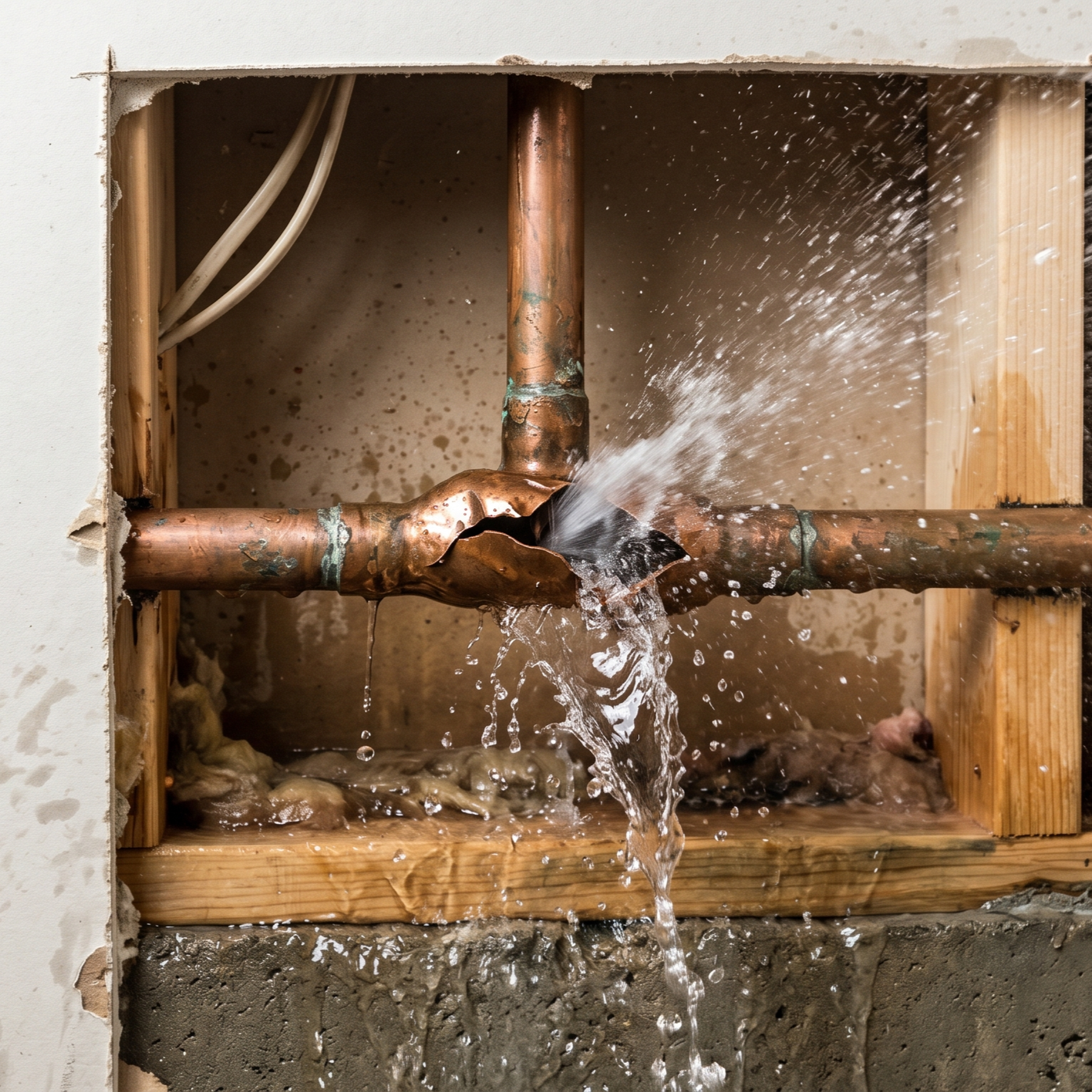
The first sign is usually a sound — a muffled pop behind drywall, or a sudden pressure drop that turns a shower to a trickle mid-rinse. By the time a pipe bursts indoors, the failure has typically been developing for months. Understanding what actually causes a pipe to give way helps a homeowner catch the warning signs before a slow problem turns into a flooded room and a $10,000 remediation bill.
High water pressure is the most common cause
Residential supply lines are engineered for water pressure between 40 and 80 PSI. When static pressure runs higher than that, every fitting, valve, and section of pipe takes a constant mechanical beating.
A pipe doesn't fail under high pressure the way a balloon pops — it fails the way metal fatigues. Each pressurization cycle stresses the pipe wall at micro-fracture points. Solder joints at copper elbows loosen over years. Threaded fittings begin to weep. CPVC, common in homes built from the 1970s through the 1990s, becomes brittle with age and can crack sharply under pressure spikes.
In many neighborhoods, municipal supply pressure runs 90 to 110 PSI. Without a properly functioning pressure-reducing valve (PRV) at the main, that pressure transfers directly into the home's distribution system, where pipe walls and fixture connections weren't designed to handle it indefinitely.
A gauge test at the hose bib takes two minutes and costs nothing beyond the $20 gauge. Anything above 80 PSI warrants a PRV inspection. Above 100 PSI, most fixture warranties are void and pipe failure risk climbs substantially.
Water hammer splits fittings over time
Water hammer happens when a fast-closing valve — a washing machine solenoid, a dishwasher inlet, a quick-turn ball valve — stops a moving water column almost instantly. That column has momentum. When it stops, the kinetic energy redirects as a pressure spike that can briefly reach several hundred PSI.
Think of it like a semi-truck braking from 60 mph in under a second. The contents keep moving even after the container stops. Each pressure spike is brief, but repeated spikes crack fitting joints, split soldered connections, and eventually fracture pipe walls — especially at 90-degree elbows where force redirects.
Water hammer arrestors, small spring-loaded chambers installed at the appliance connection, absorb the spike cleanly. Without them, every laundry cycle or dishwasher fill delivers a small shock to the same vulnerable points until something gives.
Corrosion hollows pipe walls from the inside out
Galvanized steel pipe, common in homes built before 1970, develops rust scale on the interior wall over decades. That scale thickens year after year, narrows the water path, and makes the pipe increasingly brittle. A corroding galvanized line doesn't fail all at once — it develops pinhole leaks first, then joint failures, and eventually a full split under normal operating pressure.
Copper corrodes differently. In homes with low-pH (acidic) water, copper develops pitting — small craters in the pipe wall that grow inward over years until the wall is too thin to hold pressure. Hard water creates a different problem: scale deposits at fittings restrict flow and trap moisture against metal joints, accelerating corrosion from the outside.
Polybutylene pipe, installed widely between the late 1970s and mid-1990s, fails through a chemical mechanism. Chlorine compounds in treated municipal water oxidize the polymer from the inside, causing it to flake and crack. The pipe looks intact from the outside until it doesn't — and then it fails without warning at a fitting or mid-run.
Thermal stress damages plastic pipe in hot climates
Pipe bursts from freezing are uncommon in the Valley but not impossible. During the occasional hard freeze that drops overnight temperatures below 28°F, pipes in unconditioned attic spaces, exterior walls, or unheated garages lose heat faster than the water inside them can retain. Water expands roughly 9% when it freezes — in a sealed pipe section, that expansion generates enough internal pressure to split copper or crack CPVC. The burst often doesn't occur at the frozen section itself; it occurs downstream, where the thawing ice plug releases the pressure buildup all at once.
Heat creates the opposite problem for plastic pipe. Attic pipe runs in desert climates can see ambient temperatures of 130°F to 150°F on a summer afternoon. CPVC has a maximum service temperature around 200°F, but prolonged exposure to high heat accelerates the brittleness that develops with age. Combined with any UV exposure from gaps in attic insulation, CPVC in hot attic runs fails earlier than the same pipe installed in a cooler climate.
Foundation movement creates stress points
Expansive clay-based soil — common in older neighborhoods across the Valley — swells when wet and contracts during dry months. That movement shifts a home's slab in ways that create mechanical stress on pipes embedded in or passing through it.
Supply lines and drain lines that pass through slab penetrations are particularly vulnerable. As the foundation shifts, the pipe rubs against the concrete edge. That repeated contact wears a groove in the pipe wall. The same shift-and-settle cycle stresses solder joints in copper supply lines, loosening connections that were originally watertight.
A sudden pressure drop throughout the entire house — not just at one fixture — combined with a spike in the water bill often indicates a supply line failure under the slab or inside a wall. That combination warrants immediate professional leak detection rather than a wait-and-see approach.
Aging materials fail under normal operating stress
Not every burst pipe involves a dramatic triggering event. Sometimes a pipe simply reaches the end of its service life and splits under conditions it handled easily when new.
CPVC installed in the late 1980s is now approaching or past its 30-to-40-year service life in hot climates. Galvanized steel in pre-1960s homes has been corroding for 60 or more years. Polybutylene — still present in some homes that have never been repiped — can fail at any fitting or compression joint without visible prior symptoms.
A home that has had recurrent pinhole leaks in copper, multiple failed joints within a few years, or unexplained pressure drops is showing a systemic signal. Spot repairs extend the calendar on a single section; they don't reset the overall condition of the system.
Severe clogs can rupture drain lines
Most clogs cause slow drains or backups. A deep, fully obstructed line creates something worse: a pressure differential. Water entering the pipe from above has nowhere to go. In older drain lines — cast iron, galvanized, or compromised ABS — that trapped pressure can split a section that was already weakened by corrosion or root intrusion.
This mechanism is less common than supply-line failures, but it explains why a stubborn recurring clog should be cleared professionally rather than hammered with chemical drain cleaners that corrode the pipe wall further.
Warning signs that a pipe is failing
Pipes rarely fail without precursors. The signals are easy to miss or attribute to something else, but they follow consistent patterns:
Discolored water from a specific fixture — rust-brown, orange-tinged, or yellowish — indicates active corrosion in the line serving that outlet. If the discoloration appears only on the hot side, the problem is likely in the water heater supply or tank; if it's on both sides, the distribution line itself is corroding.
Banging or knocking sounds inside walls after appliances cycle points to water hammer at the connection. A persistent hissing or ticking from a wall cavity with no fixture running suggests a slow leak losing pressure against the pipe wall.
Visible moisture at a fitting, pipe sweating that doesn't dry out between days, or a damp patch on drywall that keeps returning after drying out indicates a weeping joint or pinhole that's wet enough to migrate through the wall material.
A pressure drop at all fixtures simultaneously — not just one room — signals either a PRV failing or a developing supply-side breach. Conversely, pressure that suddenly spikes and makes faucets hiss suggests the PRV has failed open.
A household water bill that jumps 20–30% with no corresponding change in usage almost always means the water is going somewhere other than fixtures.
Frequently Asked Questions
Yes. In desert climates, pipe bursts are more commonly caused by high water pressure, aging or degraded pipe materials, water hammer, and foundation movement than by freezing. Freezing remains a low but real risk during rare hard freeze events, particularly for attic-run pipes and pipes in unheated garages.
Shut off the main water supply immediately — typically at the main shutoff near the water meter or at the PRV on the main supply line entering the home. This stops new water from entering the failure point. Do not run fixtures or flush toilets until a licensed plumber has assessed the line and restored pressure safely.
A 1/2-inch supply line running at 60 PSI releases roughly two gallons per minute. A pipe that goes undetected for eight hours releases close to a thousand gallons. Drywall, insulation, subfloor, and framing absorb water quickly, and mold colonization in a saturated wall cavity can begin within 24 to 48 hours of the initial breach.
Polybutylene has the highest known failure rate of any residential pipe material due to chlorine degradation from the inside out. Galvanized steel fails through corrosion, particularly at threaded joints. CPVC becomes brittle with age and heat exposure. Copper is the most durable common residential material but can still fail from pitting corrosion or failed solder joints under sustained high pressure or water hammer stress.
Burst supply line repairs require the water to be shut off at the main, the failure section to be cut out, and the line to be properly repaired and pressure-tested before being put back into service. The repair method depends on pipe material — copper requires soldering or press fittings; CPVC requires solvent cement; PEX requires crimp or expansion fittings. Incorrect repairs fail under pressure and can cause the same or worse damage. A licensed plumber has both the tools and the legal authorization to perform and certify the repair.
The three highest-impact steps are: confirm incoming water pressure is below 80 PSI and the PRV is functioning, install water hammer arrestors at washing machine and dishwasher connections, and know the age and material of the home's supply pipes. Homes with galvanized or polybutylene pipe have a known failure risk that preventive repiping can address before a catastrophic failure occurs.
An accessible supply-line break — exposed behind a wall cut or under a sink — typically runs $300 to $700 for the repair itself, not counting water damage remediation. Slab-line failures range from $800 to $3,000 or more depending on whether the line can be rerouted overhead or requires tunneling. Emergency after-hours calls carry premium labor rates on top of the repair cost.
A burst pipe that fails without warning almost always had months of pressure stress, corrosion, or water hammer building behind it. Simba Plumbing serves Phoenix, Scottsdale, Mesa, Chandler, Gilbert, Glendale, Peoria, Tempe, Surprise, Goodyear, Avondale, and surrounding Valley communities. ROC #327259. Call (602) 500-2153.
