
How Do I Know If I Have a Slab Leak?
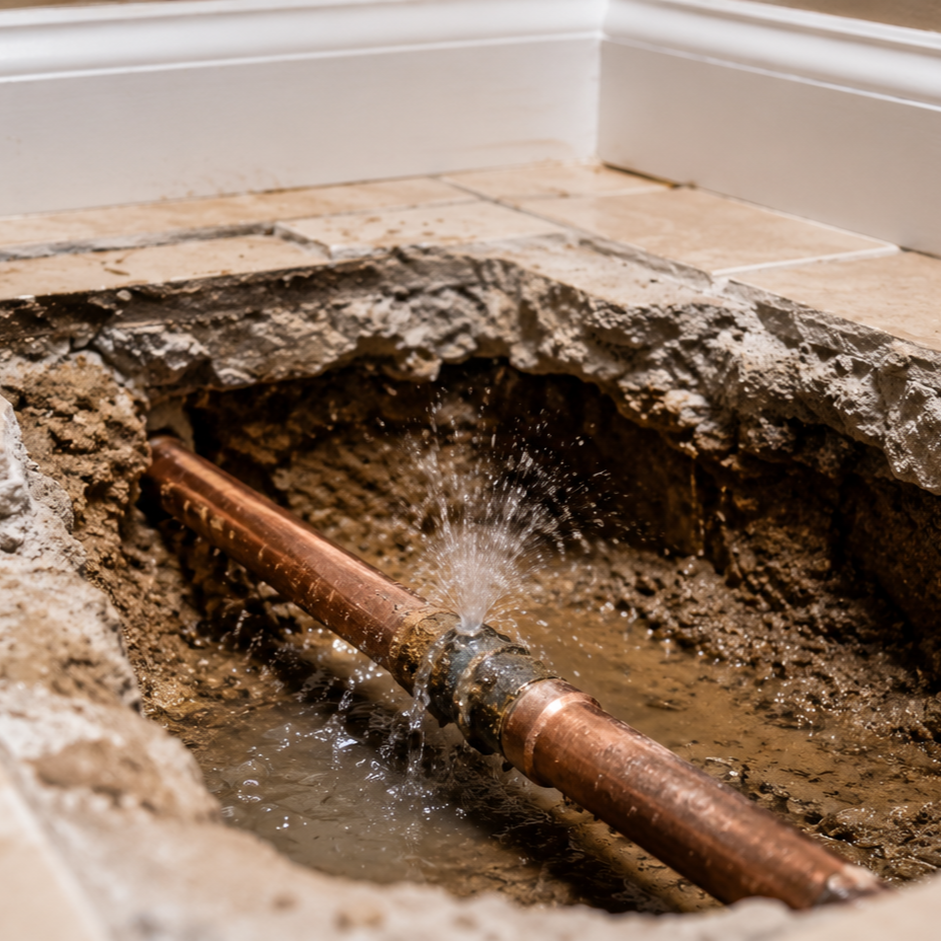
The tile feels warm underfoot even though no one has run a shower in hours. A section of the living room floor — maybe a two-foot patch near the south wall — radiates heat in a way that doesn't match anything else in the house. Homeowners notice the sensation before they have a name for what's causing it.
A slab leak is a pipe failure that occurs beneath the concrete foundation of a home. Water or drain lines running through or beneath the slab can develop a break due to corrosion, pressure, abrasion, or soil movement, and water escapes into the ground or rises through the concrete. The leak is invisible from above. The house itself gives the only evidence.
The floor feels warm in one specific spot
Supply pipes carrying hot water run beneath the slab in most homes built on a concrete foundation. When one of those pipes develops a crack or pinhole, hot water escapes into the ground below. The concrete slab acts as a thermal conductor, and heat from the escaping water transfers upward. A warm patch that stays warm regardless of time of day — particularly one that doesn't align with any vent, appliance, or heat source — points to a hot-water line failure beneath the slab.
The spot doesn't need to be scorching to be significant. A temperature difference of 5–10°F compared to the surrounding flooring is enough to warrant investigation.
The water bill climbs for no apparent reason
A slab leak runs continuously. Unlike a dripping faucet that loses a few gallons per day, a pressurized pipe beneath a slab can lose hundreds of gallons daily without a single drop visible above ground. The water meter keeps spinning, and the bill reflects it.
A sudden 20–40% increase in water consumption — with no change in household use or season — is a reliable indicator. The meter test is simple: turn off every fixture in the house and check whether the water meter dial is still moving. If it is, water is escaping somewhere in the system. When no visible leak exists above ground, the slab is the first place to look.
The meter test works best with the main shutoff open and all faucets, toilets, and appliances confirmed off. Even a slow meter movement — one full dial rotation over 10 minutes — represents roughly 1 gallon per minute, or 1,440 gallons per day.
The sound of running water with nothing on
Pressurized water escaping through a cracked pipe under a slab produces a hissing, trickling, or rushing sound. In a quiet house — particularly at night when appliance noise drops away — the sound can sometimes be heard through the floor or through a wall where pipes enter the slab. It may be faint enough to dismiss as settling noises for weeks before the other symptoms make the source obvious.
The sound is most audible near the perimeter of the slab, close to where supply lines enter the home from the street. Plumbing that runs beneath tile or hardwood carries sound better than carpeted areas.
Flooring buckles, stains, or feels soft underfoot
Water that escapes beneath the slab eventually finds its way up. Concrete is porous. A sustained leak saturates the substrate material above the slab — often sand or compacted fill — and moisture wicks upward. Hardwood planks buckle or cup at the edges. Tile grout lines develop dark staining. Carpet develops a persistent dampness that doesn't dry. Vinyl flooring bubbles or separates at seams.
These signs appear closest to the leak source first, but water travels. A leak at one point in the slab can surface three or four feet away, depending on how the substrate is graded. This is why the wet flooring and the warm spot don't always coincide.
Cracks appear in walls or at door frames
A slab leak that goes undetected long enough creates structural problems. The soil beneath the foundation becomes saturated and loses density. In the Valley, caliche — a calcium carbonate hardpan layer found at depths of 6 to 24 inches below grade — is common. Water has nowhere to drain easily when it accumulates beneath the slab. It pools there, softening the sub-base, and the slab begins to shift unevenly.
The result is hairline cracks in drywall, particularly along door frames and at ceiling corners. Exterior stucco may crack in a stair-step pattern along mortar lines. Doors and windows that previously opened and closed freely begin to stick. These aren't cosmetic problems — they signal that the foundation itself is moving.
Foundation repair in the Valley runs $3,000–$15,000 or more, depending on the degree of movement. A slab leak caught and repaired early, before soil saturation causes settlement, costs a fraction of that.
Water pressure drops throughout the house
When a supply line beneath the slab is losing water, the pressure available to fixtures above grade decreases. A single pinhole in a 3/4-inch copper line can drop household pressure from a normal 60–80 PSI to 40 PSI or less, depending on break size and duration.
Low pressure that affects every fixture simultaneously — not just one faucet or shower — and that isn't explained by a failing pressure-reducing valve (PRV) or a municipal supply issue points to a mainline or branch-line leak. When that pressure drop exists alongside a warm spot and a spiking water bill, the slab is the answer.
Hot water runs out faster than it used to
A hot-water line leak beneath the slab sends water — and the energy stored in it — directly into the ground. The water heater runs more frequently to compensate for the lost volume. From inside the house, the symptom looks like a failing water heater: showers go cold sooner, the tank seems undersized, and recovery time between uses stretches out. The water heater itself tests fine because it is fine. The problem is upstream, in the line running to it.
This sign is easy to misread. A plumber called for a "water heater problem" who finds the unit is heating correctly and the pressure valve is seated, should check supply line pressure at the heater inlet — a significant drop there, without a corresponding drop at the cold-water inlet, points to a hot-line loss somewhere between the heater and the fixtures.
Wet patches in the yard that don't dry out
A slab leak that develops near the perimeter of the foundation or along an exterior wall can surface through the soil rather than through the concrete. Grass that stays green in a defined patch during dry months — or a section of ground that feels soft underfoot when the surrounding soil is hard — indicates water escaping beneath grade. Some homeowners notice this before any interior signs appear.
Unusually fast-growing or lush grass in one strip of an otherwise uniform lawn is the subtler version of the same symptom. Tree roots in the vicinity complicate the diagnosis — they follow moisture, so a root incursion into a failing pipe and a slab leak can produce overlapping yard symptoms. A pressure test isolates what is actually occurring.
Mold, mildew, or an earthy smell inside the home
Sustained moisture beneath a slab doesn't stay beneath the slab. It creates high-humidity pockets inside wall cavities, under baseboards, and beneath flooring. Mold colonizes those pockets — often before any visible moisture appears on the surface. The first sign is a musty, earthy smell that seems to come from a specific room or wall.
Slab leaks that feed moisture into wall cavities can produce mold growth on structural members while the drywall surface remains dry to the touch. By the time mold becomes visible, the colony has typically been established for weeks.
Why Valley homes face heightened risk
The conditions in the Valley accelerate the pipe failures that cause slab leaks.
Municipal water here is extremely hard — 200–400 ppm total dissolved solids, with calcium and magnesium as the primary minerals. The mineral content pits the interior of copper supply lines, thinning the pipe wall unevenly. Think of it like rust working from the inside out on a steel pipe, except it's calcium etching through copper. The exterior looks fine, while the interior wall degrades to the point of failure.
Thermal cycling adds to the stress. Soil temperatures at slab depth can exceed 90°F in summer. Combined with cold supply water entering from the street, copper pipes expand and contract significantly across seasons. A 3/4-inch copper line changes roughly 1/16 inch in length for every 10°F of temperature change. Across a 30-foot run and a 50-degree seasonal swing, that movement accumulates — and it works at every joint and connection point.
Caliche soil adds another layer. Unlike sandy soil that allows water to disperse when a pipe breaks, caliche acts as an impermeable barrier. Water from a slab leak pools beneath the slab rather than dissipating, accelerating pressure on the foundation.
Homes built before 1990 with original copper plumbing are at the highest risk. The pipes are nearing the end of their design life just as the compounding effects of hard water and thermal cycling reach their peak.
What professional leak detection involves
A licensed plumber investigating a suspected slab leak doesn't guess. The process uses specialized equipment to confirm and pinpoint the break before any concrete is touched.
Electronic amplification equipment listens for the acoustic signature of pressurized water escaping through a pipe — a specific frequency that's distinct from normal flow. Thermal imaging identifies temperature differentials at the slab surface. Ground microphones can triangulate the leak location to within 6–12 inches in most cases.
Once the location is confirmed, repair options depend on the pipe's overall condition:
Spot repair: The slab is opened at the break location only. This works well for isolated failures in an otherwise sound pipe.
Pipe rerouting: The failed line is abandoned, and a new supply line is run through the walls or attic, bypassing the slab entirely. This is the preferred option for an older pipe that is likely to fail again in a different location.
Epoxy pipe lining: A resin liner is applied to the interior of the existing pipe, sealing the break and slowing corrosion. Best suited for lines that are accessible but structurally marginal.
A plumber who jumps straight to spot repair on a 40-year-old copper system without evaluating the pipe's overall condition is doing the homeowner a disservice — the pipe will fail again, and sooner than expected.
Frequently Asked Questions
Detection typically runs $150–$500, depending on the equipment used and time required to locate the break. Repair costs vary: a spot repair involving concrete access typically runs $500–$2,000 for the plumbing work alone, not counting concrete patching and flooring restoration. Pipe rerouting runs $1,500–$4,000 or more, depending on how many lines need to be rerouted and routing complexity. Epoxy lining prices vary by footage.
No. A pipe break under pressure does not self-seal. The leak may seem to fluctuate with system demand, but the break is permanent until the pipe is repaired or replaced. Waiting allows more water to saturate the sub-base and increases the likelihood of structural movement and mold growth.
Months, in some cases. Small pinholes in hot-water lines may not produce dramatic symptoms right away. The floor warmth may be subtle enough to be attributed to summer heat. The water bill increase may seem like a normal variation. Slab leaks that cause foundation movement or visible mold have typically been running for three to six months or longer.
Coverage depends on the specific policy and cause of the leak. Many standard policies cover the cost of accessing the damaged area and restoring flooring and drywall — sometimes called "access coverage" — while excluding the pipe repair itself. Damage attributed to long-term leakage that could have been caught earlier is frequently excluded. Policy terms vary significantly; the insurer's adjuster will determine coverage based on the verified cause and policy language.
In some cases, yes. Pipe rerouting avoids opening the slab altogether by running new supply lines through interior walls or attic space. Epoxy lining also avoids concrete cutting. Both are viable depending on pipe condition and layout. Spot repair — the option that requires breaking concrete — makes the most sense only when the failure is isolated, and the rest of the pipe is in good condition.
The hot-water test: shut off the cold-water supply at the main and isolate the water heater supply only. If the meter keeps moving and there's a warm spot on the floor, the break is in the hot-water line. If the meter stops when the water heater is isolated, the cold-water supply line is the problem. A licensed plumber can confirm this quickly with pressure testing on both circuits.
Yes, significantly. Homes with original copper plumbing installed in the 1960s through 1980s are at the highest risk, particularly in hard-water markets. Copper pipe has a design life of roughly 40–60 years under typical conditions — shorter where interior pitting accelerates wall thinning. Homes in that age bracket that have never had plumbing updates and are showing any of the above symptoms warrant a professional evaluation sooner rather than later.
