
Why Does My Water Heater Make a Popping or Rumbling Noise?
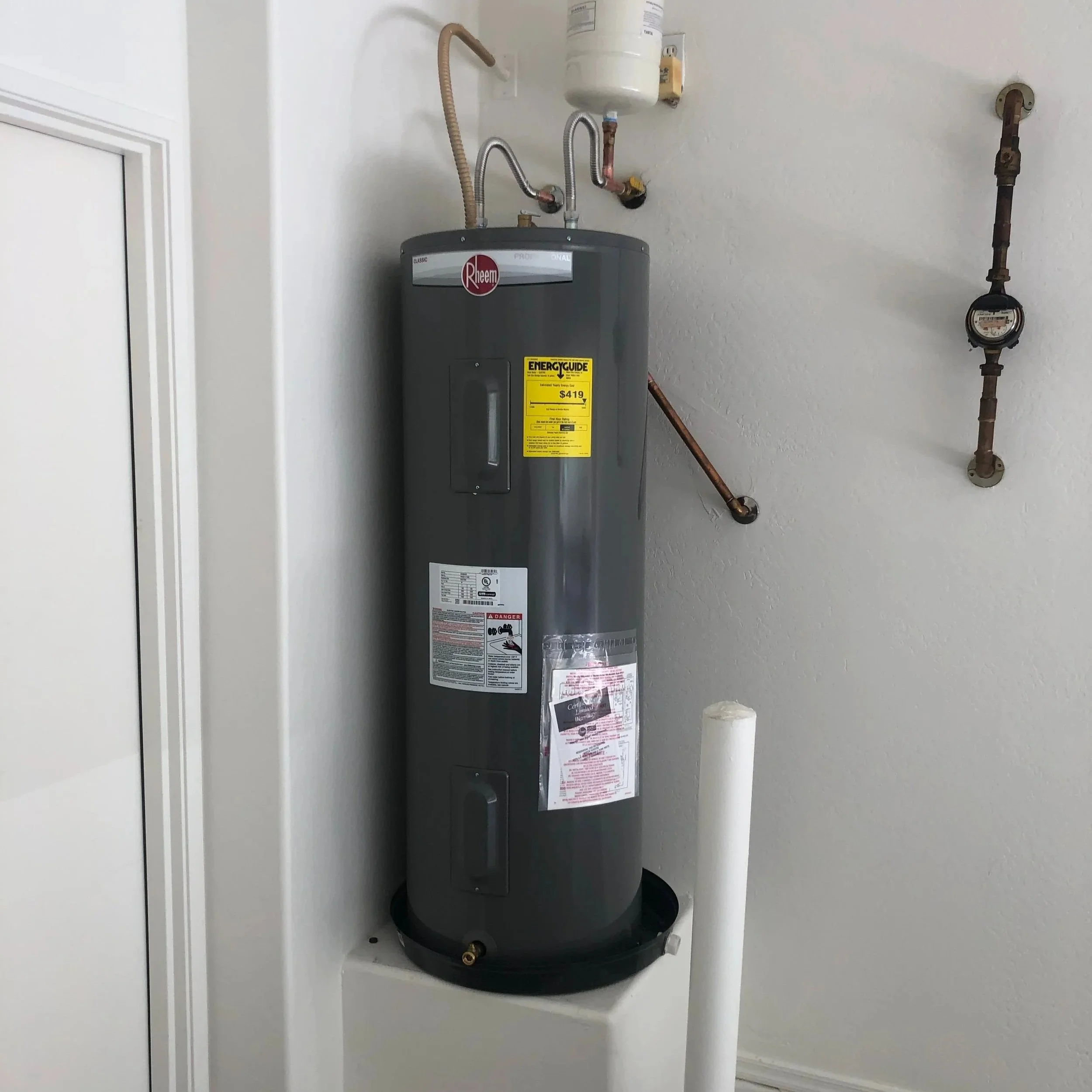
The sound comes from the utility closet — a low, hollow rumble that rolls into a series of sharp pops, like someone cracking knuckles against the inside of the tank. It shows up when the burner fires, fades as the water finishes heating, then returns the next morning. Homeowners usually live with it for weeks before wondering whether the unit is about to fail.
In most cases, immediate failure isn't the issue. But the noise is a warning worth taking seriously.
What makes that sound
The sound is almost always sediment. Hard water carries dissolved calcium and magnesium bicarbonates — in desert Southwest markets, water commonly tests between 200 and 400 ppm total dissolved solids — and when that water sits inside a storage tank and gets heated repeatedly, those minerals drop out of solution and settle at the bottom. The same process that leaves white crust on showerheads and faucet aerators leaves a layer of calcium carbonate on the tank floor.
Once that mineral layer builds — a few millimeters at first, eventually a half-inch or more — it sits directly over the burner in a gas unit or directly over the lower heating element in an electric unit. Water gets trapped beneath that crust. When the burner or element fires, it has to push heat through the mineral layer to reach the water above.
That's where the popping comes from. Steam bubbles form in the pockets of water trapped under the sediment and then force their way up through the crusty layer — each one producing a pop. Multiply that across the entire tank floor, and the sound resembles popping corn or a continuous low rumble, depending on how thick the deposits have become.
Hard-water markets accelerate the process
Hard water accelerates everything. A tank in a soft-water region might go four or five years before sediment becomes a real problem. In high-mineral areas, that same process plays out in two to three years. The mineral concentration is higher, and every gallon that moves through the tank deposits a thin film.
Tankless water heaters develop a related but different problem: scale builds inside the heat exchanger — a compact coil of water passages that moves water over a hot surface. When scale coats those passages, flow restriction increases, and the unit may produce a hissing or gurgling sound rather than the pop-rumble of a tank unit.
What the noise reveals about tank condition
Think of sediment as thermal insulation installed in the worst possible place. The burner runs longer to push heat through the mineral layer, and the tank bottom takes repeated cycles of extreme heat trapped against metal that cannot cool normally. That wear pattern shows up in energy bills first — a water heater with significant sediment can draw 10–20% more energy than a clean unit — and eventually in tank failure.
Sediment also gives moisture a foothold against the tank wall. Anode rods, which protect the tank interior from corrosion through a process called sacrificial oxidation, have a harder time protecting tank surfaces that are buried under mineral deposits. In hard-water markets, anode rods typically need inspection every two to three years rather than the five-year schedule common in softer-water regions.
A popping noise that starts early and stays manageable often means the layer is thin enough to address with a flush. A constant low rumble — particularly one accompanied by longer heating cycles or discolored water — points to severe accumulation that may be displacing water capacity inside the tank.
A rumbling noise combined with rust-colored water or a sulfur smell indicates advanced tank degradation. Those symptoms together mean the tank is approaching the end of service life and should be evaluated by a licensed plumber before it fails.
How a plumber addresses sediment accumulation
The standard procedure is a tank flush — draining the unit to clear settled minerals. On a water heater that hasn't been flushed in several years, that process often requires multiple drain cycles because sediment doesn't always run out cleanly on the first pass. It behaves less like a pourable liquid and more like wet sand.
If the sediment is particularly compacted, a plumber may agitate the tank or use a vacuum extraction technique to directly remove debris. Some older deposits calcify hard enough that flushing fails to dislodge them at all — which is when replacement becomes the better option.
For tanks that are still relatively young — under five years old in a hard-water market — a flush can recover significant efficiency and reduce noise substantially. For a unit that's eight to ten years old with a persistent rumble, the math often favors replacement over repeated service calls.
Flushing works best as preventive maintenance, not a rescue operation. In hard-water areas, flushing every one to two years — before deposits have a chance to calcify — keeps the process effective and the cost low.
When the noise comes from somewhere else
Not every water heater noise originates from sediment. A few other sources produce similar sounds:
Thermal expansion in the supply lines. As water heats and supply pipes expand, metal against wood framing or rigid pipe straps produces a ticking or creaking sound. This typically occurs right when the burner fires and again as the unit cools. The sound originates outside the tank, not inside it.
A failing pressure-relief valve. A temperature and pressure relief (TPR) valve that's starting to weaken may vent briefly and reseat with a click or pop. This tends to happen intermittently rather than consistently during every heating cycle — and if the TPR vents repeatedly, that's a problem requiring prompt attention.
Loose dip tube fragments. The dip tube is the plastic component that directs cold incoming water to the bottom of the tank so it can be heated before rising to the outlet. Older water heaters — particularly units manufactured in the 1990s — had dip tubes that degraded and shed plastic fragments. Those pieces can knock around inside the tank, creating an irregular clicking or rattling sound.
Delayed ignition at the burner. A gas control valve that's not functioning correctly may allow gas to accumulate briefly before igniting, producing a thump at startup. This is distinct from sediment rumble: it happens at the moment ignition fires rather than throughout the heating cycle, and it often comes with a more pronounced sound.
Crackling on a gas unit. A crackling or sizzling sound during startup often comes from condensation dripping onto the burner assembly. Small amounts are harmless, but persistent loud crackling can indicate a condensation issue — or, occasionally, a slow drip reaching the burner from a valve or connection above it.
Humming in an electric unit. The lower heating element in an electric water heater threads directly into the tank wall. If the element works loose, vibration from water movement creates a low hum during heating cycles. Tightening the element typically fixes it, but that requires shutting power to the unit and partially draining the tank — not a task to approach without knowing what's involved.
A licensed plumber can distinguish these causes by observing when the sound occurs relative to the heating cycle, checking the hot-side water flow for debris, and directly inspecting the TPR valve and burner assembly.
Frequently Asked Questions
The noise alone doesn't indicate an emergency. Sediment causes most popping sounds in storage water heaters, and sediment is a maintenance problem rather than an immediate safety hazard. However, a unit that's been running with heavy sediment for years has taken cumulative stress to the tank bottom — especially in high-mineral water areas where thermal cycling is more aggressive. A plumber should assess the unit's condition, particularly if the noise comes with discolored water or a shorter hot water supply than the tank used to provide.
The steps — connecting a garden hose to the drain valve and opening it — aren't technically complicated. The real risks are: a drain valve that's been closed for years may not reseat correctly after being opened, and thick sediment can clog the valve partway through the process. In hard-water markets, the deposits are often compacted enough that a simple self-flush doesn't remove them effectively. A licensed plumber can flush the unit safely, swap the drain valve if it fails to reseat, and give an honest assessment of whether the service is worth doing or whether replacement makes more financial sense.
Professional flushing typically runs $100 to $200, depending on tank size and how much sediment is present. If the job requires multiple drain cycles or a drain valve replacement, the cost may be slightly higher. That service cost is harder to justify as a tank ages — at year eight or nine in a hard-water market, the replacement conversation is often more appropriate than spending money on a unit that's near the end of its life anyway.
No. Sediment doesn't dissolve or redistribute once it's settled and calcified. The popping may become less noticeable as accumulation becomes uniform across the tank floor, but the underlying condition continues to worsen. Heating cycles grow less efficient, energy costs rise, and the tank floor degrades from repeated thermal stress against the mineral layer.
Tank water heaters in areas with 200–400 ppm TDS water typically last eight to twelve years, compared to a national average of ten to fifteen. Units upstream of a working water softener can push toward the higher end of that range. Units running on untreated hard water hit failure earlier and sometimes more abruptly — often a sudden leak from the tank bottom rather than a gradual decline. Knowing the unit's age is the first piece of information a plumber needs when evaluating a noisy water heater.
Yes. Sediment acts as thermal insulation between the burner and the water above it, forcing the unit to run longer to reach the set temperature. Efficiency losses in heavily scaled tanks typically run 10–20% compared to a clean unit of the same size. That difference shows up in monthly gas or electric bills — a gas heater may fire for several additional minutes per cycle, adding up meaningfully over a year's worth of use.
A properly maintained salt-based softener significantly reduces the mineral load that hits the tank. Softened water contains far less calcium and magnesium in ionic form, so the precipitation that forms scale occurs much more slowly. Homes with working softeners see dramatically slower sediment accumulation and typically get more service life from their water heaters. Maintenance is still needed — the tank should be flushed periodically, even with soft water — but the timeline between service intervals is much longer.
A licensed plumber can assess the sediment level, flush the tank if the unit has enough life remaining to justify the service, and give a clear recommendation on repair versus replacement. Simba Plumbing serves Phoenix, Scottsdale, Mesa, Chandler, Gilbert, Glendale, Peoria, Tempe, Surprise, Goodyear, Avondale, and surrounding Valley communities. ROC #327259. Call (602) 500-2153.
