
Why Does My Kitchen Sink Drain Slowly but My Bathroom Drains Fine?
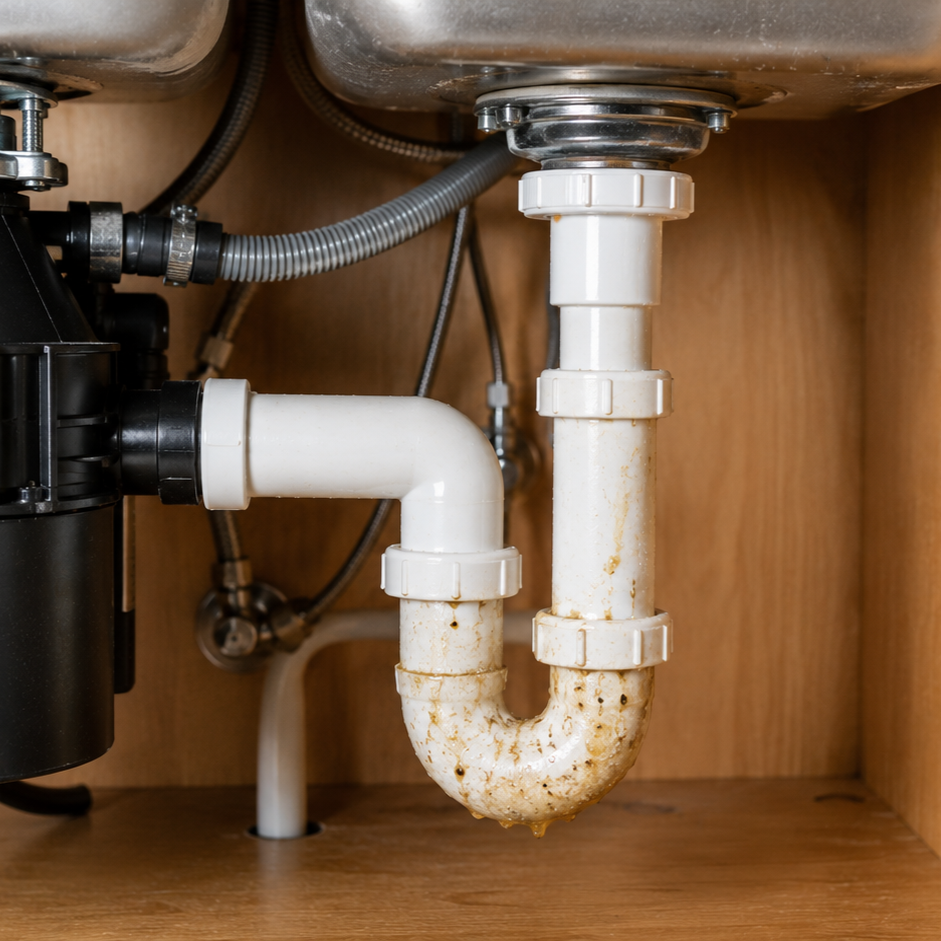
The water sat in the basin for four minutes after the dishes were done. A slow spin toward the drain, then nothing for a while. Run the bathroom sink on the same side of the house — clear in seconds. Same house, same day, two completely different results.
That gap in performance is not a coincidence. Kitchen drains and bathroom drains fail for different reasons, accumulate different waste, and develop clogs at different rates. When the kitchen is sluggish, and everything else is fine, the problem is almost always confined to the kitchen branch line — and the most common cause is grease.
Kitchen and bathroom drains share a main line, but nothing before it
Every drain in a house eventually connects to the main sewer line running out under the foundation. But the path from sink to main varies by fixture. The kitchen sink has its own 2-inch branch line that runs horizontally through the wall or beneath the floor before joining the main stack. Bathroom sinks, tubs, and toilets connect through their own separate branches.
A clog in the kitchen branch line can slow or stop the kitchen drain without affecting the bathroom lines at all. The two systems don't cross paths until they merge near the main stack — and clogs almost never form at that junction because the water is moving fast there, carried by flow from multiple fixtures simultaneously.
When only the kitchen is slow, the problem is upstream of that merge point. It's local, not systemic.
Grease behaves differently than any other drain waste
Bathroom drains collect hair, soap scum, and toothpaste residue. That material sticks to pipe walls but stays relatively soft. Kitchen drains carry cooking grease — animal fats, vegetable oils, bacon drippings — and grease does something that hair and soap do not: it liquefies at cooking temperature, flows easily down the drain, then solidifies again as it cools inside the pipe.
When grease hits a 55°F pipe wall, it doesn't keep moving. It sticks. The next load of hot grease sticks to the first layer. Soap residue from dishwashing binds the layers together. Food particles embed into the grease matrix. The deposit grows inward from the pipe walls, narrowing the 2-inch opening like a sleeve tightening around the interior.
Think of a garden hose with a layer of wax built up on the inside. Water still gets through, just slower — until the wax gets thick enough to block it entirely.
The process is gradual and cumulative. A drain that was working fine a year ago may be down to 40 percent of its original diameter today, without anyone having noticed the change day to day.
Where in the kitchen drain line clogs actually form
The P-trap directly under the sink catches the first accumulation. That curved section holds standing water by design — it's the seal that blocks sewer gas from entering the house — but it also catches debris that doesn't make it past the curve. Grease, food scraps, and soap residue settle there first.
Past the P-trap, the drain arm runs horizontally through the wall or cabinet before dropping into the main drain stack. Horizontal pipe sections are where grease accumulates fastest. Vertical sections get a natural rinse from gravity every time the drain runs. Horizontal sections rely entirely on flow velocity to push waste along, and water moving through a 2-inch kitchen drain arm does not travel fast enough to keep grease from settling.
If the kitchen has a garbage disposal, food particles make the problem worse. Disposal units grind food into small pieces, but they don't dissolve grease or oil. Those particles travel down the line coated in whatever fat came with them, then adhere to the grease layer already building on the pipe walls.
Why drain cleaners don't work on kitchen grease clogs
Liquid drain cleaners are formulated to dissolve organic material — primarily hair and soap. They work by generating a chemical reaction (usually lye-based or sulfuric acid-based) that breaks down biological matter. Hair dissolves. Soap softens.
Grease does not respond the same way. The chemical reaction that breaks down hair has minimal effect on solidified animal fat. What typically happens with a lye-based product poured onto a grease clog: the product sits on top of the clog, generates heat, possibly loosens the surface layer, and then the water drains slightly faster for a few days before the grease layer reforms.
Beyond ineffectiveness, there's a practical risk. Lye-based drain cleaners are caustic enough to soften older PVC pipe if they sit in contact long enough. On a slow drain — one where the liquid pools rather than moving through quickly — the chemical contact time is much longer than the product was designed for.
Never mix drain cleaning products or use them back-to-back. Combining different formulations can create chlorine gas or cause violent reactions inside the drain trap.
What actually clears a kitchen grease clog
A drain snake — the standard cable machine — punches through the grease clog and opens a channel. Water flows again. But the grease coating the pipe walls is still there. A cable machine drills a hole through the clog; it doesn't scrape the walls clean. Most kitchen drains that get snaked are slow again within weeks or months because the remaining grease continues to accumulate.
Hydro jetting uses high-pressure water — typically 3,000 to 4,000 PSI through a nozzle at the tip of a flexible hose — to clean the pipe walls entirely. The nozzle sprays forward to cut through the clog and backward to scour the walls, then the debris flushes down the line. After a proper jetting, the inside of the pipe is as close to clean as it can get without replacing it.
For a kitchen drain that has been slow repeatedly or has been snaked more than once, hydro jetting addresses the actual problem instead of just opening a temporary channel.
A slow kitchen drain that comes back within 3 months of snaking is almost always a grease accumulation problem, not a clog that wasn't fully cleared. Hydro jetting is the appropriate next step, not repeat snaking.
Reading the symptoms: what the drain is telling you
A slow kitchen sink that stands alone — no other fixtures affected, no gurgling — almost always sits in the kitchen branch. Context clues narrow it further.
| What's happening | What it points to |
|---|---|
| Only the kitchen sink is slow; bathrooms drain normally | Grease accumulation in the kitchen branch line |
| Kitchen slow, toilet gurgles when flushing | Vent stack partially blocked |
| Kitchen slow after cabinet work | Crimped drain arm or shifted P-trap |
| Kitchen slow, occasional odor | Grease and organic material in the P-trap |
| Kitchen slow AND at least one bathroom slow | Main line issue — needs camera inspection |
Other causes of a slow kitchen drain
Grease is the most common cause, but not the only one.
Hard water scale compounding the grease layer. Desert tap water in Arizona typically measures 200–400 ppm total dissolved solids, loaded with dissolved calcium and magnesium. As water moves through pipes, those minerals precipitate out as calcium carbonate and deposit on the inner walls. In bathroom fixtures, scale shows up as white chalky rings around faucet openings. Inside drain pipes, scale doesn't show up at all — it just keeps narrowing the interior diameter. A kitchen drain pipe already coated with grease provides an even better surface for scale to adhere to, which accelerates the restriction. Homes without water softeners that also cook frequently tend to see kitchen drain problems develop faster than comparable homes in lower-mineral markets.
A blocked or missing vent. Drain lines need air to drain properly. The vent stack — the pipe that exits through the roof — equalizes pressure as water flows down the drain. If a vent gets blocked by a bird nest, debris, or a dead animal, the drain creates a partial vacuum as it flows. Water trickles rather than drains freely. A blocked vent typically causes slow drainage across multiple fixtures, but it can affect the kitchen first if that branch line has the longest horizontal run.
A partially closed shutoff or crimp in the line. After cabinet work or a previous repair, a drain arm can end up with a slight crimp or an offset joint that reduces flow. This is less common but worth considering if the slow drain started after any cabinet or countertop work.
Improper P-trap installation. A P-trap that is too shallow, installed at the wrong angle, or missing altogether creates chronic drainage problems regardless of how clean the pipe is. The trap needs to have a consistent water seal — typically 2 to 4 inches of standing water — to function correctly.
When a slow kitchen drain points to something bigger
If the kitchen drain is slow and the bathrooms are starting to slow as well — especially if flushing a toilet causes the kitchen drain to back up — that pattern suggests the problem has moved from the kitchen branch line to the main stack or the sewer line itself.
Root intrusion, sewer line offset, or accumulation in the main horizontal run under the foundation produces backups that affect multiple fixtures simultaneously or in sequence. A slow kitchen drain that appeared on its own, with no other fixtures affected, almost certainly stays confined to the kitchen branch. A slow kitchen drain that appears alongside any backup or gurgling at a bathroom fixture needs a camera inspection to rule out a main line problem.
Frequently Asked Questions
Boiling water can soften grease near the top of the clog and push it slightly further down the line. It rarely resolves a clog because the grease cools and re-solidifies before it reaches the main stack. On older homes with PVC drain arms installed with standard CPVC fittings, repeatedly pouring boiling water down the drain can soften the fittings over time. Hot tap water — around 140°F — is safer and about as effective.
The grease layer built up on pipe walls traps organic material — food particles, soap residue, and bacteria. That material decomposes, generating sulfur compounds. The smell is coming from the pipe walls, not the water. Clearing the grease accumulation eliminates the odor source. Drain deodorizers or baking soda treatments mask the smell temporarily without addressing what's causing it.
In a household that does regular cooking with oils and fats, hydro jetting once every 18 to 24 months keeps the kitchen drain line clear before accumulation becomes a blockage. Households that cook infrequently or use very little oil can go longer. A kitchen drain that has already been slow and snaked multiple times may benefit from a camera inspection first to assess how much accumulation is present.
A disposal reduces solid food particles into small pieces that pass easily through the drain. But it has no effect on liquid fats and oils. Those still coat the pipe walls on the way down. Some plumbers argue that a disposal makes grease clogs worse because the finely ground food particles embed into the grease layer more efficiently than larger pieces. Running cold water while the disposal operates does not solidify or remove grease — it just dilutes it briefly.
If a drain snake has been used once and the drain slowed again within a few weeks, the clog is almost certainly a grease accumulation issue that snaking won't resolve. A plumber with a hydro jetter can clean the pipe walls instead of just drilling a hole through the clog. If the slow drain is accompanied by any gurgling from other drains or any backup anywhere in the house, a camera inspection is the right first step to rule out a main line issue.
The dishwasher drain line connects to either the disposal or directly to the drain arm under the sink. If the drain arm is partially clogged, dishwasher discharge adds a sudden high-volume surge that the restricted line can't handle quickly, causing the sink to fill or back up during or after the dishwasher cycle. This isn't a separate dishwasher problem; it's the kitchen drain clog showing up under higher-volume conditions. Clearing the drain line fixes both.
A slow kitchen drain that keeps coming back after snaking almost always has a grease buildup that only hydro jetting can resolve. Simba Plumbing serves Phoenix, Scottsdale, Mesa, Chandler, Gilbert, Glendale, Peoria, Tempe, Surprise, Goodyear, Avondale, and surrounding Valley communities. ROC #327259. Call (602) 500-2153.
