
Should I Repair or Replace My Garbage Disposal?
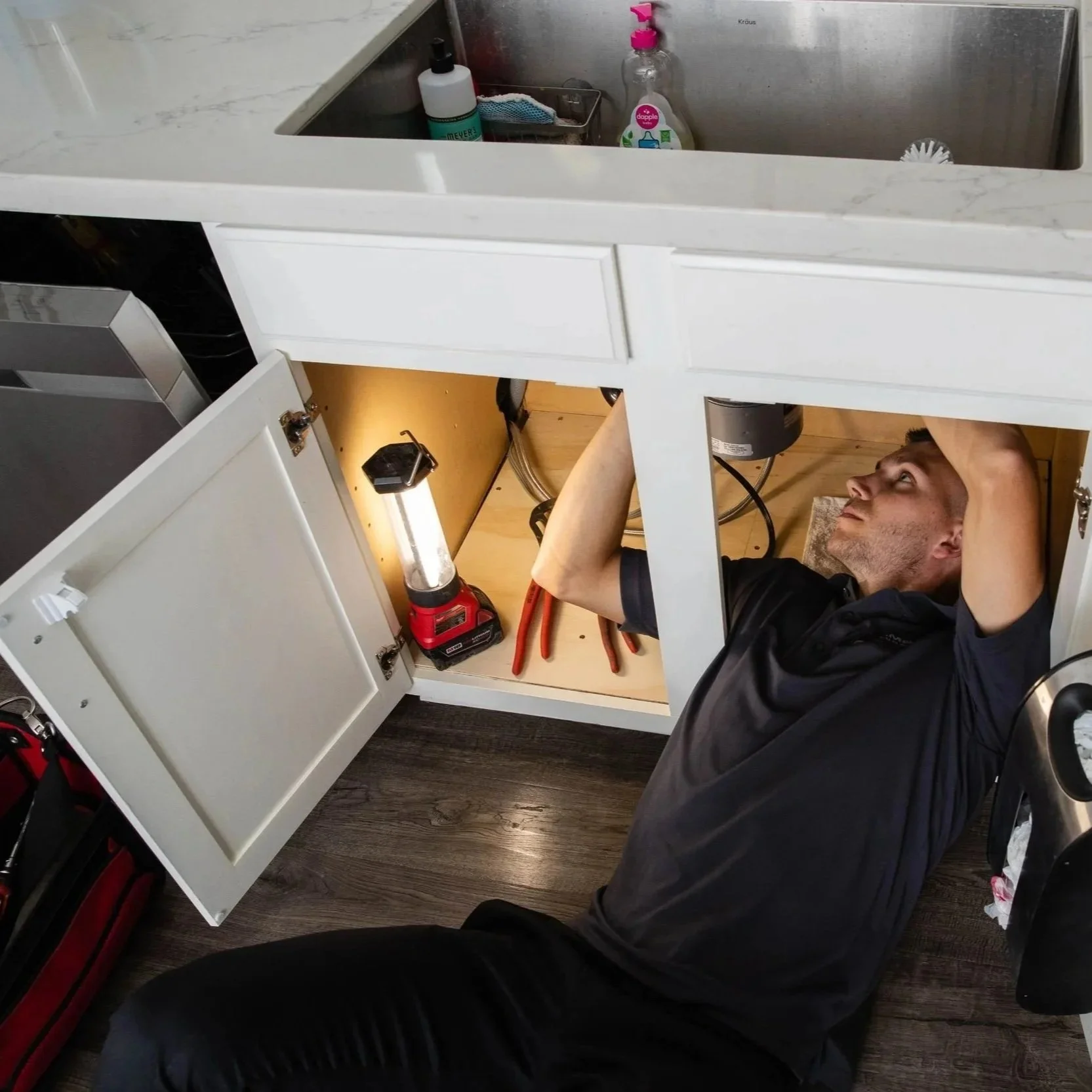
The kitchen sink backed up again. Not a slow drain — the water just sits there. Open the cabinet underneath, and that faint burning smell hits immediately. The disposal hums when the switch gets flipped, but nothing spins. Or it grinds and rattles in a way it never has before. Eventually, the same question lands: is this worth fixing, or is it time to pull the whole thing out?
The answer depends on four things: the type of problem, the unit's age, where any leak is located, and what a repair costs compared to what a new unit costs. Work through each one, and the decision becomes a lot clearer — usually before a plumber even arrives.
The problem type reveals whether a fix is even possible
Some disposal problems are mechanical dead-ends. They signal internal failure that no repair can reverse. Others are surface issues a plumber resolves in under an hour.
Problems that are almost always repairable:
Jams. A disposal that hums but doesn't spin has a jammed flywheel — usually a bone fragment, pit, or small piece of cutlery wedged under the grinding plate. The flywheel frees with a 1/4-inch hex wrench at the bottom center of the unit. Push the reset button afterward. If the motor sounds strong once it's clear, the unit is fine.
Loose connection leaks. Leaks at the sink flange — where the disposal meets the drain basket — or at the dishwasher inlet hose are connection failures, not disposal failures. Tightening hardware or swapping a gasket fixes it. These say nothing about the condition of the motor or grinding chamber.
Tripped reset button. A disposal that won't turn on at all — no hum, nothing — has usually tripped its thermal overload protector. The reset button is on the underside of the housing. Push it and try again. But if it trips repeatedly without a jam present, that's a different problem.
Problems that almost always require replacement:
Bottom leaks. A leak from the very bottom of the housing means the internal seals between the motor section and the grinding chamber have failed. Those seals live inside the motor housing and can't be reached for repair. The unit needs to come out.
Motor failure. A disposal that hums without grinding, or trips the reset every few uses without a jam, has a failing motor. Disposal motors aren't economically serviceable — rebuilding the motor core costs more than a new mid-range unit. Full stop.
Cracked grinding chamber. Visible cracks in the lower housing or grinding chamber mean the structure is compromised. Replacement only.
Age is the single biggest variable in the decision
A garbage disposal realistically lasts 8 to 12 years under normal use. Some go longer. Some don't make it that far. But age shapes how to weigh every other problem on the list — and it's the first thing a plumber considers.
A 3-year-old disposal with a jammed flywheel? Fix it, no question. A 10-year-old disposal with the same jam might still be worth repairing — if the motor sounds strong and nothing else shows wear. But that same 10-year-old unit with a drain leak, persistent odors, and sluggish grinding is at the end of life regardless of whether the current jam can be cleared.
Think of a disposal motor like a pair of running shoes. There's a finite number of miles in them. Clearing the jam is like replacing the laces — the cushioning's still gone. The motor's total wear doesn't reset because the immediate problem got solved. And on an older unit, one repair often just exposes the next failure waiting behind it.
If a repair costs more than half the price of a comparable new unit, and the existing unit is 8+ years old, replacement is almost always the better value.
Where the leak is located changes everything
Leak location is one of the clearest signals in the garbage disposal repair or replacement decision. Most homeowners don't realize that a top leak and a bottom leak mean completely different things.
Top of the disposal (at the sink flange). The mounting hardware where the disposal meets the drain basket has worked loose, or the plumber's putty underneath has dried out. A plumber reseats the flange and re-secures the mounting ring. Repairable at any age, as long as the unit itself is working.
Side of the disposal (at the dishwasher inlet or drain pipe connection). Side leaks are connection leaks — failed gaskets or loose hose clamps at external fittings. Also repairable. These say nothing about the motor or grinding components.
Bottom of the disposal (from the housing itself). Internal seal failure. Water passes through the motor housing to the drain port at the bottom. No field repair exists for this. The unit must be replaced.
Here's a useful distinction: a top or side leak is a problem with the plumbing around the disposal. A bottom leak is a problem inside the disposal itself. Different category entirely.
Frequent reset trips signal a motor under stress
The reset button on the underside of the unit is a thermal overload protector. It trips when the motor overheats to prevent burnout. Pressing it once after a hard jam is normal. Pressing it twice a week is not.
When a motor starts tripping the reset without an obvious jam, it's working harder than it should be. Motor windings are degrading, flywheel bearings are worn and generating friction, or both. Clearing the last jam doesn't touch any of that wear.
A disposal that trips its reset frequently is developing a pattern — and that pattern won't stop on its own. The unit runs it until the motor seizes or the reset stops resetting at all. Getting there earlier means one replacement bill. Getting there later means a repair bill followed by a replacement bill.
The cost math is simpler than it looks
Repair is almost always cheaper than replacement in the short term. Over time, the math gets murkier — especially on older units.
| Factor | Repair | Replace |
|---|---|---|
| Upfront cost | $75–$200 labor + parts | $150–$350 unit + $150–$300 install |
| Typical warranty | Varies by shop | 2–8 years on the new unit |
| Fixes root cause | Depends on the problem | Yes |
| Risk of next failure | Higher on 8+ yr units | Low |
| Motor strength | Unchanged (declining) | New |
Installing a new mid-range disposal — 1/2 to 3/4 HP, from a recognized brand — typically runs $300 to $600 in the Phoenix area, depending on the unit and labor. That's the real comparison number when deciding whether a repair on an aging unit is actually worth it.
A 5-year-old disposal with a $150 repair bill is almost certainly worth fixing. A 10-year-old unit with that same bill warrants harder scrutiny — particularly if it's going to need another service call within the year.
What a new disposal offers that an old one doesn't
Disposal technology hasn't changed dramatically over the decades. But the gap between a unit installed in 2013 and a mid-grade unit installed today is real.
Current mid-range and above models use multi-stage grinding — a two-stage plate system that breaks food waste into finer particles before it exits into the drain line. Finer particles mean fewer clogs and less accumulation in the kitchen drain line over time. Sound insulation has improved noticeably, too. A unit grinding at 55 decibels is a genuine upgrade over the 80-decibel groan of a disposal from 12 years ago.
Jam protection has gotten better as well. Auto-reverse systems detect a jam and reverse the flywheel to clear it, reducing the frequency of manual intervention. None of this justifies replacing a 4-year-old disposal. But on an older unit already showing wear, these upgrades tip the scale further toward replacement than repair cost alone would.
Phoenix's hard water shortens disposal life compared to national averages
Phoenix tap water runs between 200 and 400 ppm TDS — total dissolved solids, mostly calcium and magnesium. That mineral load doesn't attack grinding components the way it attacks water heater tanks or shower valves. But it does affect the drain side of the system.
Calcium scale builds up inside the drain elbow and discharge tube below the disposal, narrowing the pipe and increasing backpressure against the drain port. A disposal working against a partially obstructed drain line runs the motor harder than it was designed to. That accelerates bearing wear and raises motor heat. A unit that might reach 12 years in a soft-water market can show motor fatigue by year 8 or 9 in the Valley.
Under-sink temperatures add to the problem. In Phoenix summers, cabinet interiors near an exterior wall can hit 100°F or above. Sustained heat degrades seals faster and shortens the life of plastic components inside the housing. Homeowners with units in the 8-to-10-year range should factor that shortened life expectancy into any repair calculation before committing to another service call.
Frequently Asked Questions
Most residential garbage disposals last between 8 and 12 years with normal use. Units in the Phoenix metro area may show motor and seal wear earlier — sometimes by year 8 or 9 — because of hard water scale buildup in the drain line and higher ambient temperatures under the sink during summer months.
Practically speaking, no. Motor windings and bearings inside a disposal housing aren't economically serviceable — rebuilding the motor core typically costs more than a new unit, and no warranty applies to the rebuilt component. Motor failure, whether indicated by continuous humming without grinding or repeated reset trips without a jam, is a replacement condition.
A bottom leak means the internal seals between the motor section and the grinding chamber have failed. These seals are embedded inside the unit and can't be replaced as a field repair. Bottom leaks always require disposal replacement — regardless of the unit's age.
It depends on what's causing the jams. If jams result from fibrous vegetables, oversized bones, or non-food items going into the unit, clearing the jam and changing habits solves it. If jams happen with a normal food load and normal use, the flywheel or grinding plate may be worn — which is a motor wear symptom. On an older unit, repeated unexplained jams are a warning sign, not a one-time fix.
A 1/3-HP unit handles light use in a one- or two-person household. For a family of three to four people with normal cooking habits, a 1/2-HP or 3/4-HP unit is appropriate and handles a wider range of food waste without straining. Households that cook heavily should consider a 1-HP unit. In Phoenix, where mineral scale in the drain line adds some baseline backpressure, the extra headroom of a 3/4-HP unit is a sensible choice for most families.
A new mid-range disposal — 1/2 to 3/4 HP from a recognized brand — runs $150 to $300 for the unit. Installation adds $150 to $300, depending on job complexity and whether the drain connection or wiring needs updating. Total installed cost typically falls between $300 and $600. A basic 1/3-HP unit with standard installation can come in under $300; a premium 1-HP unit with updated drain plumbing can approach $700.
