
Pressure-Balancing vs Thermostatic Shower Valve: What’s the Difference?
The toilet flushes in the hall bathroom, and the shower suddenly runs hot. That momentary spike — cold water pressure drops, hot pressure surges — is exactly the scenario shower valves exist to prevent. Two different valve technologies do the job through entirely different mechanisms, and choosing between them is less about brand loyalty than understanding what each one actually does inside the wall.
How a pressure-balancing valve works
A pressure-balancing valve monitors the ratio of hot water pressure to cold water pressure. It contains a piston or spool element that slides back and forth to equalize pressure on both sides. When a toilet flush drops cold-water pressure by 5–10 PSI, the piston shifts and simultaneously restricts the hot-water inlet by a proportional amount. The result: pressure drops briefly, but the ratio between hot and cold stays constant, so the temperature holds.
The keyword is "ratio." A pressure-balancing valve doesn't know what the actual temperature of the water is. It doesn't measure heat. It measures differential pressure and maintains a fixed proportion. In a home where the hot-water supply sits at 120°F, a pressure-balancing valve will deliver water at roughly the same temperature as long as the supply pressure ratio doesn't shift.
That works well in most single-shower configurations. Where it falls short: if the hot-water supply temperature itself varies — as it often does in Phoenix homes on summer afternoons when ground-level water supply temps rise and the water heater cycles differently — the pressure-balancing valve will maintain the ratio but deliver a different outlet temperature.
All pressure-balancing valves sold in the U.S. include an anti-scald stop that limits the maximum hot-water rotation to around 120°F at the handle. This stop is a physical limiter on the cartridge — not a temperature sensor.
How a thermostatic valve works
A thermostatic valve measures the actual temperature of the mixed water and adjusts the blend in real time. Inside the valve body, a wax capsule or bimetallic spring element expands and contracts with temperature changes. When mixed water cools by even a few degrees, the element contracts, opening the hot inlet fractionally more. When the temperature rises above the set point, the element expands, reducing the hot flow.
The result is a valve that holds a precise, user-defined temperature regardless of whether pressure fluctuates, incoming hot water temperature shifts, or someone runs a dishwasher three rooms away. A thermostatic valve set to 104°F will deliver 104°F water even if the supply-side hot water drops from 120°F to 115°F because of simultaneous demand elsewhere.
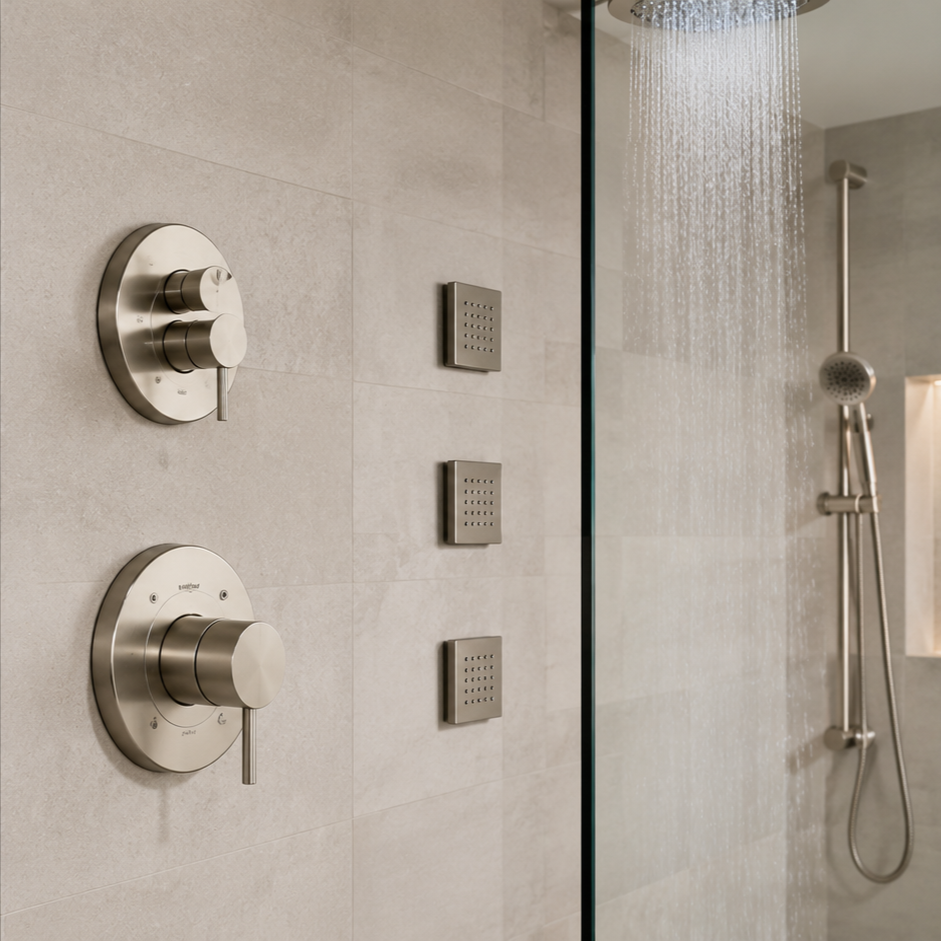
Thermostatic valves also allow volume and temperature to be controlled independently. This is what makes multi-outlet shower systems possible — a single thermostatic valve maintains the temperature while separate volume controls open or close individual body sprays, the overhead rain head, and the handheld without changing the temperature dialed in.
Side-by-side comparison
| Feature | Pressure-balancing valve | Thermostatic valve |
|---|---|---|
| Controls | Pressure ratio | Actual mixed-water temperature |
| Scald protection | Pressure-ratio limiting (indirect) | Direct temperature control |
| Handles | Single (combined volume/temp) | Separate volume and temperature |
| Multiple outlets | Not suited for multi-outlet setups | Designed for multi-outlet systems |
| Typical cost (valve only) | $40–$200 | $300–$900+ |
| Installation cost (labor) | $150–$300 | $350–$700+ |
| Warm-up time | Same as a standard shower | Faster — valve pre-sets temp before water flows |
| Best application | Single showerhead, standard shower | Multi-outlet, steam, or high-end shower systems |
Cost breakdown for Arizona installs
In the Phoenix metro, expect to pay $200–$500 all-in for a pressure-balancing valve replacement, including parts and labor. A full thermostatic system — valve, trim, separate volume controls — runs $700–$2,500+, depending on the number of outlets and trim package selected. High-end brands like Kohler, Moen, and Delta sit at the lower end of the thermostatic range; European brands like Hansgrohe and Grohe can push significantly higher on parts alone.
Phoenix's hard water (200–400 ppm TDS) accelerates wear on both valve types, particularly on internal seals and the wax element inside thermostatic cartridges. A thermostatic cartridge that performs well for 15 years in a soft-water market may show drift — temperature wanders away from the set point — in 8–10 years in a high-mineral-content environment without periodic maintenance.
Where Phoenix's hard water affects both valve types
Scale deposits inside shower valve bodies restrict ports, stiffen cartridge movement, and coat the heat-sensing elements inside thermostatic valves. A thermostatic valve with calcium scale coating the wax capsule responds sluggishly to temperature changes and eventually fails to hold the set point accurately.
Pressure-balancing cartridges suffer from scale that binds the spool or piston, causing the valve to stick rather than slide freely. A stuck cartridge produces the exact problem the valve was installed to prevent — temperature spikes when pressure shifts.
Both problems are manageable with a water softener upstream and periodic cartridge cleaning or replacement. In Phoenix conditions, cartridge replacement every 7–12 years is a realistic maintenance interval for either valve type, versus 15+ years in soft-water markets.
Which one belongs in a given shower
Most shower applications don't need a thermostatic valve. A single showerhead in a standard bathroom — one person, one outlet — works well with a quality pressure-balancing cartridge. The protection is adequate, the cost is a fraction of the thermostatic, and cartridge replacement when it eventually stiffens is inexpensive.
Thermostatic valves make sense when:
The shower has multiple outlets (body sprays, rain head, handheld) that need to run simultaneously from a single temperature-controlled source
The homeowner wants to set a precise temperature and have it waiting at the valve before stepping in
A steam generator is part of the system — thermostatic control is essentially required for steam applications
The hot-water supply temperature is inconsistent due to long pipe runs or shared demand in a large home
Upgrading from pressure-balancing to thermostatic during a bathroom remodel is a logical time to make the switch — the wall is already open. Retrofitting a thermostatic valve into an existing shower that was designed around a single pressure-balancing valve may require new blocking, different rough-in dimensions, and additional plumbing for separate volume control trim.
Signs the current valve needs attention
Both valve types show their age in similar ways:
Temperature swings during use that didn't happen when the shower was new (pressure-balancing cartridge wearing out)
Difficulty turning the handle — stiff operation (scale binding the cartridge)
Temperature that won't hold the set point (thermostatic element failing)
Dripping or running water even with the handle closed (cartridge O-rings worn)
Handle that spins past the original stop positions (anti-scald stop has slipped)
In Phoenix, stiff handle operation is the most common complaint on showers older than 8–10 years. In the majority of cases, the fix is a cartridge replacement — not a full valve replacement — which runs considerably less than a new valve installation.
Frequently Asked Questions
Not usually. Thermostatic valves have different body dimensions and require separate connections for the temperature and volume controls. In most cases, the tile around the valve opening needs to come out to install a thermostatic rough-in body. If a full bathroom remodel is already planned, it's the right time to upgrade. Doing it as a standalone project means tile work, which adds cost.
The most common cause is hot-water supply temperature variation. A pressure-balancing valve can only maintain the ratio of hot to cold — it can't compensate for a water heater that runs at different temperatures throughout the day. Phoenix homes with long horizontal runs of uninsulated hot-water pipe in attics are especially prone to this: the pipe cools significantly between uses, and the first water out of the showerhead may be cooler or hotter than expected, regardless of valve type.
Both types provide scald protection. A pressure-balancing valve limits the maximum temperature at the handle through a mechanical stop set at the factory. A thermostatic valve holds the exact temperature dialed in, even if supply conditions change. For households with young children or elderly members, a thermostatic valve's direct temperature control offers a stronger safety margin, but either type, installed correctly, meets current anti-scald standards.
In Phoenix's hard-water environment, a realistic service life for most cartridges is 7–12 years before the valve becomes difficult to operate or starts temperature-drifting. Installing a whole-house water softener or a point-of-use filter upstream of the shower valve extends cartridge life significantly. Annual showerhead descaling is not a substitute for softening — the deposits that affect cartridges build up inside the valve body where descaling cleaners don't reach.
Moen, Delta, and Kohler all offer pressure-balancing cartridges that are relatively easy to replace and widely stocked locally. For thermostatic valves, Moen's Posi-Temp and Delta's Monitor lines use cartridge designs that can be serviced without removing the entire valve body from the wall. Brands with proprietary cartridges that require factory-direct sourcing become a maintenance headache in high-replacement-frequency markets like Phoenix.
Cartridge replacement is within DIY reach on most standard pressure-balancing valves — the cartridge pulls out after removing the handle, a retaining clip, and the trim. The complication is knowing which cartridge goes with the specific valve body. Installing the wrong cartridge (or installing the right one backward) produces a shower that runs hot on cold and cold on hot, or one that drips regardless of handle position. Thermostatic cartridges are more sensitive to installation orientation and should be handled by a licensed plumber.
Simba Plumbing installs and services both pressure-balancing and thermostatic shower valves throughout the Valley, including cartridge replacements and full multi-outlet shower system builds. Simba Plumbing serves Phoenix, Scottsdale, Mesa, Chandler, Gilbert, Glendale, Peoria, Tempe, Surprise, Goodyear, Avondale, and surrounding Valley communities. (602) 500-2153.
