
Reverse Osmosis vs. Whole-House Carbon Filter: Which One Wins?
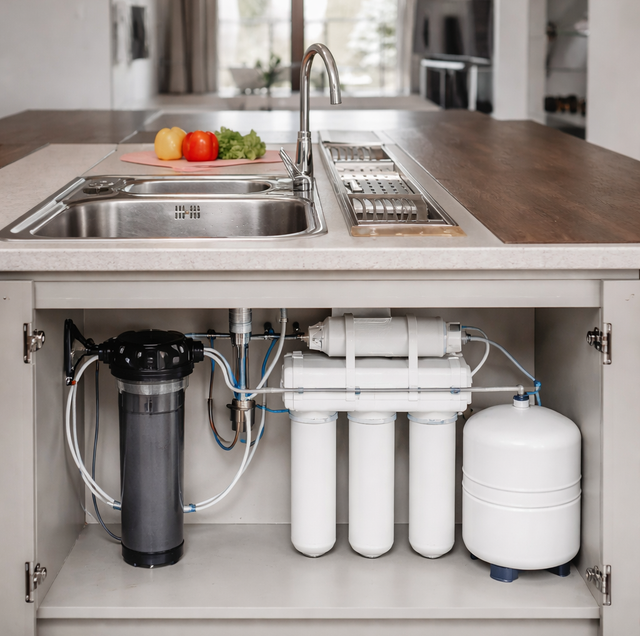
Quick Answer: A whole-house carbon filter treats every drop entering the home and mainly cuts chlorine, taste, and odor, but it leaves dissolved minerals and salts in the water. A reverse-osmosis system usually sits under one sink and strips out dissolved solids, salts, and many contaminants for drinking and cooking. They fix different problems, and plenty of homes run both. A water test tells you which one you need.
Shopping for water filtration is a lot like buying tires and buying a windshield in the same trip. Both keep the vehicle usable, but nobody swaps one in for the other, because each solves a problem the other cannot touch. Carbon filtration and reverse osmosis land in the same spot. Both improve your water, yet they work at different points in the plumbing and remove very different things. Understanding where each one sits and what it actually pulls out is the difference between spending money on the right system and spending it twice.
Point Of Entry Versus Point Of Use
The first fork in the road is location, and it decides almost everything else.
A whole-house carbon filter installs at the point of entry, meaning it taps into the main water line right after the water enters the house, usually near the meter or the pressure regulator. Everything downstream gets treated: showers, laundry, the outdoor spigots, every tap. Because it handles the full household flow, it uses a large tank of media and is sized to the home's peak demand so pressure does not drop when several fixtures run at once.
Reverse osmosis is almost always a point-of-use system. It installs under a single sink, most often the kitchen, and treats only the water that comes out of a dedicated faucet or feeds the refrigerator and ice maker. It is slow and deliberate by design, producing a few gallons a day into a holding tank rather than treating the whole house on demand.
That split matters. A point-of-entry unit protects plumbing and improves how water feels and smells everywhere. A point-of-use unit delivers a smaller volume of much more thoroughly cleaned water exactly where you drink it.
What A Carbon Filter Actually Does
Carbon works by adsorption, where contaminants stick to the enormous surface area inside activated carbon granules as water passes through. It is very good at a specific list of jobs.
The strengths
- Chlorine and chloramine reduction: Municipal water is disinfected, and carbon pulls out most of that chlorine taste and smell. Catalytic carbon is the grade used when chloramine is present, since standard carbon struggles with it.
- Taste and odor: The rotten-egg or musty notes that make water unpleasant to drink largely come from compounds carbon captures well.
- Some organic chemicals: Certain pesticides, solvents, and volatile organic compounds are reduced, depending on the carbon type and contact time.
The hard limit: Carbon does almost nothing to dissolved minerals and salts. Calcium, magnesium, sodium, and dissolved solids pass straight through, because they are ions in solution, not particles or organic molecules that adsorb onto the media. So a carbon filter will not make hard water soft, will not lower total dissolved solids in any meaningful way, and will not stop scale from forming in a water heater. If the goal is better-tasting, better-smelling water throughout the house, carbon delivers. If the goal is removing what is dissolved in the water, it is the wrong tool.
What Reverse Osmosis Actually Does
Reverse osmosis pushes water under pressure through a semipermeable membrane with pores small enough to block particles far tinier than carbon can catch. Water molecules squeeze through; most everything larger gets rejected and flushed away.
An RO system is usually a stack of stages, not a single filter. A typical layout runs a sediment prefilter, one or two carbon prefilters to protect the membrane, the RO membrane itself, and a final polishing carbon filter after the storage tank. The prefilters do the coarse work so the delicate membrane lasts.
What comes out is water with the large majority of dissolved solids, salts, and many contaminants removed. That includes much of the mineral content, along with a broad range of dissolved substances that carbon alone leaves behind. The tradeoff is speed and volume: RO produces a modest amount of water slowly, which is why it lives at one tap rather than feeding the whole house.
Two practical notes come with RO. It sends a portion of incoming water down the drain as concentrate, so there is some wastewater in normal operation, and newer membranes have improved that ratio considerably over older units. It also removes beneficial minerals along with everything else, so many systems add a remineralization stage that puts calcium and magnesium back for taste and balance.
They Solve Different Problems, And Often Team Up
Because carbon and RO target separate things, the smart move is often not choosing between them at all.
A common setup runs a whole-house carbon filter at the point of entry to knock out chlorine, taste, and odor everywhere, then an RO system at the kitchen tap for drinking and cooking water that also strips out dissolved solids. The carbon stage does double duty here, since it also protects the RO membrane from chlorine, which can degrade certain membrane materials over time. You get pleasant water from every fixture and highly purified water where you actually drink it.
Trying to force one system to do both jobs is where money gets wasted. A carbon-only home still has hard, mineral-heavy drinking water. An RO-only home still has chlorinated water in every shower and washing machine, because the RO unit only treats one faucet.
A Softener Is A Separate Thing Entirely
One point trips up a lot of homeowners: neither carbon nor RO is a water softener, and softening is its own category.
A softener uses ion exchange, swapping the hardness minerals, calcium and magnesium, for sodium or potassium as water flows through a resin bed. That is a different mechanism from adsorption and a different one from membrane filtration. Carbon leaves hardness untouched. RO does reduce hardness at the single tap it serves, but it does not protect the water heater, the dishwasher, or the shower fixtures where scale actually builds up across the house.
So in a home with truly hard water, the full stack is often three parts working together: a softener for scale protection across the house, carbon for chlorine and taste, and RO at the kitchen for drinking water. A water test is what tells you whether all three are warranted or whether one or two will do.
Maintenance: Both Need Attention, On Different Schedules
Neither system is install-and-forget, and the upkeep looks different for each.
Carbon filter upkeep: A whole-house carbon system either uses replaceable cartridges or a bed of loose media in a tank. Cartridges get swapped on a schedule tied to water volume and incoming quality. Tank-style media eventually exhausts, since the adsorption sites fill up, and the media is replaced, or the tank is regenerated depending on the design. Skipping this is a real problem, because a saturated carbon bed can start releasing captured contaminants back into the water rather than holding them.
RO system upkeep: An RO system has more moving parts to track. The sediment and carbon prefilters get changed regularly to protect the membrane. The membrane itself lasts far longer than the prefilters but does eventually need replacement once its rejection rate drops. The postfilter and any remineralization cartridge get changed on their own cadence. A slow-filling storage tank or a change in taste is usually the first sign a stage is overdue.
The takeaway on maintenance is simple: budget the ongoing filter changes into the decision, not just the install. A neglected system quietly stops doing its job.
How To Choose: Start With A Water Test
Every real recommendation flows from one thing: knowing what is actually in your water.
A certified water test measures chlorine or chloramine, total dissolved solids, hardness, pH, and any specific contaminants of concern. That result points to the answer:
- High chlorine or noticeable taste and odor, low dissolved solids points toward whole-house carbon.
- High total dissolved solids or specific dissolved contaminants you want out of drinking water points toward RO at the tap.
- High hardness on top of either means a softener enters the picture alongside them.
- Several issues at once is exactly when the combined stack earns its keep.
Guessing leads to buying a system that does not address the actual problem. A test turns the decision into a clean match between what is in the water and what each technology removes.
Before buying either system, get a certified water test that measures chlorine or chloramine, total dissolved solids, hardness, and pH. High chlorine with low dissolved solids points toward whole-house carbon, high dissolved solids points toward reverse osmosis at the tap, and several issues at once is when a combined stack earns its keep.
A note on installation: a whole-house filter taps directly into the main supply line, and an RO unit needs a proper connection to the supply, the drain for its concentrate, and often the refrigerator line. A licensed plumber best sets both up so the connections are correct, code-compliant, and leak-free, and so the system is sized right for your household. A pro can also run or interpret the water test that drives the whole choice.
Frequently Asked Questions
Yes, with a tankless RO unit. These use a higher-output membrane and an internal pump to produce water on demand instead of filling a pressurized bladder tank. They save the under-sink space a bulky tank would take and avoid the slight staleness water can pick up sitting in a tank, though they draw electricity and cost more up front than a standard tanked system.
A correctly sized one should not cause a noticeable drop. Pressure loss happens when the tank or cartridge is undersized for the home's peak flow, or when the media bed clogs near the end of its life. Sizing is rated in gallons per minute against the number of fixtures that might run at once, which is why a two-bathroom home and a five-bathroom home need different units.
Under normal residential conditions with the prefilters changed on schedule, an RO membrane commonly lasts around two to five years. Its life shortens fast if the carbon prefilter is neglected and chlorine reaches a thin-film composite membrane, or if incoming water is unusually high in sediment or hardness, both of which foul the membrane surface early.
RO membranes reject a large share of dissolved lead, and certain carbon blocks are specifically rated for lead reduction while ordinary carbon is not. Lead often enters at the household plumbing rather than the source, so a point-of-use system at the kitchen tap is the practical spot to address it for drinking water. A test confirms whether lead is present before you choose a system rated for it.
RO water is often preferred for sensitive aquariums because it starts as a blank slate that hobbyists remineralize to an exact target, and it avoids chlorine and chloramine that harm fish. For houseplants, dechlorinated carbon-filtered water suits most species, while some plants sensitive to mineral buildup do better on RO. The right choice depends on the plant or species, not on which filter is objectively cleaner.
Yes, periodic sanitizing matters, especially for RO. The storage tank and lines are typically sanitized once a year, often at the same visit as a filter change, to clear any biofilm that forms in standing water. Whole-house carbon tanks are less prone to this because water keeps moving through them, but the housing still gets cleaned whenever cartridges are swapped.
Book a certified water test and let a licensed tech match the right filtration to your results — cleaner, better-tasting water without guessing. Simba Plumbing LLC serves Phoenix and the Valley. ROC 327259. Call (602) 500-2153.
