
Can Chemical Drain Cleaners Damage Your Pipes?
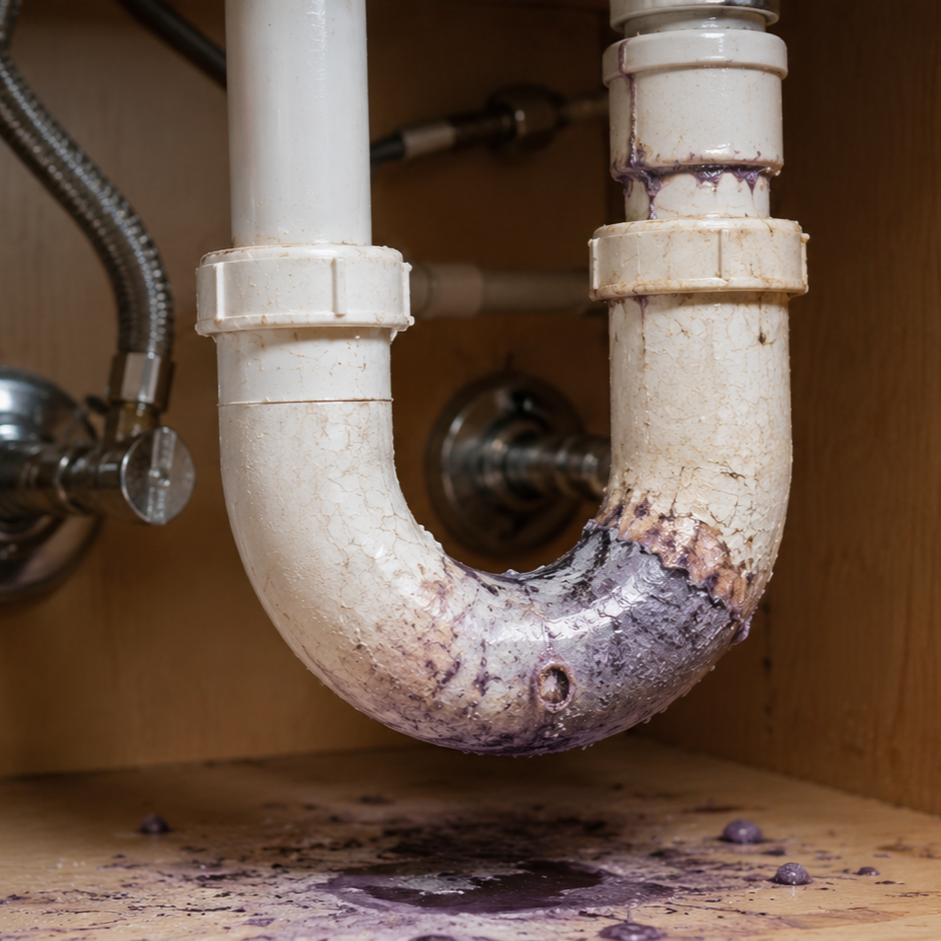
The bottle has been under the sink for two years. The bathroom drain slows down, someone pours in a capful, and by morning water moves again. It feels like the right move — fast, cheap, no phone calls to make. But the chemistry happening inside the drain tells a different story.
Chemical drain cleaners don't dissolve clogs the way water dissolves salt. They trigger an exothermic reaction — a process that generates heat while releasing caustic ions — and that reaction attacks everything in its path, including the pipe wall itself.
How chemical drain cleaners work — and why that's a problem
There are three main categories of chemical drain cleaners, and each damages pipes through a different mechanism.
Caustic cleaners — products built around sodium hydroxide (lye) or potassium hydroxide — generate heat by reacting with water. The pH of these solutions runs around 13 to 14, which is near the upper limit of the pH scale. That alkalinity breaks down grease and organic material, but it also attacks the surface of PVC fittings, softens ABS plastic, and degrades rubber gaskets with repeated use.
Oxidizing cleaners — based on bleach, nitrates, or peroxides — work by stripping electrons from the organic material in a clog, breaking it apart. The bleach chemistry is particularly corrosive to copper pipe fittings and can cause pitting in older brass fixtures.
Acidic cleaners — sulfuric acid or hydrochloric acid formulas — are the most aggressive. Sulfuric acid drain cleaners generate heat exceeding 250°F in concentrated form, and that heat has nowhere to go except into the pipe wall. These are the formulas that corrode galvanized steel and eat through chrome trap assemblies.
What different pipe materials can and cannot tolerate
The risk is not uniform across a home's plumbing. It depends heavily on what the pipes are made of.
PVC and ABS plastic pipe is the most common material in drain systems installed after the 1980s. Both plastics soften when exposed to sustained heat — PVC starts to deform around 140°F, ABS around 160°F. The exothermic reaction from a caustic cleaner can exceed those thresholds in a partially clogged pipe where standing water traps the heat. The softening is usually gradual and invisible: the pipe maintains its shape but develops micro-cracks at joints, which is where most chemical-related leak failures originate.
Copper pipe handles heat better than plastic, but acidic cleaners attack it through a different mechanism. Sulfuric acid reacts with copper to form copper sulfate, which deposits on the interior pipe wall and accelerates future corrosion. Even oxidizing cleaners containing bleach will accelerate pitting in copper supply fittings if any product contacts the exterior surface.
Galvanized steel pipe — still present in homes built before the late 1960s — has already lost a significant portion of its zinc coating by now. Acid-based cleaners accelerate that corrosion: iron exposed under the depleted zinc layer reacts aggressively with both acidic and high-pH caustic formulas. The result is accelerated interior rust and eventual pin-hole leaks.
Cast iron drain pipe , found in older homes, tolerates caustic cleaners reasonably well — iron handles high pH without immediate degradation. But acidic cleaners attack cast iron directly, and the real long-term risk with cast iron lies in the joints: many older sections use oakum and lead-sealed connections, and repeated lye exposure deteriorates the oakum packing over years of contact.
The older a home's plumbing, the higher the risk from chemical drain cleaners. Homes built before 1985 are more likely to have galvanized steel supply lines, lead-sealed cast iron drain sections, or aging rubber gaskets — all of which are poorly suited to chemical drain cleaner chemistry.
The standing-water problem
Here is where drain cleaner chemistry becomes particularly damaging. If a pipe is fully blocked — not slow, but backed up — a poured chemical cleaner does not reach the clog. It sits in the standing water in the drain, diluting while maintaining prolonged contact with the trap and the lower section of the drainpipe.
Think of it like submerging a penny in vinegar. The reaction is slow but continuous. At a diluted concentration sitting against a PVC trap for several hours, caustic chemistry achieves what a quick flush would not: sustained exposure to a softened polymer surface.
Plumbers who cut out failed PVC traps regularly find evidence of this — a trap that feels structurally sound on the outside but has a waxy, softened interior where the pipe wall has lost tensile strength.
Hard water scale changes the equation
The Valley sits on some of the hardest tap water in the country — typically 250 to 400 parts per million TDS (total dissolved solids), largely from calcium and magnesium carbonates. That mineral content plays directly into drain cleaner chemistry.
Scale deposits inside drain pipes are alkaline by nature: calcium carbonate carries a pH of approximately 9.5. When an acidic drain cleaner contacts scale, the reaction produces carbon dioxide gas and calcium salts. The CO₂ bubbles create turbulence that briefly looks like the cleaner is working — but the calcium salts that precipitate out of that reaction can contribute to new deposits further down the line.
The more significant effect: calcium carbonate scale creates a roughened interior surface that retains both clog material and chemical residue between uses. A pipe with heavy scale is harder to clear mechanically and more susceptible to cumulative chemical damage from each cleaning attempt.
Signs that chemical drain cleaners have already caused damage
The damage usually stays invisible until it becomes a leak. But there are physical indicators that a drain system has been chemically stressed.
A trap that drips from the joint after a drain cleaning attempt — when the connection was dry before — suggests the chemical exposure softened the fitting or degraded the slip-joint washer.
A persistent sulfur smell after using an acid-based cleaner means the reaction did not complete. Residual acid or sulfur compound is sitting somewhere in the drain system, and that is not a normal outcome.
Discoloration or staining on chrome drain assemblies — a gray or greenish tinge on the trap or tailpiece — indicates oxidation from bleach-based or acid-based cleaner contact.
Recurring clogs that form faster each time suggests the cleaner is not removing the obstruction but burning through a portion of it and leaving residue that accelerates the next blockage. Each round of chemical treatment makes the next clog more likely, not less.
Never mix chemical drain cleaners with each other, or with bleach or ammonia. Caustic and acid formulas react violently on contact, generating chlorine gas or generating heat sufficient to cause splash burns. Plumbers regularly encounter drains that have received incompatible products and present a chemical hazard before they can be safely serviced.
When chemical drain cleaners carry the least risk
Occasional use of a caustic cleaner — sodium hydroxide-based — in a newer PVC drain system with a partial clog carries relatively low risk compared to other scenarios. The conditions that keep risk manageable: the drain is only partially slow (not fully backed up), the formula is caustic rather than acidic, the pipe is plastic installed in the past 20 to 30 years, and use is genuinely occasional rather than monthly.
The highest-risk scenario is repeated acid-based cleaner use in an older home with galvanized or cast iron drain lines — particularly on a fully blocked drain where the chemical will pool for hours rather than flush through.
Safer ways to clear a drain
A drain snake — either a hand-operated auger or a motorized cable machine — physically removes the clog rather than dissolving a portion of it. There is no residue left in the pipe and no chemical heat introduced to the system. For a hair clog in a bathroom sink, a 25-foot hand snake reaches and clears the obstruction in most cases.
Hydro jetting introduces high-pressure water through a cleanout fitting. Water at 1,500 to 4,000 PSI scours the pipe wall, clearing grease, scale, and debris without adding chemistry to the drain system. A camera inspection before jetting confirms there is no structural pipe damage that would be worsened by pressure.
For routine maintenance on kitchen sink drains, enzyme-based treatments add beneficial bacteria that digest grease over time. These products will not clear an active clog but reduce accumulation between professional service visits.
Frequently Asked Questions
Occasional use of a caustic (sodium hydroxide-based) cleaner on a partial clog in newer PVC drain lines carries relatively low risk. The scenarios to avoid: repeated use of acid-based products, use on fully backed-up drains where the chemical pools in standing water, and any chemical drain cleaner in a home with galvanized steel or pre-1970s cast iron plumbing.
Acid-based drain cleaners — those built around sulfuric acid or hydrochloric acid — generate the most heat and the most aggressive corrosive chemistry. They cause the most damage to metal pipes, particularly galvanized steel and copper, and are least appropriate for DIY use in residential plumbing.
When a drain is fully blocked, chemical cleaner sits in the standing water rather than reaching the clog. It dilutes without resolving the blockage, and the calcium salt byproducts of an acid-scale reaction can contribute new deposits downstream. A professional snake or hydro jetting is more effective because it physically removes the material rather than partially dissolving it in place.
Yes. High-pH caustic cleaners kill the beneficial bacteria in a septic tank that process waste solids. A single heavy application can impair digestion capacity for weeks. Homes on septic systems should avoid chemical drain cleaners entirely and use enzyme-based alternatives or call a plumber for mechanical clearing.
No. Toilets use a porcelain trap with a specific curvature, and most chemical drain cleaner formulas are not designed for toilet use. The heat generated by caustic or acid reactions can crack the porcelain trap from the inside. A toilet auger is the correct tool for a toilet clog.
Chemical drain cleaners dissolve a channel through a clog but don't fully remove it. The residue that remains on the pipe wall collects grease, hair, and mineral scale more readily than a clean pipe wall does. Each successive clog tends to form faster than the last. Mechanical clearing removes the material entirely, which is why a properly snaked drain stays clear longer than a chemically treated one.
The primary tool for drain clearing is a cable machine — a motorized steel cable that breaks up and retrieves clog material from the pipe. For more significant blockages or recurring slow drains, hydro jetting introduces pressurized water at 1,500 to 4,000 PSI to scour the pipe wall clean. Neither method introduces heat or chemistry to the system, and neither leaves residue that accelerates the next blockage.
If chemical drain cleaners have left a drain slow, recurrent, or smelling of sulfur, a licensed plumber can inspect, clear, and assess the line without adding more chemistry to the system. Simba Plumbing serves Phoenix, Scottsdale, Mesa, Chandler, Gilbert, Glendale, Peoria, Tempe, Surprise, Goodyear, Avondale, and surrounding Valley communities. ROC #327259. Call (602) 500-2153.
