
What Happens When a Sump Pump Fails During Heavy Rain?
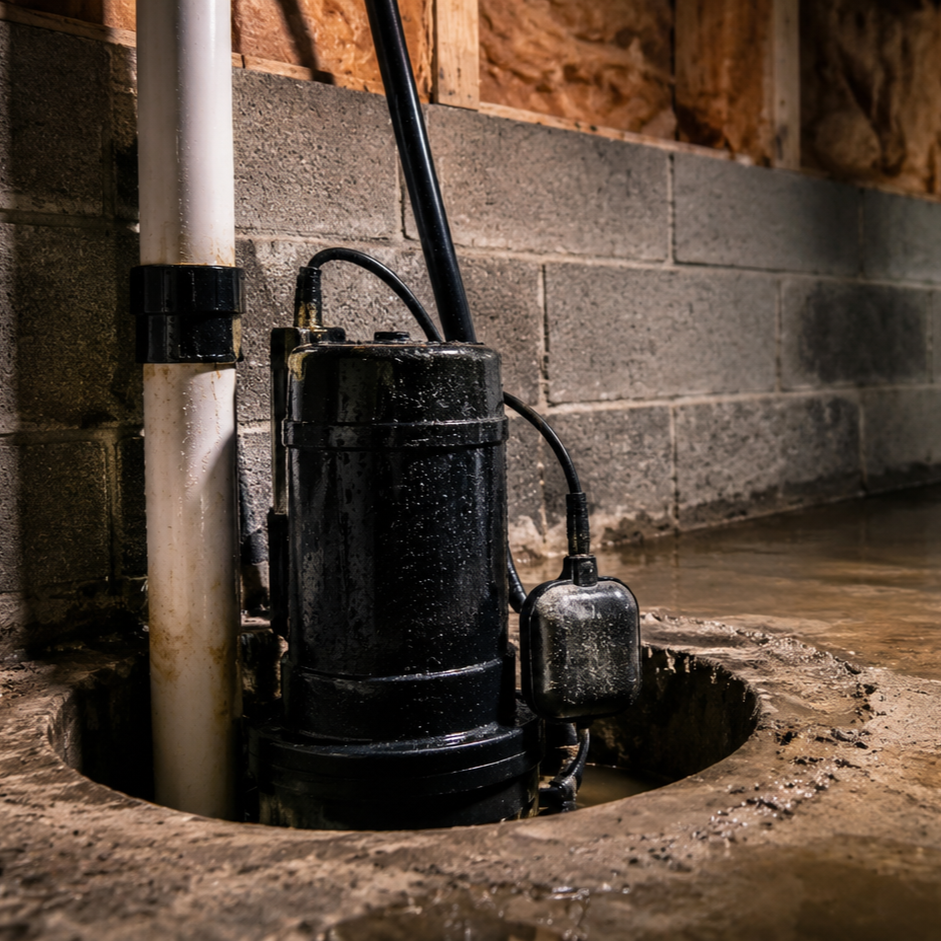
The floor drain is already bubbling. The utility room is dark, the pump's not running, and outside, the sky is still dumping. By the time water reaches the doorway between the utility room and the hall, the damage clock has already started.
Sump pump failure during a rainstorm is one of the most damaging events a crawl space can experience — not because rain is rare, but because failure almost always happens at exactly the moment the pump is needed most.
How a sump pump handles rain
A sump pump sits inside a pit — usually 18 to 24 inches wide, 24 to 36 inches deep — dug into the lowest point of a crawl space or basement floor. When groundwater seeps through foundation walls or rises from below the slab, it drains into that pit. A float switch detects the water level, and once the water reaches a set height, the pump kicks on, pushes water through a discharge line to the exterior, and the pit drains. The cycle repeats as water keeps coming in.
The process works reliably under normal conditions. But heavy rain changes the math fast. Instead of running once every 15 to 30 minutes, a pump during peak rainfall may cycle every 2 to 3 minutes. Motor components sized for routine use get pushed well past their working range. Not every pump survives that transition.
What changes when rain intensifies
Several things hit at once during a heavy storm.
Soil saturation changes how fast water enters. Desert soil absorbs water initially. Once it saturates, runoff routes straight toward the foundation. The Valley's caliche layer — a dense hardpan that sits anywhere from 6 inches to several feet below grade — acts like a bathtub floor. Water that can't drain through caliche has nowhere to go except toward foundation walls and under slabs.
Pump cycling accelerates. During monsoon conditions, a pump may run nearly continuously for 30 to 60 minutes. Most residential submersible pumps are rated for 8 to 12 starts per hour. Pushing past that rate sends the motor toward overheating.
Discharge lines can back up. If the discharge line terminates close to the foundation, or if the yard is already saturated, ejected water has nowhere to go and drains back toward the house. The pump winds up in a loop — moving the same water in circles rather than clearing it.
The damage sequence when a pump fails during rain
When failure occurs mid-storm, things move fast.
Water in the pit rises past the pump intake within minutes. Once it overtops the pit, it spreads across the floor. A typical crawl space can accumulate 2 to 4 inches of water within 30 to 45 minutes of a pump failure during peak storm conditions. At that depth, water reaches wall base plates, floor joists, and any electrical components at or near floor level.
Structural material starts absorbing moisture almost immediately. Oriented strand board subfloor, wood framing, and drywall swell within hours. If water sits for more than 24 to 48 hours, mold spores — always present in the environment — start colonizing the wet material. In unconditioned crawl spaces where temperatures can exceed 100°F during summer months, colonization can begin in under 24 hours. The heat doesn't help — it speeds everything up.
Concrete block foundations, common in older Valley construction, are porous. Sustained contact with standing water causes efflorescence and can compromise mortar joints if the saturation repeats across multiple storm cycles.
If standing water contacts any electrical panel, subpanel, or wiring at or below floor level, do not enter the space until a licensed electrician confirms the area is safe. Water and energized conductors are a fatal combination.
Warning signs that a pump is at risk
A pump that's about to fail rarely does so quietly. These are the signals that show up first.
The motor runs, but no water moves. This usually points to a failed impeller — the spinning disc that creates suction and moves water out of the pit. Plastic impellers degrade faster than cast iron. A pump that sounds normal but leaves the pit full is already in trouble.
The pump cycles on dry days. When the pump activates with no rain, either the float switch is stuck in the on position or the check valve has failed. A stuck float means constant motor operation. That kind of sustained running burns out thermal protection within days.
The discharge line drains poorly. Mud, debris, and mineral scale can partially block a discharge line. The blockage creates back pressure, forcing the motor to work harder to produce the same output. The area's hard water — typically 200–400 ppm TDS — deposits calcium carbonate scale inside pipes, including discharge lines, over time.
Unusual sounds from the pump. Grinding or rattling during operation points to a loose or worn impeller, damaged motor bearings, or debris caught inside the pump housing. A noisy pump is signaling that something is wrong before it stops working entirely.
The pump is 7 or more years old. Most residential submersible pumps are rated for 7 to 10 years with average use. A pump at year 9 hasn't failed yet, but it's borrowing time. Age alone isn't a guarantee of failure — it's just the best predictor of when one is coming.
The pit has no backup. Homes with a single pump and no battery backup have no fallback when the primary fails. During a power outage — which often accompanies the worst monsoon storms — a pump with no battery sits idle regardless of whether the motor itself is still functional.
Common causes of failure
Power loss. The most common cause, and the most preventable. A pump that loses power does nothing. Brief outages during monsoons are common across the Valley, and even a 10-minute gap during peak rainfall can allow a pit to overflow.
Float switch failure. The float switch tells the pump when to turn on. If it sticks, binds against the pit wall, or becomes waterlogged, the pump won't activate even when the pit is full. Float switches are the most frequently replaced component on residential sump pumps.
Motor burnout. Sustained high-cycle operation generates heat in the motor windings. Pumps without thermal protection will run until the motor burns. Those with thermal protection shut off automatically to cool — but in the middle of a storm, a thermal shutdown is functionally the same as a failure.
Failed check valve. The check valve sits in the discharge line and keeps pumped water from flowing back into the pit once the motor shuts off. When it fails, water drains back in — and the pump immediately activates again to clear it. The pump cycles without stopping, even in dry conditions, and burns out ahead of its rated lifespan.
Undersized pump for the application. A 1/3-horsepower pump, common in basic residential installs, moves roughly 1,800 to 2,200 gallons per hour. A 1/2-hp unit moves 2,400 to 3,000 gallons per hour. If groundwater enters the pit faster than the pump can remove it, the pit overflows — even with a fully functional motor.
What property damage looks like by stage
Water removed within 1 to 2 hours of entry typically leaves surface damage only: cleaning, drying, and maybe some flooring replacement. Water that sits for 12 to 24 hours requires structural drying equipment. Water that remains beyond 48 hours almost always means mold remediation addition roof structural repairs.
Industry figures place average mold remediation costs at $1,500 to $5,000 for a crawl space and $3,000 to $12,000 or more for a finished basement, depending on the affected area.
A battery-backup sump pump can be installed alongside an existing primary pump for $400 to $800 in parts and labor. That cost compares favorably to the average water intrusion claim, which typically runs $3,000 to $7,000 after a single flooding event.
Pre-season checks that prevent failure
A pre-season inspection takes less than 15 minutes. Pouring a bucket of water directly into the pit confirms the float switch is working, and the pump activates within seconds. The discharge line should terminate at least 10 feet from the foundation, slope downward to the exit point, and show no signs of blockage at the outlet.
A pump older than 8 years warrants a replacement evaluation even if it appears functional. A low-demand test tells a homeowner the motor turns on — it says nothing about whether it will hold up under sustained monsoon-level cycling.
Frequently Asked Questions
The first visible sign is usually water on the floor around the pit or near foundation walls. A pump that fails silently lets the pit overflow before anyone notices — which is why a high-water alarm is worth adding to any sump pit that lacks one. These battery-powered devices sound when water reaches a set level and typically cost $25 to $50.
Yes. Extended operation — the kind that happens during sustained monsoon rainfall — generates heat in the motor windings. Most modern pumps have thermal overload protection that shuts the motor down to prevent damage, but that protection also means the pump stops running during a storm. Without time to cool, a pump in thermal shutdown will cycle off and on repeatedly, providing partial protection at best.
Structural materials begin absorbing moisture within the first hour. Subfloor sheathing, framing lumber, and drywall swell as soon as water contacts them. The 24-hour mark is when mold colonization risk increases substantially, particularly in warm, unconditioned spaces where summer temperatures can push crawl space temperatures above 100°F.
No. A battery backup system is a secondary unit that activates when the primary pump fails or loses power. It runs at a lower flow rate — typically 1,000 to 1,500 gallons per hour compared to 2,000-plus for a primary unit — but it provides critical protection during outages and pump failures. The primary pump handles routine operation; the backup handles emergencies.
Some homes in the Valley with deep crawl spaces or low-lying lots use sump systems to manage monsoon water intrusion, even without a traditional basement. The caliche layer that traps water near the foundation can make a sump pit useful on flat lots or homes in flood-prone areas, particularly near washes or arroyos.
Testing quarterly and before the start of the monsoon season is a reasonable schedule. The test is simple: 3 to 5 gallons of water poured directly into the pit should cause the pump to activate, clear the water, and shut off cleanly. Confirming the discharge line is flowing freely completes the check.
A 1/2-horsepower submersible pump, rated at 2,400 to 3,000 gallons per hour, handles most residential applications. Homes in areas with high water tables, larger crawl spaces, or persistent drainage problems may benefit from a 3/4-hp unit. A licensed plumber can assess pit volume and historical inflow rate to recommend the correct size.
Simba Plumbing installs, tests, and replaces sump pump systems throughout the Valley, including battery backup units for homes that need protection against power outages. Simba Plumbing serves Phoenix, Scottsdale, Mesa, Chandler, Gilbert, Glendale, Peoria, Tempe, Surprise, Goodyear, Avondale, and surrounding Valley communities. ROC #327259. Call (602) 500-2153.
